International Rice Research Institute, Los Baños, Philippines.
Department of Chemistry and Biotechnology, Faculty of Science, Engineering and Technology, Swinburne University of Technology, Hawthorn, Vic., Australia.
Plant Biotechnol J. 2019 Jul;17(7):1261-1275. doi: 10.1111/pbi.13051. Epub 2019 Jan 24.
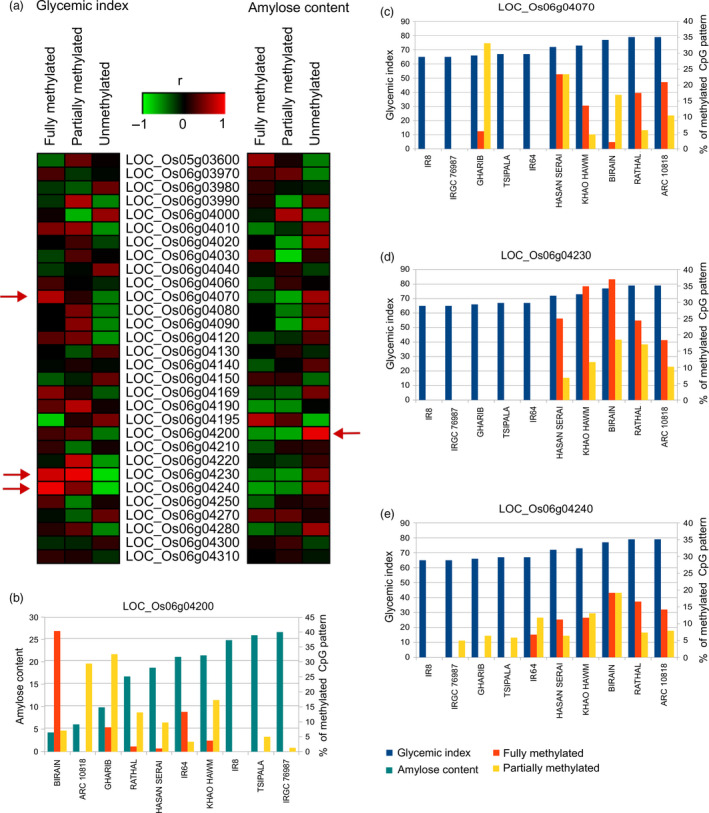
Reliably generating rice varieties with low glycaemic index (GI) is an important nutritional intervention given the high rates of Type II diabetes incidences in Asia where rice is staple diet. We integrated a genome-wide association study (GWAS) with a transcriptome-wide association study (TWAS) to determine the genetic basis of the GI in rice. GWAS utilized 305 re-sequenced diverse indica panel comprising ~2.4 million single nucleotide polymorphisms (SNPs) enriched in genic regions. A novel association signal was detected at a synonymous SNP in exon 2 of LOC_Os05g03600 for intermediate-to-high GI phenotypic variation. Another major hotspot region was predicted for contributing intermediate-to-high GI variation, involves 26 genes on chromosome 6 (GI6.1). These set of genes included GBSSI, two hydrolase genes, genes involved in signalling and chromatin modification. The TWAS and methylome sequencing data revealed cis-acting functionally relevant genetic variants with differential methylation patterns in the hot spot GI6.1 region, narrowing the target to 13 genes. Conversely, the promoter region of GBSSI and its alternative splicing allele (G allele of Wx ) explained the intermediate-to-high GI variation. A SNP (C˃T) at exon-10 was also highlighted in the preceding analyses to influence final viscosity (FV), which is independent of amylose content/GI. The low GI line with GC haplotype confirmed soft texture, while other two low GI lines with GT haplotype were characterized as hard and cohesive. The low GI lines were further confirmed through clinical in vivo studies. Gene regulatory network analysis highlighted the role of the non-starch polysaccharide pathway in lowering GI.
可靠地培育低血糖生成指数(GI)的水稻品种是一个重要的营养干预措施,因为亚洲地区 2 型糖尿病发病率很高,而大米是主食。我们将全基因组关联研究(GWAS)与转录组关联研究(TWAS)相结合,以确定水稻 GI 的遗传基础。GWAS 利用了 305 个重测序的多样化籼稻群体,其中包含约 240 万个在基因区域富集的单核苷酸多态性(SNP)。在 LOC_Os05g03600 外显子 2 的同义 SNP 处检测到一个新的与中间到高 GI 表型变异相关的关联信号。另一个主要热点区域被预测为中间到高 GI 变异的贡献者,涉及 6 号染色体上的 26 个基因(GI6.1)。这组基因包括 GBSSI、两个水解酶基因、参与信号转导和染色质修饰的基因。TWAS 和甲基化测序数据揭示了顺式作用的、具有功能相关性的遗传变异,在热点 GI6.1 区域有差异甲基化模式,将目标缩小到 13 个基因。相反,GBSSI 的启动子区域及其选择性剪接等位基因(Wx 的 G 等位基因)解释了中间到高 GI 的变异。在前面的分析中,还突出了外显子 10 处的 SNP(C>T),以影响最终粘度(FV),FV 独立于直链淀粉含量/GI。具有 GC 单倍型的低 GI 系证实了柔软的质地,而其他两个具有 GT 单倍型的低 GI 系的特点是坚硬和粘性。通过临床体内研究进一步证实了低 GI 系。基因调控网络分析强调了非淀粉多糖途径在降低 GI 方面的作用。