Department of Gastroenterology, Qilu Hospital of Shandong University, Jinan, Shandong, China (mainland).
Department of Gastroenterology, Tai'an Central Hospital, Tai'an, Shandong, China (mainland).
Med Sci Monit. 2018 Dec 16;24:9120-9126. doi: 10.12659/MSM.911915.
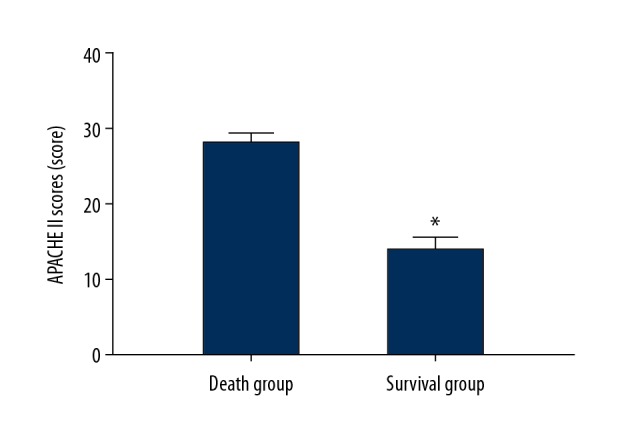
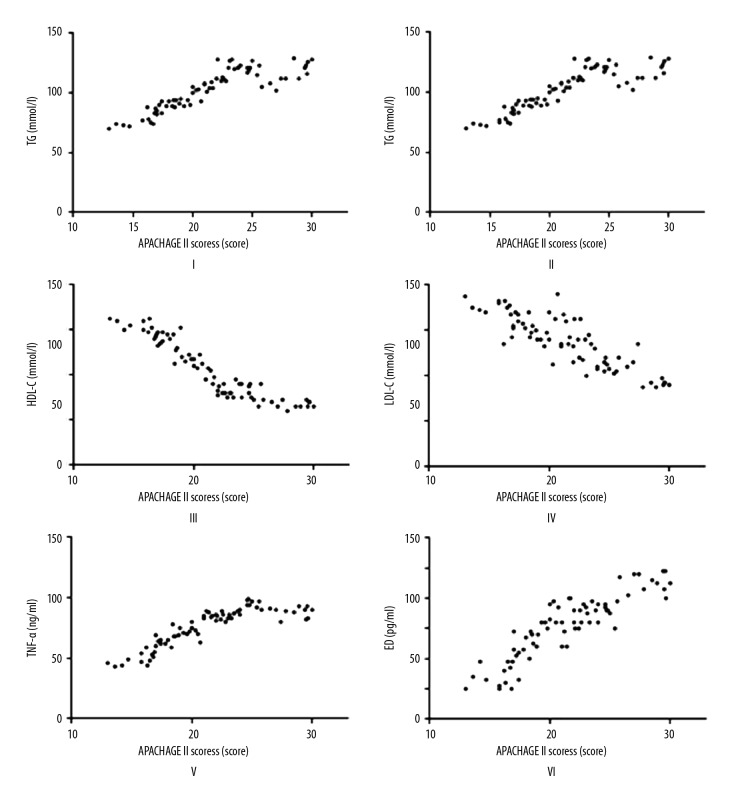
BACKGROUND This study investigated the correlations between acute cerebral hemorrhage complicated with stress ulcer bleeding and corresponding indexes, including the Acute Physiology and Chronic Health Evaluation (APACHE) II score, vascular endothelin-1 (ET-1), tumor necrosis factor-alpha (TNF-α), and blood lipid factors. MATERIAL AND METHODS A total of 53 patients with acute cerebral hemorrhage complicated with stress ulcer bleeding were selected as the observation group and 50 patients with simple acute cerebral hemorrhage were selected as the control group. The APACHE II score and the levels of ET-1, TNF-α, and blood lipid factors, including total cholesterol (TC), triglyceride (TG), high-density lipoprotein-cholesterol (HDL-C), low-density lipoprotein-cholesterol (LDL-C), and malondialdehyde (MDA), were detected and the correlations of were analyzed between the 2 groups of patients. RESULTS The blood lipid index TG, APACHE II score, ET-1, TNF-a, renal function indexes [blood urea nitrogen (BUN) and creatinine (Cr)], mortality rate, hemoglobin, and MDA in the observation group were significantly higher than those in the control group, while HDL-C in the observation group was obviously lower than in the control group (p<0.05). The APACHEII score had positive correlations with TG and TNF-α (r=0.8960, r=0.8563, respectively), while it was negatively correlated with TC, HDL-C, LDL-C, and ET-1 (r=-0.909, r=-0.9292, r=-0.8543, and r=-0.8899, respectively) (p<0.001 in all comparisons). APACHEII score, BUN, and Cr were all risk factors. CONCLUSIONS Stress ulcer in patients with acute cerebral hemorrhage is associated with blood lipid changes and inflammation, which provides clues for the diagnosis and treatment of acute cerebral hemorrhage.
本研究旨在探讨急性脑出血并发应激性溃疡出血与急性生理学与慢性健康状况评分系统(APACHE)Ⅱ评分、血管内皮素-1(ET-1)、肿瘤坏死因子-α(TNF-α)和血脂因素之间的相关性。
选择 53 例急性脑出血并发应激性溃疡出血患者作为观察组,50 例单纯急性脑出血患者作为对照组。检测两组患者的 APACHE Ⅱ评分及 ET-1、TNF-α、血脂因素[总胆固醇(TC)、三酰甘油(TG)、高密度脂蛋白胆固醇(HDL-C)、低密度脂蛋白胆固醇(LDL-C)和丙二醛(MDA)]水平,并分析两组患者的相关性。
观察组的血脂指标 TG、APACHE Ⅱ评分、ET-1、TNF-α、肾功能指标[血尿素氮(BUN)和肌酐(Cr)]、死亡率、血红蛋白和 MDA 明显高于对照组,而观察组的 HDL-C 明显低于对照组(p<0.05)。APACHE Ⅱ评分与 TG 和 TNF-α呈正相关(r=0.8960、r=0.8563),与 TC、HDL-C、LDL-C 和 ET-1呈负相关(r=-0.909、r=-0.9292、r=-0.8543 和 r=-0.8899)(p<0.001)。APACHE Ⅱ评分、BUN 和 Cr 均为危险因素。
急性脑出血患者的应激性溃疡与血脂变化和炎症有关,为急性脑出血的诊断和治疗提供了线索。