Department of Nutrition and Food Hygiene, Xiangya School of Public Health, Central South University, 110 Xiangya Road, Changsha, 410078, China.
Lipids Health Dis. 2018 Feb 7;17(1):13. doi: 10.1186/s12944-018-0660-5.
Lycopene is a kind of carotenoid, with a strong capacity of antioxidation and regulating the bloodlipid. There has been some evidence that lycopene has protective effects on the central nervous system, but few studies have rigorously explored the role of neurotransmitters in it. Therefore, the present study was designed to investigate the effects of several neurotransmitters as lycopene exerts anti-injury effects induced by hyperlipidemia.
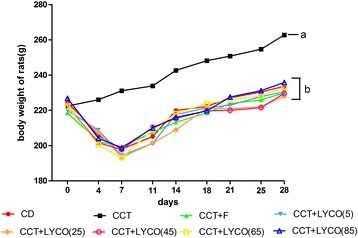
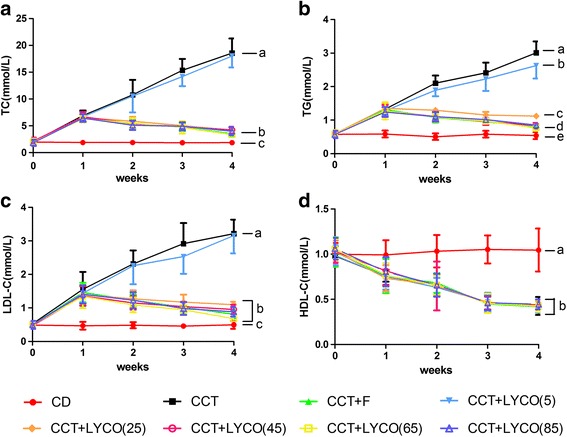
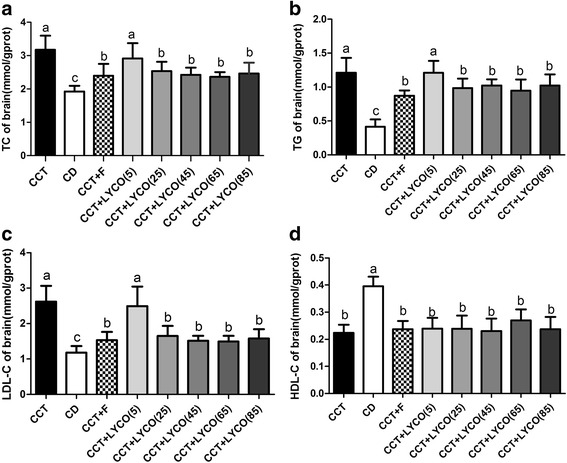
Eighty adult SD rats, half male and half female, were randomly divided into eight groups on the basis of serum total cholesterol (TC) levels and body weight. There was a control group containing rats fed a standard laboratory rodent chow diet (CD); a hypercholesterolemic diet (rat chow supplemented with 4% cholesterol, 1% cholic acid and 0.5% thiouracil - this is also called a CCT diet) group; a positive group (CCT + F) fed CCT, supplemented with 10 mg·kg·bw·d fluvastatin sodium by gastric perfusion; and lycopene groups at five dose levels (CCT + LYCO) fed with CCT and supplied lycopene at doses of 5, 25, 45, 65, and 85 mg·kg·bw·d. The levels of TC, triglyceride (TG), low-density lipoprotein cholesterol (LDL-C), high density lipoprotein cholesterol (HDL-C), interleukin-1 (IL-1), tumor necrosis factor alpha (TNF-α), oxidized low density lipoprotein (ox-LDL), low-density lipoprotein receptor (LDLR), nerve growth factor (NGF), glutamic acid (Glu), Gamma aminobutyric acid (GABA), dopamine (DA), 5-hydroxytryptamine (5-HT), N-methyl-D-aspartate (NMDA1R), GABA, 5-HT, D, and apoptosis-related proteins Caspase3, bax, and bcl-2 were measured after the experiment. Nissl staining was adopted to observe the morphological changes in neurons.
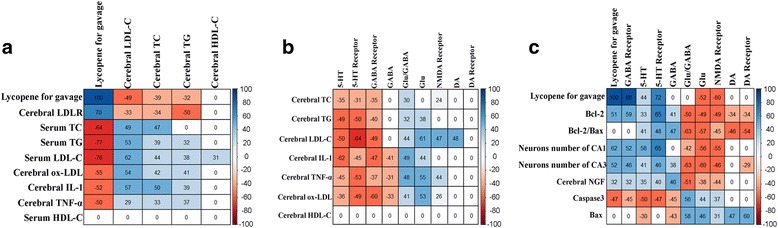
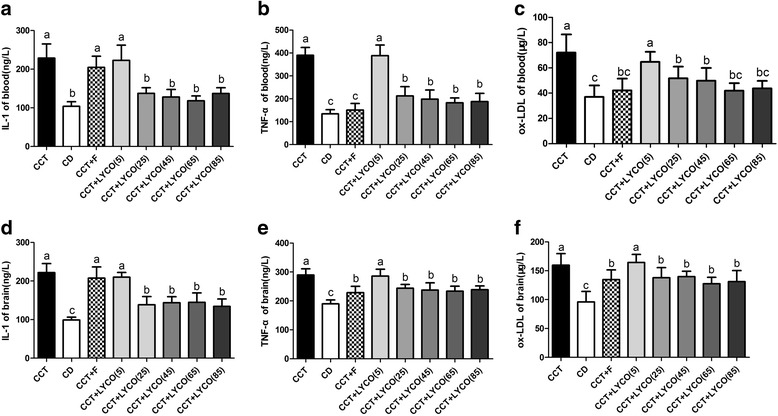
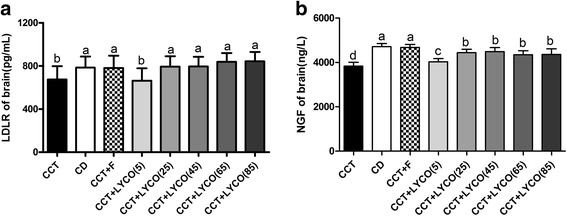
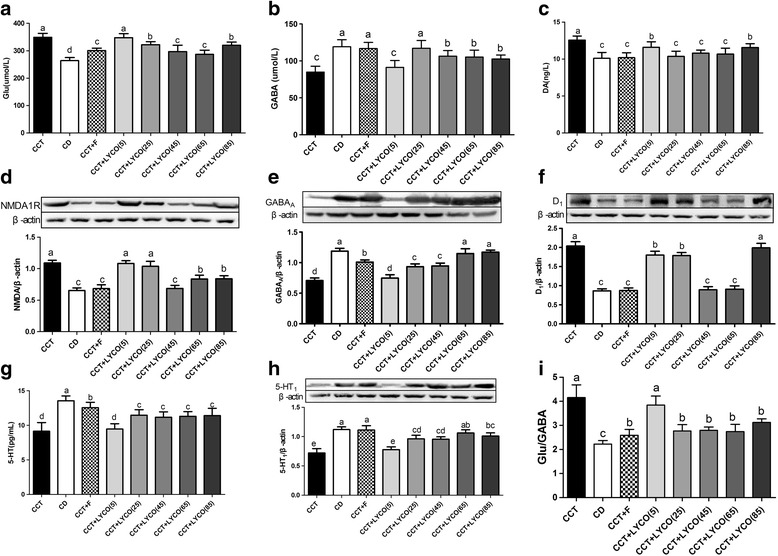
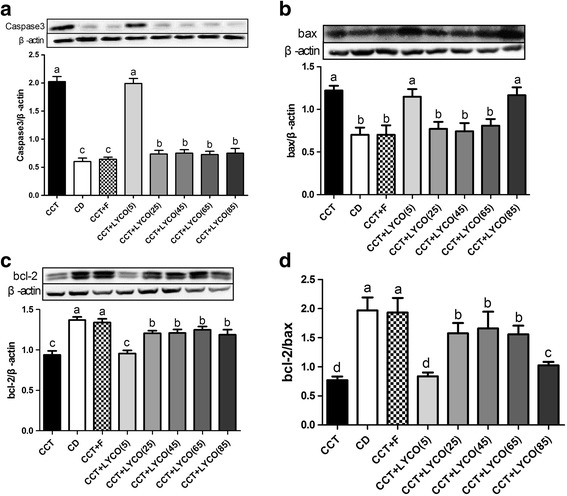
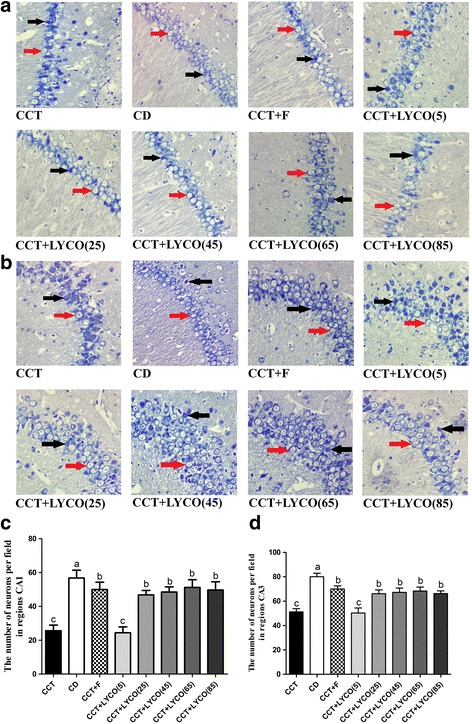
At the end of the experiment, the levels of TC, TG, LDL-C, IL-1, TNF-α, and ox-LDL in the serum and brain as well as the content of Glu, DA, NMDA, and D in the brain of rats in the CCT group were higher than those in the control group (P<0.05); the levels of LDLR, NGF, GABA, 5-HT, GABA, 5-HT, and neuron quantities in the hippocampal CA1 and CA3 areas were lower than those in the control group (P<0.05). Compared to the CCT group, levels of TC, TG, LDL-C, IL-1, TNF-α, and ox-LDL in the serum and brain, as well as the content of Glu, DA and the expression of pro-apoptotic Caspase3 in the brain decreased in the rats with lycopene (25 mg to 85 mg) added to the diet (P<0.05); the levels of LDLR, NGF, GABA, 5-HT, GABA, and 5-HT as well as the expression of anti-apoptotic bcl-2 and the neuron quantity in hippocampal CA1 and CA3 areas increased (P<0.05); further, the hippocampal cells were closely arranged. Lycopene dose was negatively correlated with the levels of TC, TG, and LDL-C in the serum and brain as well as levels of IL-1, TNF-α, ox-LDL, Glu/GABA, NMDA1R, and Caspase3 (P<0.05); it was positively correlated with the levels of LDLR, NGF, 5-HT, 5-HT, GABA, bcl-2, and the neuron quantity in hippocampal CA1 and CA3 areas (P<0.05).
Lycopene exerts anti-injury effects in the brain as-induced by hyperlipidemia. It can inhibit the elevation of serum TC, TG, and LDL-C in rats with hyperlipidemia while indirectly affecting the levels of TC, TG, and LDL-C in the brain, leading to a reduction in ox-LDL, IL-1, and TNF-α in the brain. This inhibits the release of Glu, which weakens nerve toxicity and downregulates pro-apoptotic Caspase3. Lycopene also plays an anti-injury role by promoting the release of the inhibitory neurotransmitter GABA and 5-HT, which enhances the protective effect, and by upregulating the anti-apoptotic bcl-2.
番茄红素是一种类胡萝卜素,具有很强的抗氧化和调节血脂的能力。已有一些证据表明,番茄红素对中枢神经系统具有保护作用,但很少有研究严格探索其中神经递质的作用。因此,本研究旨在探讨几种神经递质在番茄红素发挥抗高血脂诱导的损伤作用中的作用。
将 80 只成年 SD 大鼠,雌雄各半,根据血清总胆固醇(TC)水平和体重随机分为 8 组。对照组(CD)给予标准实验室啮齿动物饲料;高胆固醇饮食组(大鼠饲料中添加 4%胆固醇、1%胆酸和 0.5%硫脲——也称为 CCT 饮食);阳性组(CCT+F)给予 CCT,胃内灌注 10mg·kg·bw·d 氟伐他汀钠;番茄红素组(CCT+LYCO)在 CCT 饮食中添加 5、25、45、65 和 85mg·kg·bw·d 的番茄红素。实验结束后,测定血清和脑组织 TC、甘油三酯(TG)、低密度脂蛋白胆固醇(LDL-C)、高密度脂蛋白胆固醇(HDL-C)、白细胞介素 1(IL-1)、肿瘤坏死因子-α(TNF-α)、氧化型低密度脂蛋白(ox-LDL)、低密度脂蛋白受体(LDLR)、神经生长因子(NGF)、谷氨酸(Glu)、γ-氨基丁酸(GABA)、多巴胺(DA)、5-羟色胺(5-HT)、N-甲基-D-天冬氨酸(NMDA1R)、GABA、5-HT、DA、凋亡相关蛋白 Caspase3、bax 和 bcl-2 的含量。采用尼氏染色观察神经元形态变化。
实验结束时,CCT 组大鼠血清和脑组织 TC、TG、LDL-C、IL-1、TNF-α和 ox-LDL 水平以及脑内 Glu、DA、NMDA 和 D 含量均高于对照组(P<0.05);海马 CA1 和 CA3 区 LDLR、NGF、GABA、5-HT、GABA、5-HT 神经元数量和含量均低于对照组(P<0.05)。与 CCT 组相比,添加番茄红素(25-85mg)的饮食可降低血清和脑组织 TC、TG、LDL-C、IL-1、TNF-α和 ox-LDL 水平以及脑内 Glu、DA 和促凋亡 Caspase3 的表达(P<0.05);增加 LDLR、NGF、GABA、5-HT、GABA、5-HT 以及抗凋亡 bcl-2 的表达和海马 CA1 和 CA3 区神经元数量(P<0.05);进一步使海马细胞排列紧密。番茄红素剂量与血清和脑组织 TC、TG 和 LDL-C 以及 IL-1、TNF-α、ox-LDL、Glu/GABA、NMDA1R 和 Caspase3 水平呈负相关(P<0.05);与 LDLR、NGF、5-HT、5-HT、GABA、bcl-2 和海马 CA1 和 CA3 区神经元数量呈正相关(P<0.05)。
番茄红素对高血脂诱导的脑损伤具有保护作用。它可以抑制高脂血症大鼠血清 TC、TG 和 LDL-C 的升高,同时间接影响脑内 TC、TG 和 LDL-C 的水平,降低脑内 ox-LDL、IL-1 和 TNF-α的水平。这抑制了 Glu 的释放,从而减轻神经毒性并下调促凋亡 Caspase3。番茄红素还通过促进抑制性神经递质 GABA 和 5-HT 的释放来发挥抗损伤作用,增强保护作用,并上调抗凋亡 bcl-2。