Choi Hye Duck, Chae Seung Min
College of Pharmacy, Yeungnam University, Gyeongsangbuk-do, Republic of Korea.
Medicine (Baltimore). 2018 Dec;97(50):e13593. doi: 10.1097/MD.0000000000013593.
Dyslipidemia is a major risk factor for the development of cardiovascular disease. Both statins and omega-3 fatty acids demonstrate beneficial effects on lipid concentrations. The goal was to evaluate the safety and efficacy of combination therapy with statins and omega-3 fatty acids.
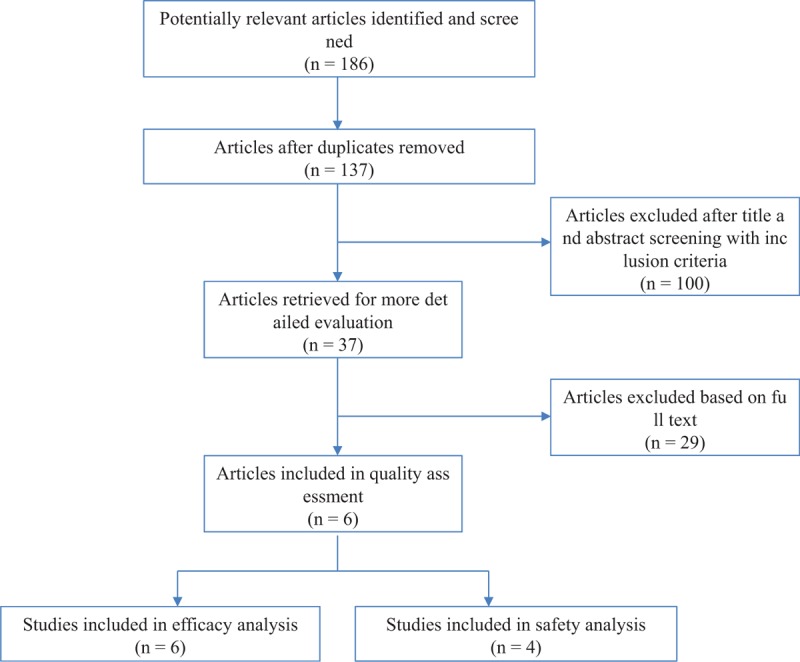
We performed a systematic review and meta-analysis of published data to compare the safety and efficacy of combination therapy with statins and omega-3 fatty acids versus statin monotherapy in patients with dyslipidemia. Six articles were assessed in the present meta-analysis (quantitative assessment) and qualitative assessment.
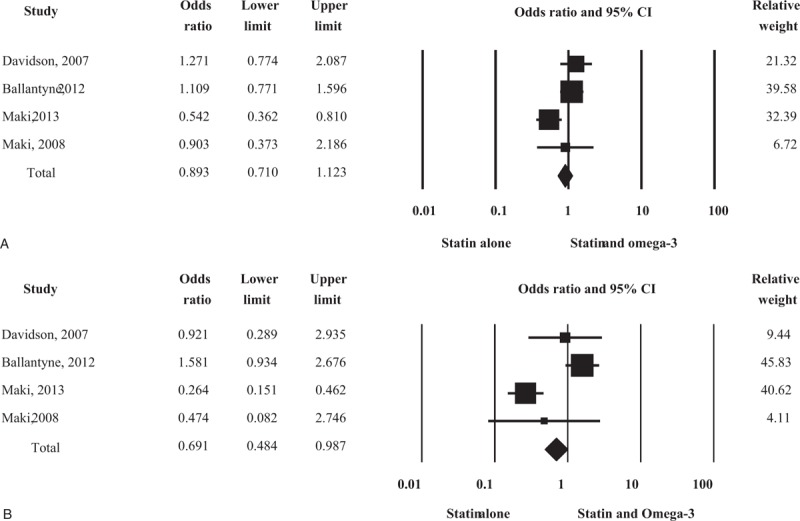
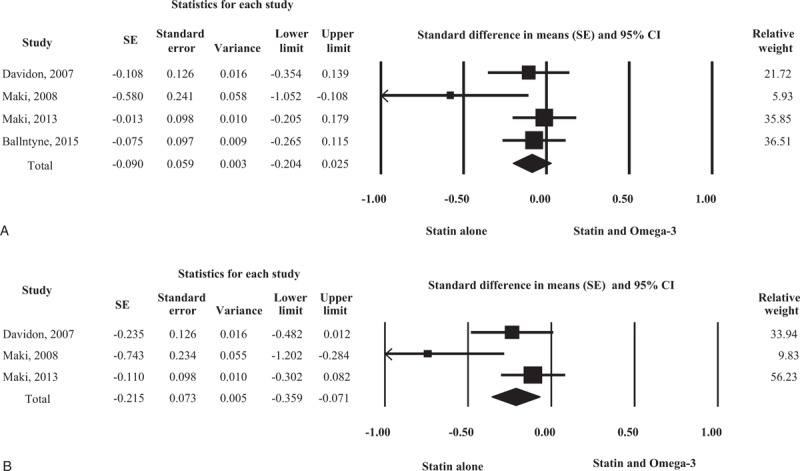
In terms of efficacy, the combination treatment afforded a significantly greater reduction in total cholesterol/high-density lipoprotein cholesterol than statin alone did [standard difference in means = -0.215; 95% confidence interval (CI) -0.359--0.071]. However, there was no significant difference in low-density lipoprotein (LDL) cholesterol between the 2 groups. Qualitative assessment of other lipid parameters was performed. Combination therapy with statins and omega-3 fatty acids was generally more effective on lipid concentration than statin monotherapy. In terms of safety, there were no significant differences in total adverse events between the 2 groups. Gastrointestinal adverse events were found to be significantly increased in patients receiving combination therapy using the fixed-effects model (relative risk = 0.547; 95% CI 0.368-0.812).
We suggest that combination therapy with statins and omega-3 fatty acids enhances lipid profile, except LDL cholesterol, compared with statin monotherapy. Nevertheless, statin and omega-3 fatty acid combination should be cautiously recommended, taking into account the clinical importance of LDL cholesterol and safety issues associated with their concomitant use.
血脂异常是心血管疾病发生的主要危险因素。他汀类药物和ω-3脂肪酸对血脂浓度均有有益作用。本研究旨在评估他汀类药物与ω-3脂肪酸联合治疗的安全性和有效性。
我们对已发表的数据进行了系统评价和荟萃分析,以比较他汀类药物与ω-3脂肪酸联合治疗与他汀类药物单药治疗在血脂异常患者中的安全性和有效性。本荟萃分析(定量评估)和定性评估共纳入6篇文章。
在疗效方面,联合治疗组总胆固醇/高密度脂蛋白胆固醇的降低幅度显著大于他汀类药物单药治疗组[均值标准差=-0.215;95%置信区间(CI)-0.359--0.071]。然而,两组间低密度脂蛋白(LDL)胆固醇水平无显著差异。对其他血脂参数进行了定性评估。他汀类药物与ω-3脂肪酸联合治疗在血脂浓度方面通常比他汀类药物单药治疗更有效。在安全性方面,两组间总不良事件无显著差异。采用固定效应模型发现,接受联合治疗的患者胃肠道不良事件显著增加(相对风险=0.547;95%CI 0.368-0.812)。
我们认为,与他汀类药物单药治疗相比,他汀类药物与ω-3脂肪酸联合治疗可改善除LDL胆固醇以外的血脂谱。然而,鉴于LDL胆固醇的临床重要性以及联合使用相关的安全性问题,应谨慎推荐他汀类药物与ω-3脂肪酸联合治疗。