Martínez-Negro María, Blanco-Fernández Laura, Tentori Paolo M, Pérez Lourdes, Pinazo Aurora, Tros de Ilarduya Conchita, Aicart Emilio, Junquera Elena
Grupo de Química Coloidal y Supramolecular, Departamento de Química Física, Facultad de Ciencias Químicas, Universidad Complutense de Madrid, 28040 Madrid, Spain.
Departamento de Farmacia y Tecnología Farmacéutica, Facultad de Farmacia, Universidad de Navarra, Instituto de Investigación Sanitaria de Navarra (IdiSNA), 31008 Pamplona, Spain.
Nanomaterials (Basel). 2018 Dec 16;8(12):1061. doi: 10.3390/nano8121061.
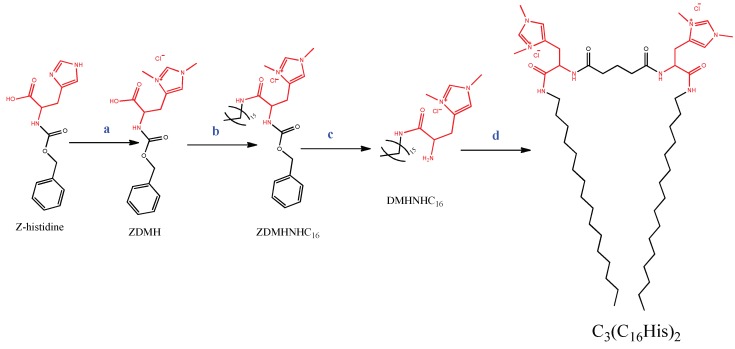
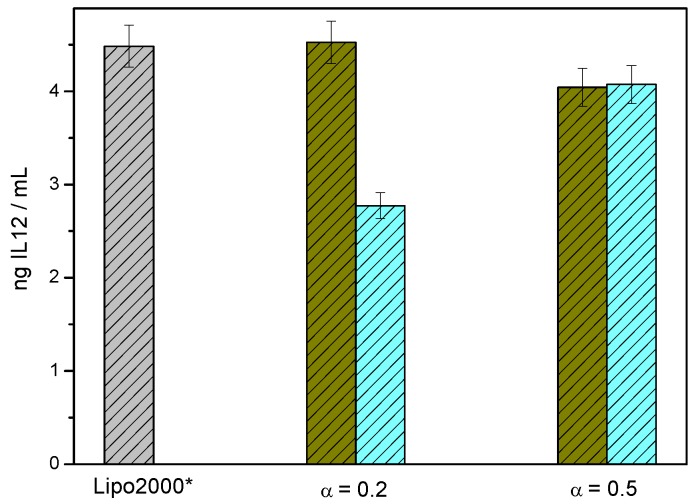
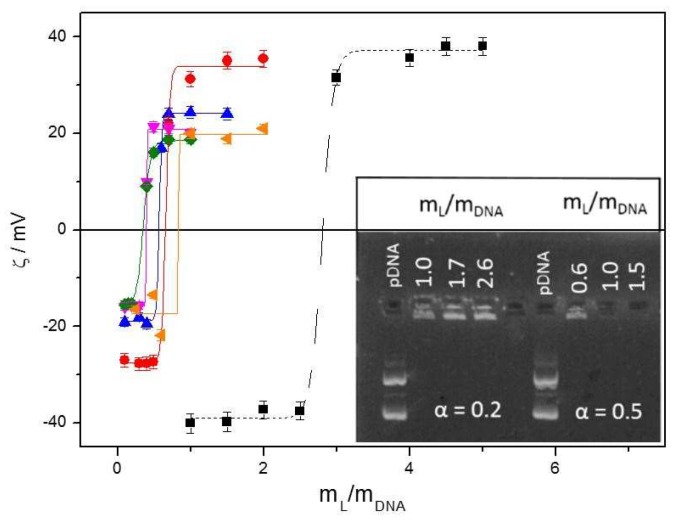
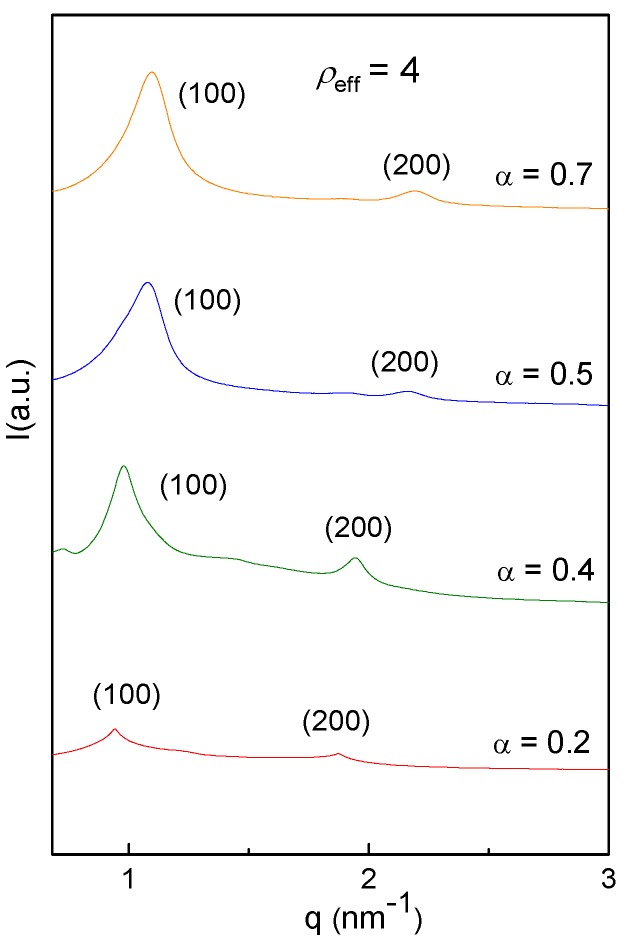
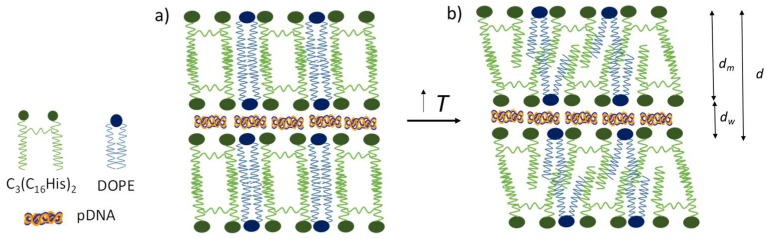
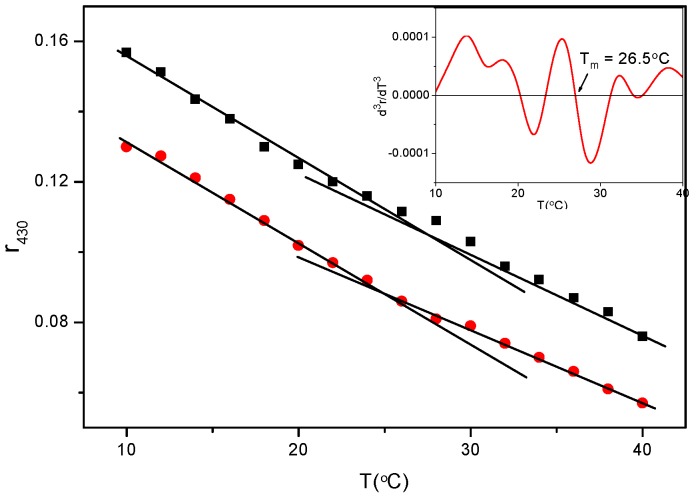
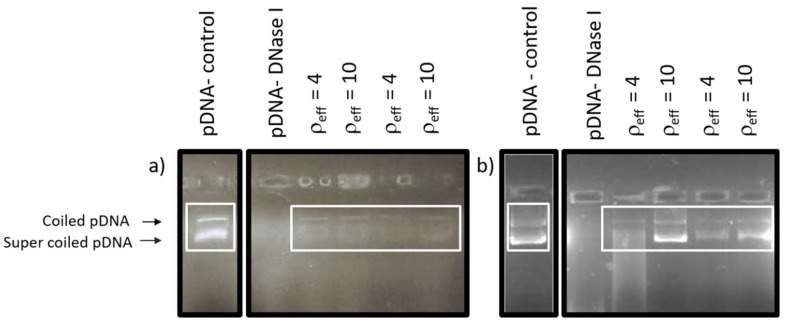
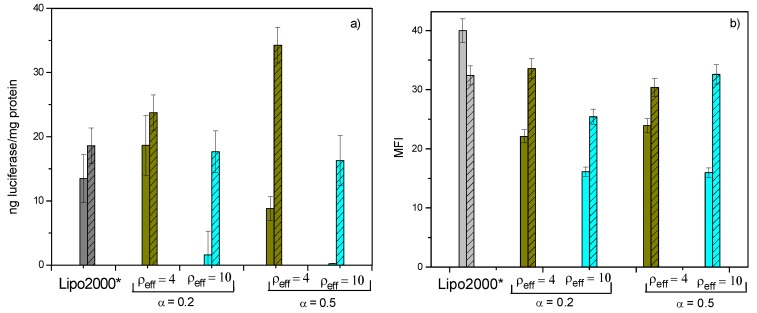
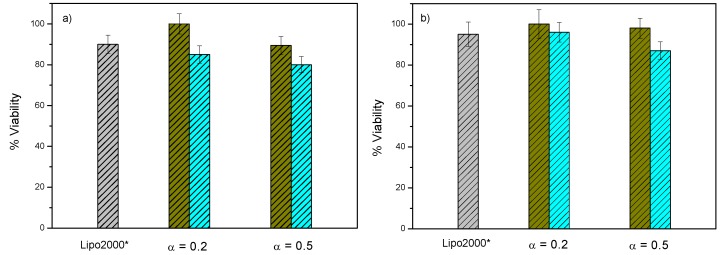
This work reports the synthesis of a novel gemini cationic lipid that incorporates two histidine-type head groups (C₃(CHis)₂). Mixed with a helper lipid 1,2-dioleoyl--glycero-3-phosphatidyl ethanol amine (DOPE), it was used to transfect three different types of plasmid DNA: one encoding the green fluorescence protein (pEGFP-C3), one encoding a luciferase (pCMV-Luc), and a therapeutic anti-tumoral agent encoding interleukin-12 (pCMV-IL12). Complementary biophysical experiments (zeta potential, gel electrophoresis, small-angle X-ray scattering (SAXS), and fluorescence anisotropy) and biological studies (FACS, luminometry, and cytotoxicity) of these C₃(CHis)₂/DOPE-pDNA lipoplexes provided vast insight into their outcomes as gene carriers. They were found to efficiently compact and protect pDNA against DNase I degradation by forming nanoaggregates of 120⁻290 nm in size, which were further characterized as very fluidic lamellar structures based in a sandwich-type phase, with alternating layers of mixed lipids and an aqueous monolayer where the pDNA and counterions are located. The optimum formulations of these nanoaggregates were able to transfect the pDNAs into COS-7 and HeLa cells with high cell viability, comparable or superior to that of the standard Lipo2000*. The vast amount of information collected from the in vitro studies points to this histidine-based lipid nanocarrier as a potentially interesting candidate for future in vivo studies investigating specific gene therapies.
本研究报道了一种新型 Gemini 阳离子脂质的合成,该脂质包含两个组氨酸型头部基团(C₃(CHis)₂)。将其与辅助脂质 1,2-二油酰基-sn-甘油-3-磷脂酰乙醇胺(DOPE)混合,用于转染三种不同类型的质粒 DNA:一种编码绿色荧光蛋白(pEGFP-C3),一种编码荧光素酶(pCMV-Luc),以及一种编码治疗性抗肿瘤剂白细胞介素-12 的质粒(pCMV-IL12)。对这些 C₃(CHis)₂/DOPE-pDNA 脂质体复合物进行的补充生物物理实验(zeta 电位、凝胶电泳、小角 X 射线散射(SAXS)和荧光各向异性)以及生物学研究(流式细胞术、发光测定和细胞毒性),为它们作为基因载体的效果提供了深入了解。结果发现,它们能够通过形成尺寸为 120⁻290 nm 的纳米聚集体,有效地压缩和保护 pDNA 免受 DNase I 的降解,这些纳米聚集体进一步被表征为基于三明治型相的非常流体化的层状结构,具有混合脂质的交替层和一个 pDNA 和抗衡离子所在的水单层。这些纳米聚集体的最佳配方能够以高细胞活力将 pDNA 转染到 COS-7 和 HeLa 细胞中,与标准 Lipofectamine 2000*相当或更优。从体外研究收集的大量信息表明,这种基于组氨酸的脂质纳米载体是未来研究特定基因疗法的体内研究中一个潜在有趣的候选者。