Kilimanjaro Christian Medical University College, P.O Box 2236, Moshi, Tanzania.
Regional Dermatology Training Centre, Kilimanjaro Christian Medical Centre, P.O. Box 8332, Moshi, Tanzania.
BMC Cancer. 2018 Dec 17;18(1):1258. doi: 10.1186/s12885-018-5155-2.
Kaposi's sarcoma (KS) is a multifocal angioproliferative tumor involving blood and lymphatic vessels, caused by Human Herpes Virus-8 (HHV-8). KS is an important AIDS-defining tumor with high prevalence in Sub-Saharan Africa, including Tanzania which has high HIV and HHV-8 sero-prevalence. It is critically important to monitor the prevalence of AIDS-defining tumors, such as KS, in the age of HIV/AIDS. We studied the prevalence of KS and associated risk factors among HIV-positive patients at Kilimanjaro Christian Medical Centre (KCMC), a referral hospital in northern Tanzania, over the period from January 2012 to December 2015.
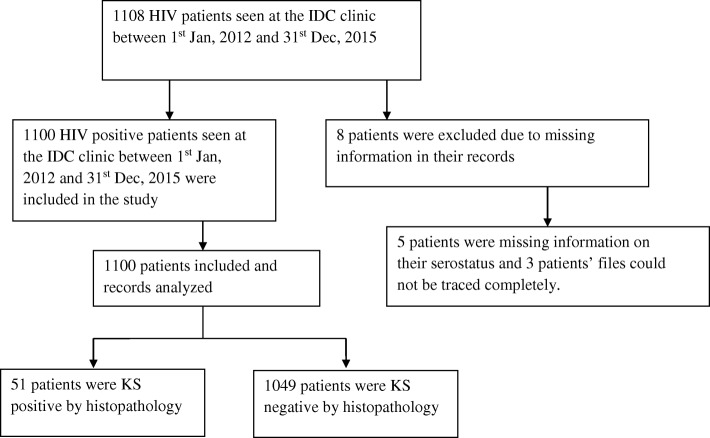
This was a retrospective hospital-based cross-sectional study to determine the prevalence of KS among HIV/AIDS patients between 2012 and 2015. The study included 1100 HIV patients' data which were collected at the Infectious Disease Clinic (IDC) from patients' files. Stata version 13 (StataCorp LP, Texas 77,845 USA) was used for all statistical analyses. The prevalence of KS was calculated across levels of a number of categorical variables. Logistic regression was performed to determine relative risk of KS for all characteristics. We included all variables with p-values ≤10% in the multivariate analysis, including ART use, as this is considered to have an influence on KS. In the multivariate analysis, statistical significance was established based on a two-tailed p-value ≤5%. All patients' notes were kept confidential as per the Helsinki declaration.
Our results revealed a 4.6% prevalence of KS at KCMC hospital, between January 2012 and December 2015, 51(4.6%) patients were diagnosed with KS out of 1100 HIV-positive patients. The study further revealed that KS in HIV patients was most associated with low CD4 cell count (less than or equal to 200 cells/μl). Moreover, women were more likely than men to diagnosed with KS, with higher odds significantly associated with KS (OR 0.42, p < 0.009). Increased age, above 35 years, among the HIV seropositive patients was significantly associated with KS (OR 25.67, p < 0.007). HIV patients who were none smokers were more likely to suffer from KS compared to HIV smokers (OR 0.41, p < 0.010).
KS remains a common malignant vascular tumor commonly associated with HIV/AIDS in Tanzania. Our study highlights the need for continued efforts to combat HIV, as well as associated diseases such as KS. Continued availability of ART (Anti-Retroviral Therapy) to HIV/AIDS patients, and test reagents for CD4 cell count and viral load determination are important measures to alleviate the suffering of these patients. Furthermore, studies to gather more evidence on ART resistance are highly needed to guide treatment choices.
卡波西肉瘤(KS)是一种涉及血液和淋巴管的多灶性血管增生性肿瘤,由人类疱疹病毒 8 型(HHV-8)引起。KS 是一种重要的艾滋病定义性肿瘤,在撒哈拉以南非洲地区包括坦桑尼亚具有高患病率,坦桑尼亚的 HIV 和 HHV-8 血清流行率均较高。监测艾滋病定义性肿瘤(如 KS)的患病率至关重要,尤其是在艾滋病时代。我们研究了 2012 年至 2015 年间,乞力马扎罗基督教医疗中心(KCMC)艾滋病毒阳性患者中 KS 的患病率及其相关危险因素,KCMC 是坦桑尼亚北部的一家转诊医院。
这是一项回顾性基于医院的横断面研究,旨在确定 2012 年至 2015 年间艾滋病毒/艾滋病患者中 KS 的患病率。该研究包括从患者档案中收集的 1100 名 HIV 患者的数据。所有统计分析均使用 Stata 版本 13(StataCorp LP,德克萨斯州 77845 美国)。在多个分类变量的水平上计算了 KS 的患病率。进行逻辑回归以确定所有特征的 KS 相对风险。我们将所有 p 值≤10%的变量纳入多变量分析,包括 ART 治疗,因为这被认为对 KS 有影响。在多变量分析中,基于双侧 p 值≤5%建立统计学意义。所有患者的病历均按照赫尔辛基宣言保密。
我们的研究结果显示,2012 年至 2015 年期间,KCMC 医院 KS 的患病率为 4.6%,在 1100 名 HIV 阳性患者中,有 51 名(4.6%)被诊断为 KS。研究进一步表明,HIV 患者的 KS 最与低 CD4 细胞计数(≤200 个/μl)相关。此外,与男性相比,女性更有可能被诊断为 KS,且与 KS 显著相关的几率更高(OR 0.42,p<0.009)。在 HIV 血清阳性患者中,年龄超过 35 岁与 KS 显著相关(OR 25.67,p<0.007)。与 HIV 吸烟者相比,不吸烟的 HIV 患者更有可能患 KS(OR 0.41,p<0.010)。
KS 仍然是坦桑尼亚与 HIV/AIDS 相关的常见恶性血管肿瘤。我们的研究强调需要继续努力抗击 HIV 以及 KS 等相关疾病。继续为 HIV/AIDS 患者提供抗逆转录病毒治疗(ART)以及 CD4 细胞计数和病毒载量测定的检测试剂,是减轻这些患者痛苦的重要措施。此外,还需要进行更多关于 ART 耐药性的研究,以指导治疗选择。