Pellegrini Carolina, Fornai Matteo, Colucci Rocchina, Benvenuti Laura, D’Antongiovanni Vanessa, Natale Gianfranco, Fulceri Federica, Giorgis Marta, Marini Elisabetta, Gastaldi Simone, Bertinaria Massimo, Blandizzi Corrado, Antonioli Luca
Department of Pharmacy, University of Pisa, Pisa, Italy.
Department of Clinical and Experimental Medicine, University of Pisa, Pisa, Italy.
Front Pharmacol. 2018 Dec 3;9:1405. doi: 10.3389/fphar.2018.01405. eCollection 2018.
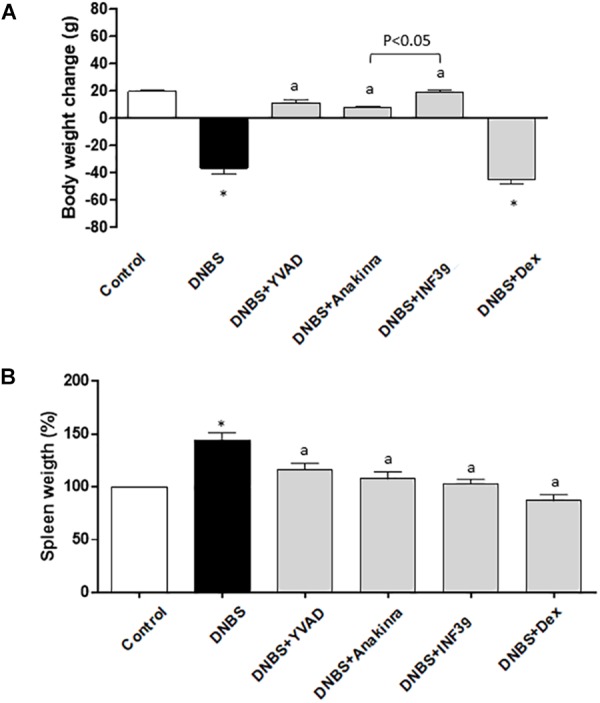
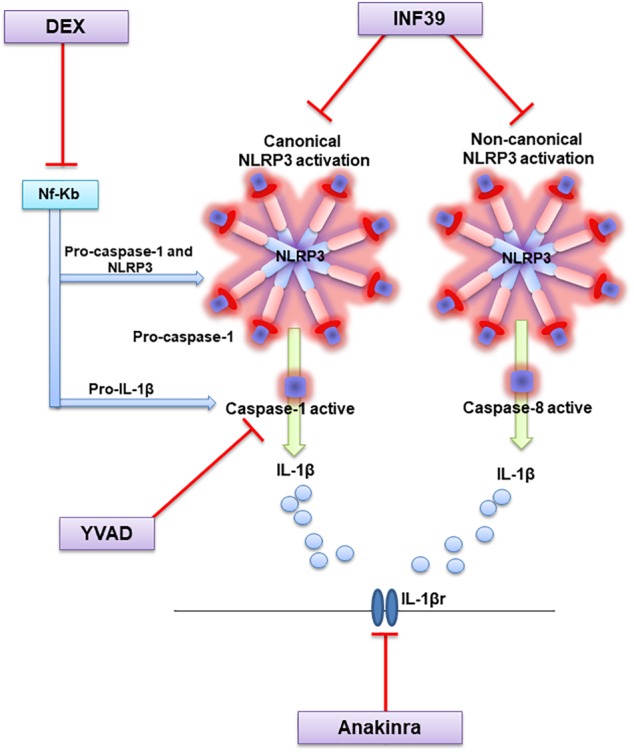
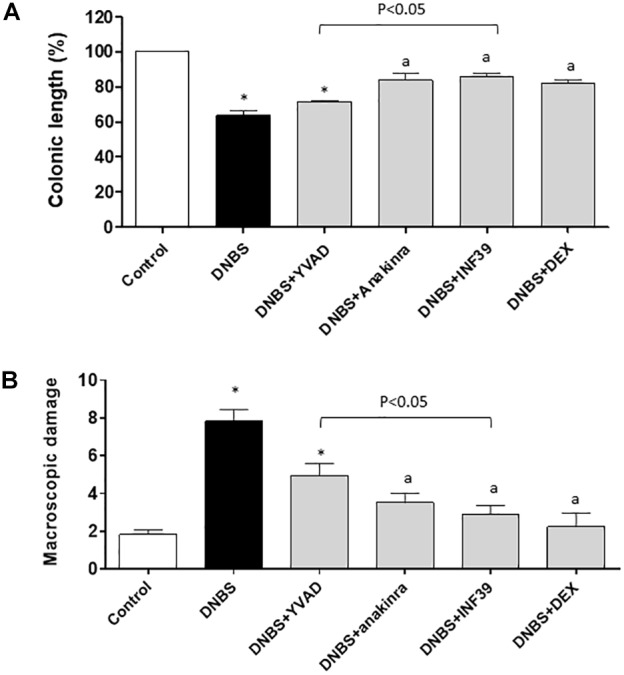
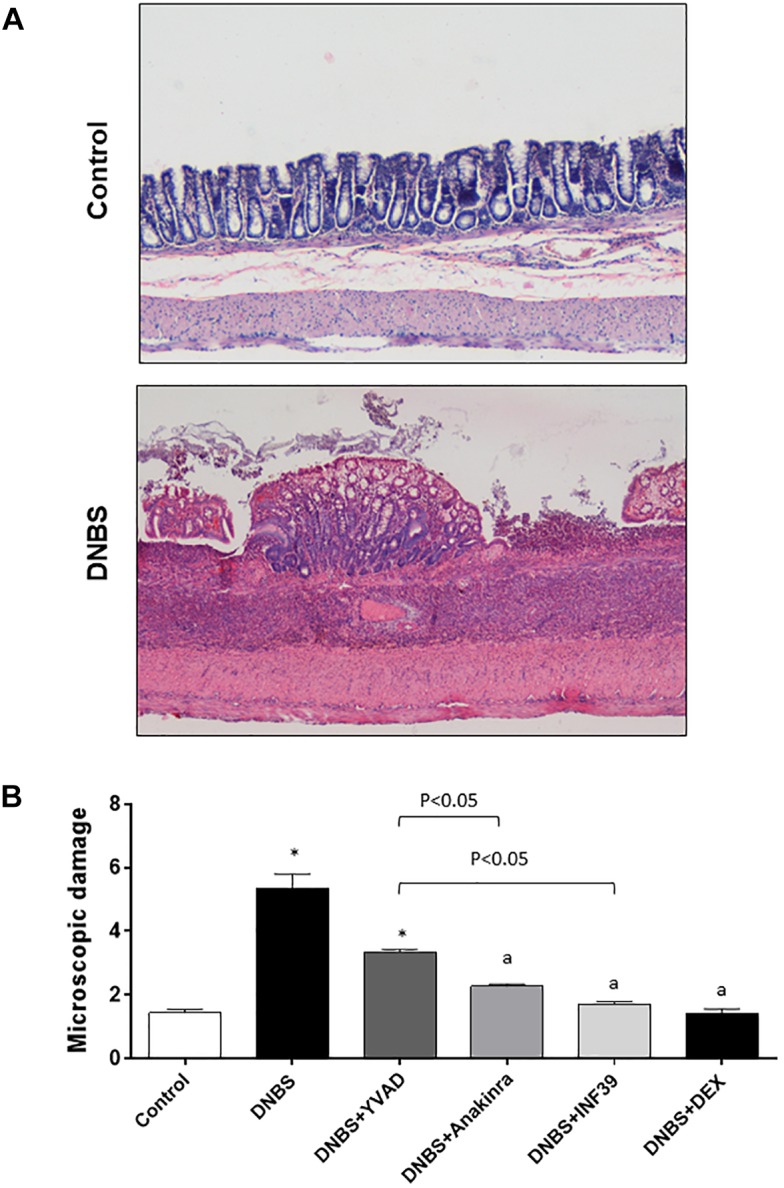
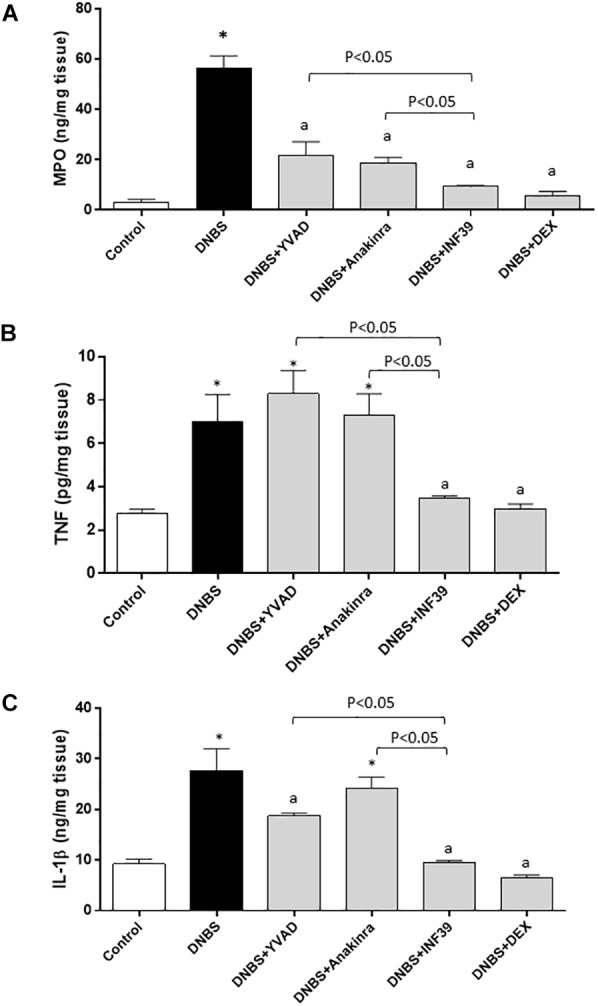
Nucleotide-binding oligomerization domain leucine rich repeat and pyrin domain-containing protein 3 (NLRP3) inflammasome is pivotal in maintaining intestinal homeostasis and sustaining enteric immune responses in the setting of inflammatory bowel diseases. Drugs acting as NLRP3 blockers could represent innovative strategies for treatment of bowel inflammation. This study was performed in rats with dinitrobenzenesulfonic acid (DNBS)-induced colitis, to investigate how the direct blockade of NLRP3 inflammasome with an irreversible inhibitor (INF39) compares with Ac-YVAD-cmk (YVAD, caspase-1 inhibitor) and anakinra (IL-1β receptor antagonist), acting downstream on NLRP3 signaling. Animals with DNBS-colitis received YVAD (3 mg/kg) or anakinra (100 mg/Kg) intraperitoneally, and INF39 (25 mg/kg) or dexamethasone (DEX, 1 mg/kg) orally for 6 days, starting on the same day of colitis induction. Under colitis, there was a body weight decrease, which was attenuated by YVAD, anakinra or INF39, but not DEX. All test drugs counteracted the increase in spleen weight. The colonic shortening and morphological colonic alterations associated with colitis were counteracted by INF39, anakinra and DEX, while YVAD was without effects. Tissue increments of myeloperoxidase, tumor necrosis factor and interleukin-1β were more effectively counteracted by INF39 and DEX, than YVAD and anakinra. These findings indicate that: (1) direct inhibition of NLRP3 inflammasome with INF39 is more effective than caspase-1 inhibition or IL-1β receptor blockade in reducing systemic and bowel inflammatory alterations; (2) direct NLRP3 inhibition can be a suitable strategy for treatment of bowel inflammation.
核苷酸结合寡聚化结构域富含亮氨酸重复序列和吡啉结构域蛋白3(NLRP3)炎性小体在维持肠道稳态以及在炎症性肠病背景下维持肠道免疫反应中起关键作用。作为NLRP3阻滞剂的药物可能代表治疗肠道炎症的创新策略。本研究在二硝基苯磺酸(DNBS)诱导的大鼠结肠炎模型中进行,以研究用不可逆抑制剂(INF39)直接阻断NLRP3炎性小体与Ac-YVAD-cmk(YVAD,半胱天冬酶-1抑制剂)和阿那白滞素(IL-1β受体拮抗剂)相比,后者作用于NLRP3信号传导的下游,二者效果如何。患有DNBS结肠炎的动物从结肠炎诱导当天开始,腹腔注射YVAD(3 mg/kg)或阿那白滞素(100 mg/Kg),口服INF39(25 mg/kg)或地塞米松(DEX,1 mg/kg),持续6天。在结肠炎状态下,体重下降,YVAD、阿那白滞素或INF39可使其减轻,但DEX无效。所有受试药物均能对抗脾脏重量的增加。INF39、阿那白滞素和DEX可对抗与结肠炎相关的结肠缩短和结肠形态改变,而YVAD则无此作用。与YVAD和阿那白滞素相比,INF39和DEX更有效地对抗了髓过氧化物酶、肿瘤坏死因子和白细胞介素-1β的组织增量。这些发现表明:(1)在减轻全身和肠道炎症改变方面,用INF39直接抑制NLRP3炎性小体比抑制半胱天冬酶-1或阻断IL-1β受体更有效;(2)直接抑制NLRP3可能是治疗肠道炎症的合适策略。