Faculty of Public Health and Policy, London School of Hygiene & Tropical Medicine, 15⁻17 Tavistock Place, London WC1H 9SH, UK.
Int J Environ Res Public Health. 2018 Dec 17;15(12):2895. doi: 10.3390/ijerph15122895.
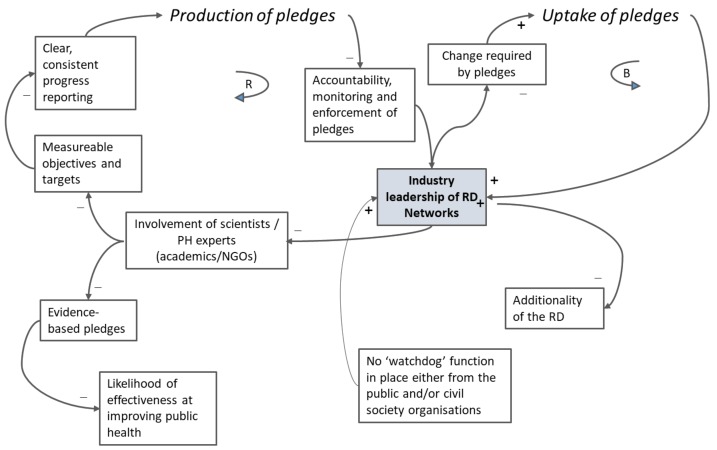
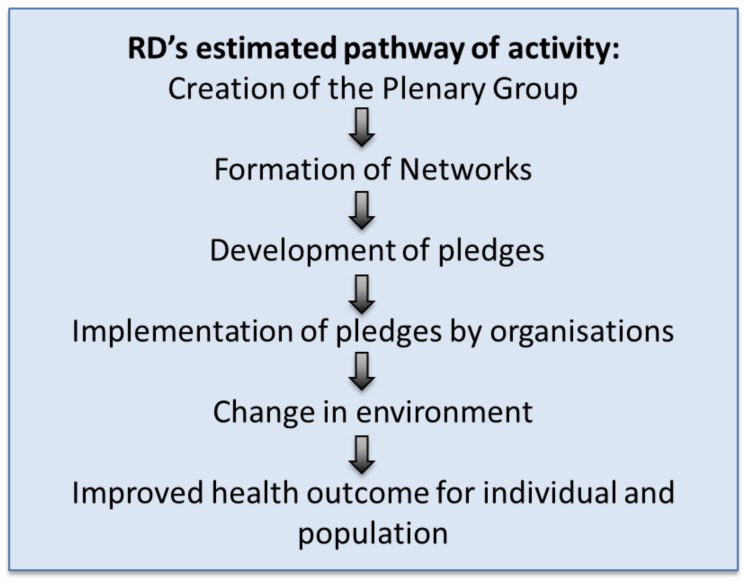
The extent to which government should partner with business interests such as the alcohol, food, and other industries in order to improve public health is a subject of ongoing debate. A common approach involves developing voluntary agreements with industry or allowing them to self-regulate. In England, the most recent example of this was the Public Health Responsibility Deal (RD), a public⁻private partnership launched in 2011 under the then Conservative-led coalition government. The RD was organised around a series of voluntary agreements that aim to bring together government, academic experts, and commercial, public sector and voluntary organisations to commit to pledges to undertake actions of public health benefit. This paper brings together the main findings and implications of the evaluation of the RD using a systems approach. We analysed the functioning of the RD exploring the causal pathways involved and how they helped or hindered the RD; the structures and processes; feedback loops and how they might have constrained or potentiated the effects of the RD; and how resilient the wider systems were to change (i.e., the alcohol, food, and other systems interacted with). Both the production and uptake of pledges by RD partners were largely driven by the interests of partners themselves, enabling these wider systems to resist change. This analysis demonstrates how and why the RD did not meet its objectives. The findings have lessons for the development of effective alcohol, food and other policies, for defining the role of unhealthy commodity industries, and for understanding the limits of industry self-regulation as a public health measure.
政府应该在何种程度上与企业利益(如酒类、食品和其他行业)合作,以改善公共卫生,这是一个持续争论的话题。一种常见的方法是与行业制定自愿协议或允许它们进行自我监管。在英国,最近的一个例子是公共卫生责任协议(RD),这是 2011 年在当时由保守党领导的联合政府发起的公私合作伙伴关系。RD 围绕一系列自愿协议组织,旨在汇集政府、学术专家以及商业、公共部门和志愿组织,承诺采取有利于公共卫生的行动。本文采用系统方法,综合了对 RD 评估的主要发现和影响。我们分析了 RD 的运作情况,探讨了涉及的因果关系途径,以及它们如何帮助或阻碍 RD;结构和流程;反馈循环以及它们如何限制或增强 RD 的效果;以及更广泛的系统对变化的适应能力(即,酒精、食品和其他系统与)。RD 合作伙伴的承诺的制定和采纳主要是由合作伙伴自身的利益驱动的,这使得这些更广泛的系统能够抵制变革。这种分析展示了 RD 如何以及为何未能实现其目标。这些发现为制定有效的酒精、食品和其他政策、界定不健康商品行业的角色以及理解行业自我监管作为公共卫生措施的局限性提供了经验教训。