Department of Pediatrics and Child Health, Aga Khan University, Stadium Road, Karachi, 74800, Pakistan.
Centre for Disease Control and Prevention, Atlanta, USA.
BMC Infect Dis. 2018 Dec 18;18(1):672. doi: 10.1186/s12879-018-3608-5.
Benefits of pneumococcal conjugate vaccine programs have been linked to the vaccine's ability to disrupt nasopharyngeal carriage and transmission. The 10-valent pneumococcal vaccine (PCV10) was included in the Expanded Program on Immunization (EPI) in Sindh, Pakistan in February 2013. This study was carried out immediately before PCV10 introduction to establish baseline pneumococcal carriage and prevalent serotypes in young children and to determine if carriage differed in urban and rural communities.
Nasopharyngeal specimens were collected from a random sample of children 3-11 and 12-59 months of age in an urban community (Karachi) and children 3-11 months of age in a rural community (Matiari). Samples were processed in a research laboratory in Karachi. Samples were transported in STGG media, enriched in Todd Hewitt broth, rabbit serum and yeast extract, cultured on 5% sheep blood agar, and serotyped using the CDC standardized sequential multiplex PCR assay. Serotypes were categorized into PCV10-type and non-vaccine types.
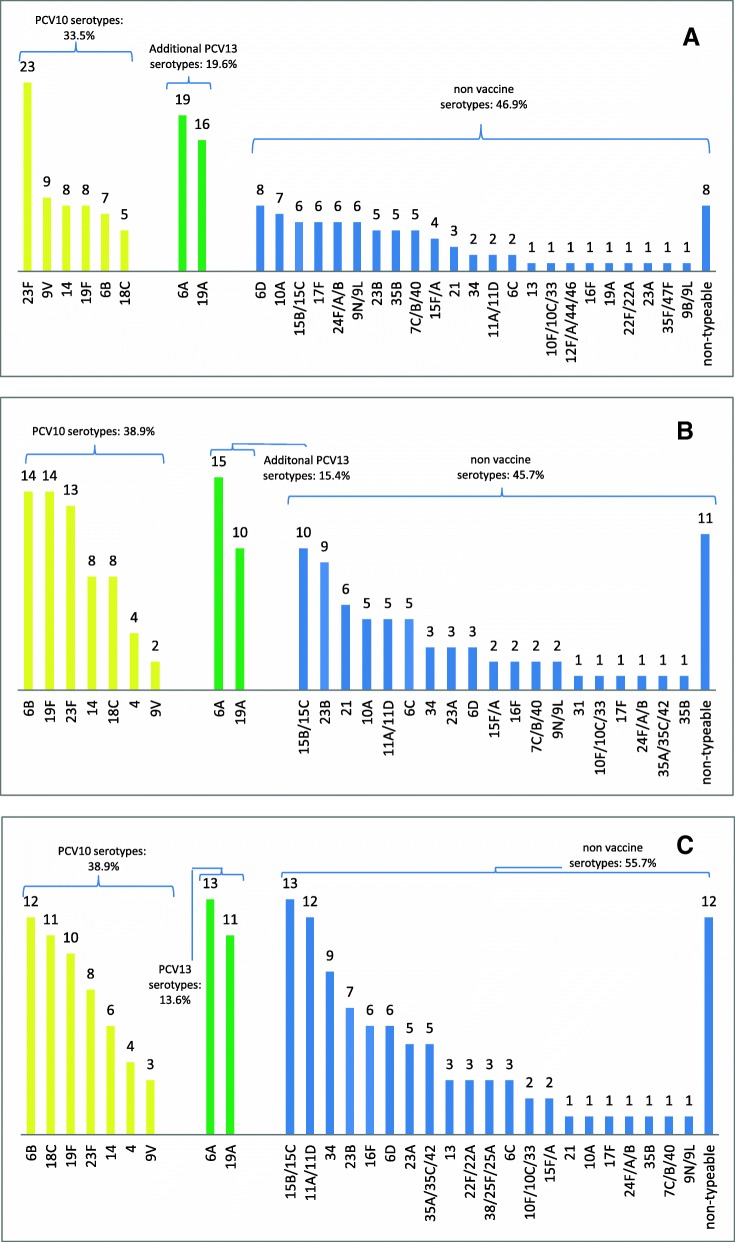
We enrolled 670 children. Pneumococci were detected in 73.6% and 79.5 % of children in the infant group in Karachi and Matiari, respectively, and 78.2% of children 12 to 59 months of age in Karachi. In infants, 38.9% and 33.5% of those carrying pneumococci in Karachi and Matiari, respectively, had PCV10 types. In the older age group in Karachi, the proportion was 30.7%, not significantly different from infants. The most common serotypes were 6A, 23F, 19A, 6B and 19F.
We found that about 3 of 4 children carried pneumococci, and this figure did not vary with age group or urban or rural residence. Planned annual surveys in the same communities will inform change in carriage of PCV10 serotype pneumococci after the introduction and uptake of PCV10 in these communities.
肺炎球菌结合疫苗计划的益处与疫苗阻断鼻咽携带和传播的能力有关。2013 年 2 月,10 价肺炎球菌疫苗(PCV10)被纳入巴基斯坦信德省扩大免疫规划(EPI)。本研究在 PCV10 引入之前进行,旨在确定儿童鼻咽携带和流行血清型的基线情况,并确定城乡社区的携带情况是否存在差异。
从卡拉奇的城市社区(卡拉奇)和马蒂阿里的农村社区(马蒂阿里)的 3-11 岁和 12-59 个月龄的随机儿童样本中采集鼻咽标本。在卡拉奇的一个研究实验室中处理样本。样本在 STGG 培养基中运输,在 Todd Hewitt 肉汤、兔血清和酵母提取物中富集,在 5%绵羊血琼脂上培养,并使用 CDC 标准化顺序多重 PCR 检测进行血清型分型。血清型分为 PCV10 型和非疫苗型。
我们共招募了 670 名儿童。在卡拉奇和马蒂阿里的婴儿组中,分别有 73.6%和 79.5%的儿童检测到肺炎球菌,在卡拉奇的 12-59 个月龄儿童中,这一比例为 78.2%。在婴儿中,卡拉奇和马蒂阿里分别有 38.9%和 33.5%的携带肺炎球菌的儿童携带 PCV10 型。在卡拉奇的大龄组中,这一比例为 30.7%,与婴儿组无显著差异。最常见的血清型为 6A、23F、19A、6B 和 19F。
我们发现,大约每 4 名儿童中就有 3 名携带肺炎球菌,而且这一数字与年龄组或城乡居住无关。在这些社区中引入和接种 PCV10 后,对同一社区进行年度计划调查将提供有关 PCV10 血清型肺炎球菌携带情况变化的信息。