
补阳还五汤通过靶向SIRT1/VEGF通路促进脑缺血/再灌注损伤后的血管生成。
Buyang Huanwu Decoction Targets SIRT1/VEGF Pathway to Promote Angiogenesis After Cerebral Ischemia/Reperfusion Injury.
作者信息
Zheng Xia-Wei, Shan Chun-Shuo, Xu Qing-Qing, Wang Yong, Shi Yi-Hua, Wang Yan, Zheng Guo-Qing
机构信息
Department of Neurology, The Second Affiliated Hospital and Yuying Children's Hospital of Wenzhou Medical University, Wenzhou, China.
Department of Cardiology, The Second Affiliated Hospital and Yuying Children's Hospital of Wenzhou Medical University, Wenzhou, China.
出版信息
Front Neurosci. 2018 Dec 4;12:911. doi: 10.3389/fnins.2018.00911. eCollection 2018.
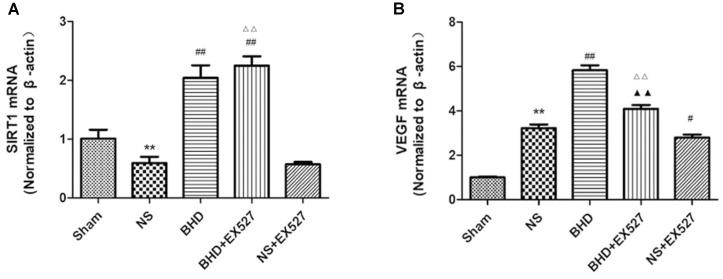
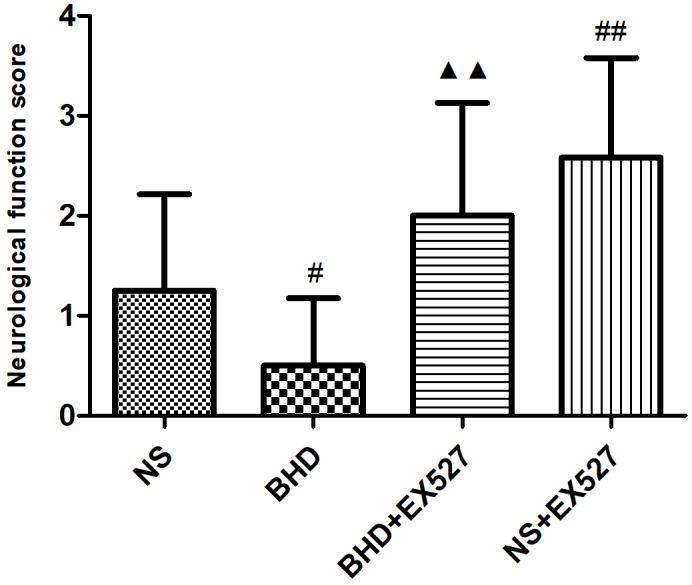
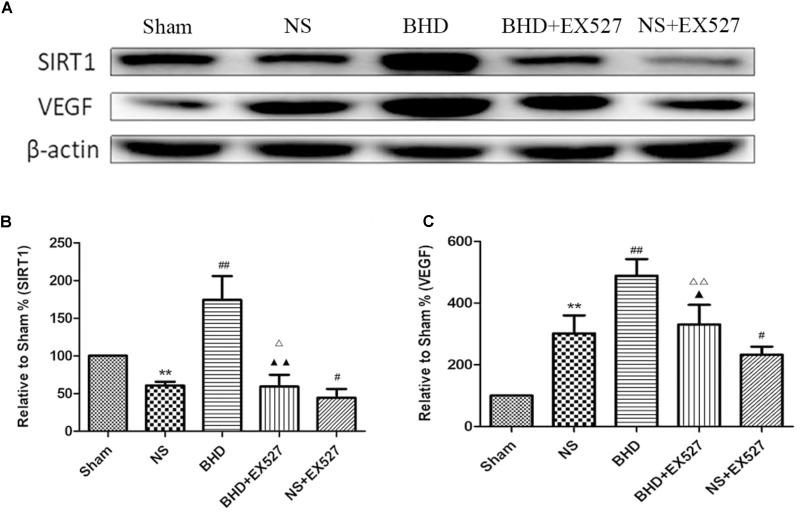
Ischemia stroke is known as the major cause of morbidity and mortality. Buyang Huanwu Decoction (BHD), a classical traditional Chinese medicine (TCM) formula, has been used to prevent and treat stoke for hundreds of years. The purpose of present study is to investigate the effects of BHD on angiogenesis in rats after cerebral ischemia/reperfusion (I/R) injury targeting Silent information regulator 1 (SIRT1) / Vascular endothelial growth factor (VEGF) pathway. The cerebral I/R injury model was induced by middle cerebral artery occlusion (MCAO). Adult Sprag-Dawley (SD) rats were randomly divided into five groups: sham group, normal saline (NS) group, BHD group, BHD+EX527 (SIRT1 specific inhibitor) group, and NS+EX527 group. Each group was divided into the subgroups according to 1, 3, 7, or 14 days time-point after cerebral ischemia/reperfusion, respectively. Neurological function score (NFS) was evaluated by the Rogers scale; microvascular density (MVD) in brain tissue around infarction area was observed by immunofluorescence; and the expression of SIRT1 and VEGF was assessed by Western Blot and Quantitative Real-time-PCR. BHD can significantly improve NFS ( < 0.05), increase the MVD in the boundary ischemic area ( < 0.01) and elevate the expression of protein and mRNA of SIRT1 and VEGF following I/R injury ( < 0.01). In contrast, treatment with EX527 reversed the BHD-induced improvements in NFS ( < 0.01) and decreased the MVD ( < 0.01) and the expression of SIRT1 and VEGF ( < 0.05). BHD exerts neuroprotection targeting angiogenesis through the up-regulation of SIRT1/VEGF pathway against cerebral ischemic injury in rats.
缺血性中风是发病率和死亡率的主要原因。补阳还五汤(BHD)是一种经典的中药配方,数百年来一直用于预防和治疗中风。本研究的目的是探讨补阳还五汤对脑缺血/再灌注(I/R)损伤大鼠血管生成的影响,其作用靶点为沉默信息调节因子1(SIRT1)/血管内皮生长因子(VEGF)通路。采用大脑中动脉闭塞(MCAO)法制备脑I/R损伤模型。将成年Sprag-Dawley(SD)大鼠随机分为五组:假手术组、生理盐水(NS)组、补阳还五汤组、补阳还五汤+EX527(SIRT1特异性抑制剂)组和NS+EX527组。每组再根据脑缺血/再灌注后1、3、7或14天的时间点分为亚组。采用Rogers量表评估神经功能评分(NFS);通过免疫荧光观察梗死灶周围脑组织的微血管密度(MVD);采用蛋白质印迹法和定量实时聚合酶链反应评估SIRT1和VEGF的表达。补阳还五汤可显著改善NFS(<0.05),增加缺血边界区的MVD(<0.01),并提高I/R损伤后SIRT1和VEGF的蛋白及mRNA表达(<0.01)。相比之下,EX527治疗可逆转补阳还五汤诱导的NFS改善(<0.01),降低MVD(<0.01)以及SIRT1和VEGF的表达(<0.05)。补阳还五汤通过上调SIRT1/VEGF通路对大鼠脑缺血损伤发挥靶向血管生成的神经保护作用。



 Zotero 插件