Pan Xiongfeng, Kaminga Atipatsa C, Wen Shi Wu, Liu Aizhong
Department of Epidemiology and Health Statistics, Xiangya School of Public Health, Central South University, Changsha, China.
Department of Mathematics and Statistics, Mzuzu University, Mzuzu, Malawi.
Front Mol Neurosci. 2018 Dec 4;11:450. doi: 10.3389/fnmol.2018.00450. eCollection 2018.
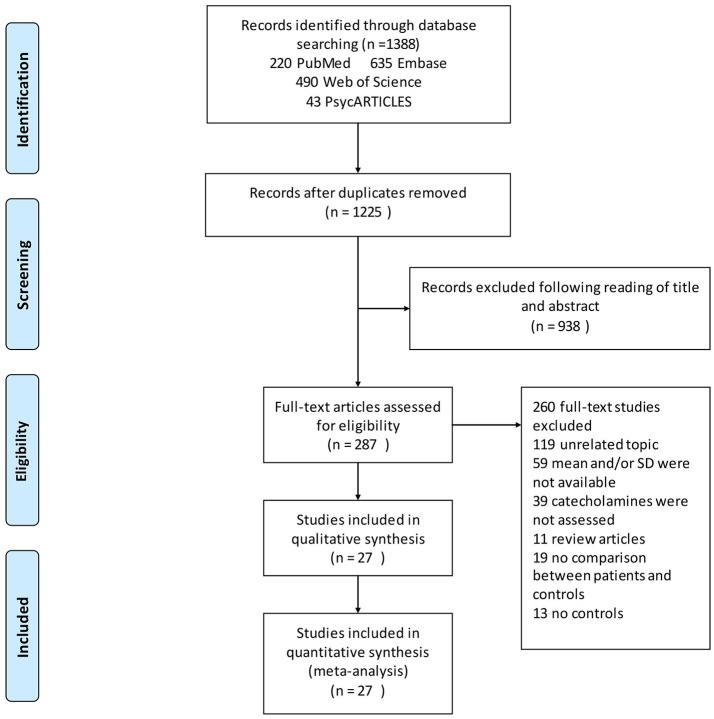
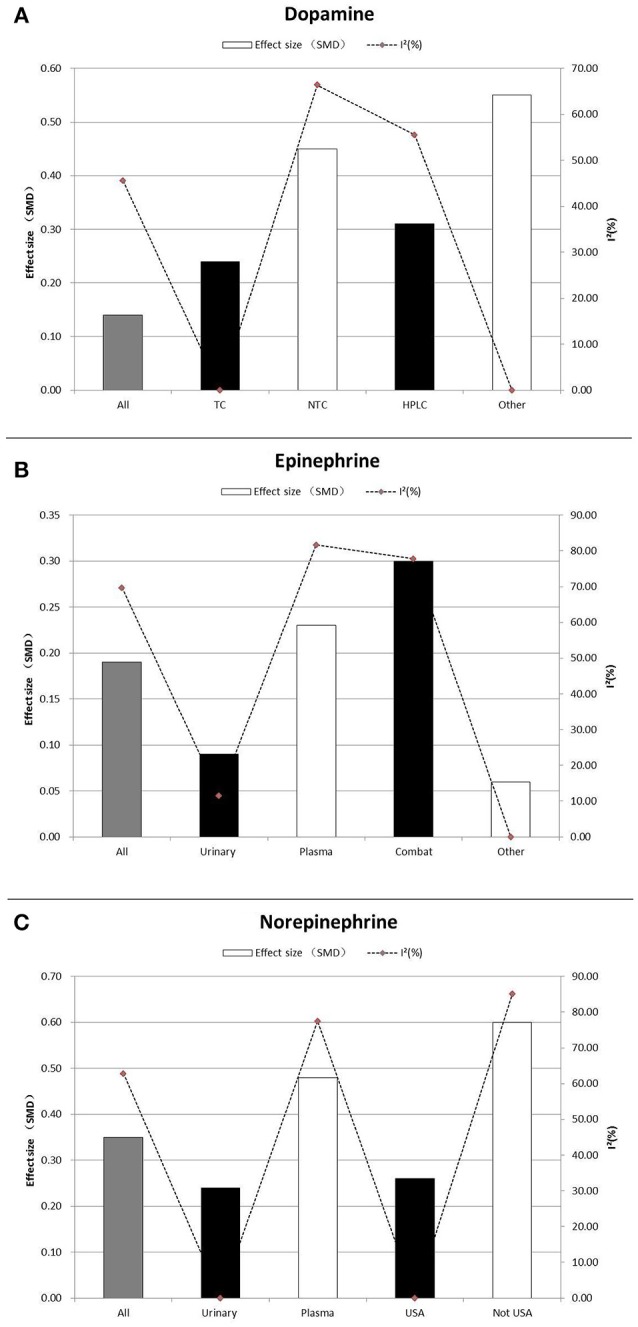
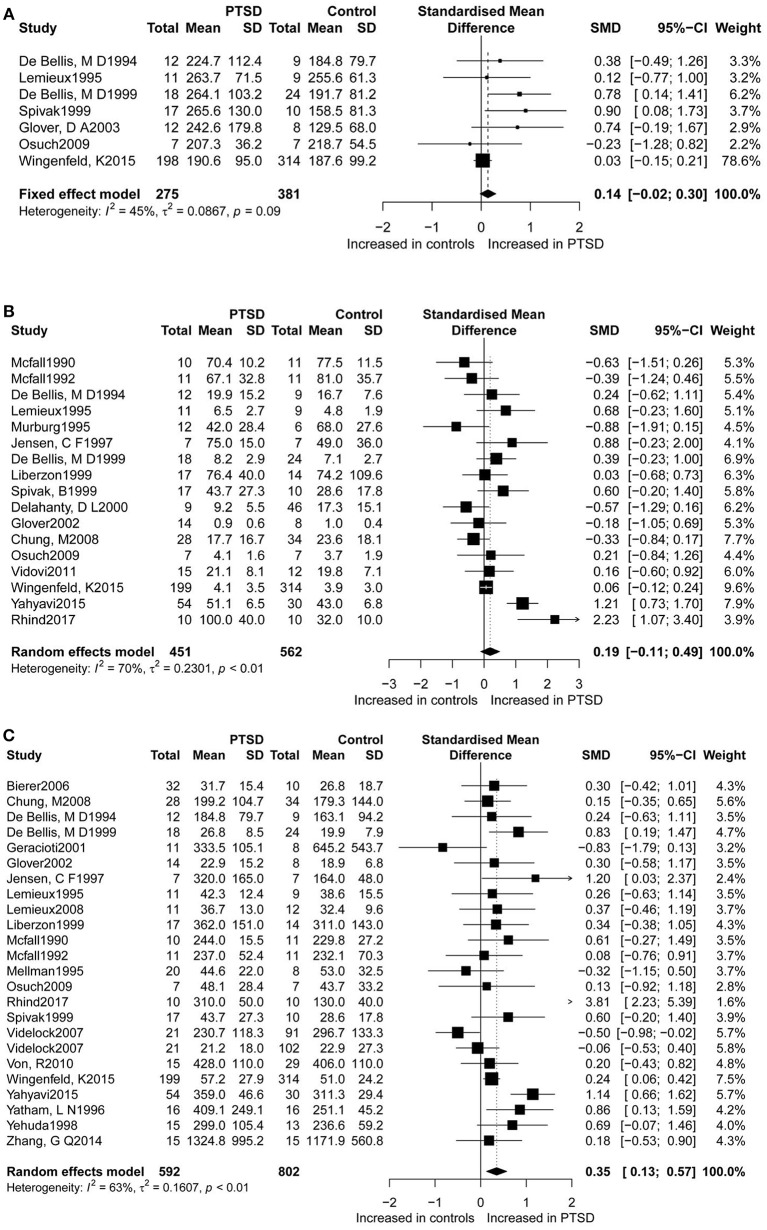
Studies on the association between post-traumatic stress disorder (PTSD) and levels of catecholamines have yielded inconsistent results. The aim of this study was to conduct a systematic review and meta-analysis to assess whether concentrations of the catecholamines dopamine, norepinephrine, and epinephrine are associated with PTSD. This study searched relevant articles in the following databases: PubMed, Embase, Web of Science, and Psyc-ARTICLES. Each database was searched from its inception to September, 2018. Data related to catecholamine concentrations were extracted for patients with PTSD and the controls to calculate standardized mean differences and to evaluate effect sizes. A meta-analysis was then performed to compare the concentration of each catecholamine between the two groups in blood and/or urine samples. Heterogeneity was quantified using and its significance was tested using the Q statistics. Subgroup analyses of the types of controls, PTSD assessment tools, and assayed methods used in the studies were performed to explore sources of heterogeneity among studies. Random-effects models were used to combine results from selected studies. A total of 1,388 articles were identified, of which 27 were included in the final analysis. Heterogeneity was high; hence random-effects models were used to combine results of selected studies. Results revealed significantly higher norepinephrine levels in people with PTSD than in the controls [standardized mean difference (SMD) = 0.35, 95% confidence interval (CI): 0.13 to 0.57, = 0.002]. No difference was found in dopamine and epinephrine concentrations between the two groups. Elevated norepinephrine levels may be an important indicator for PTSD.
关于创伤后应激障碍(PTSD)与儿茶酚胺水平之间关联的研究结果并不一致。本研究的目的是进行一项系统评价和荟萃分析,以评估儿茶酚胺多巴胺、去甲肾上腺素和肾上腺素的浓度是否与PTSD相关。本研究在以下数据库中检索相关文章:PubMed、Embase、Web of Science和Psyc-ARTICLES。每个数据库从其创建至2018年9月进行检索。提取PTSD患者和对照组与儿茶酚胺浓度相关的数据,以计算标准化均数差并评估效应量。然后进行荟萃分析,比较两组血液和/或尿液样本中每种儿茶酚胺的浓度。使用I²量化异质性,并使用Q统计量检验其显著性。对研究中使用的对照类型、PTSD评估工具和测定方法进行亚组分析,以探索研究间异质性的来源。采用随机效应模型合并所选研究的结果。共识别出1388篇文章,其中27篇纳入最终分析。异质性较高;因此使用随机效应模型合并所选研究的结果。结果显示,PTSD患者的去甲肾上腺素水平显著高于对照组[标准化均数差(SMD)=0.35,95%置信区间(CI):0.13至0.57,P=0.002]。两组之间的多巴胺和肾上腺素浓度未发现差异。去甲肾上腺素水平升高可能是PTSD的一个重要指标。