Sato Kimi, Kumar Arnav, Krishnaswamy Amar, Mick Stephanie, Desai Milind Y, Griffin Brian P, Kapadia Samir R, Popović Zoran B
Department of Cardiovascular Medicine, Heart and Vascular Institute, Cleveland Clinic, Cleveland, Ohio.
Clin Cardiol. 2019 Feb;42(2):270-276. doi: 10.1002/clc.23138. Epub 2018 Dec 31.
We aimed to assess longitudinal changes of B-type natriuretic peptide (BNP) in aortic stenosis (AS) patients treated by transcatheter aortic valve replacement (TAVR).
From our TAVR database, we identified 193 consecutive patients with severe symptomatic AS who underwent TAVR and were prospectively followed using serial BNP levels and echocardiography. Patients were divided into subgroups according to type of left ventricular (LV) remodeling as having normal LV mass and relative wall thickness, or showing concentric remodeling (CR), concentric hypertrophy (CH), and eccentric hypertrophy (EH).
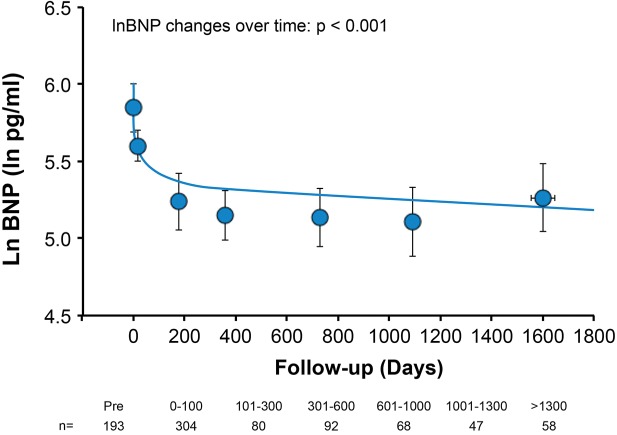
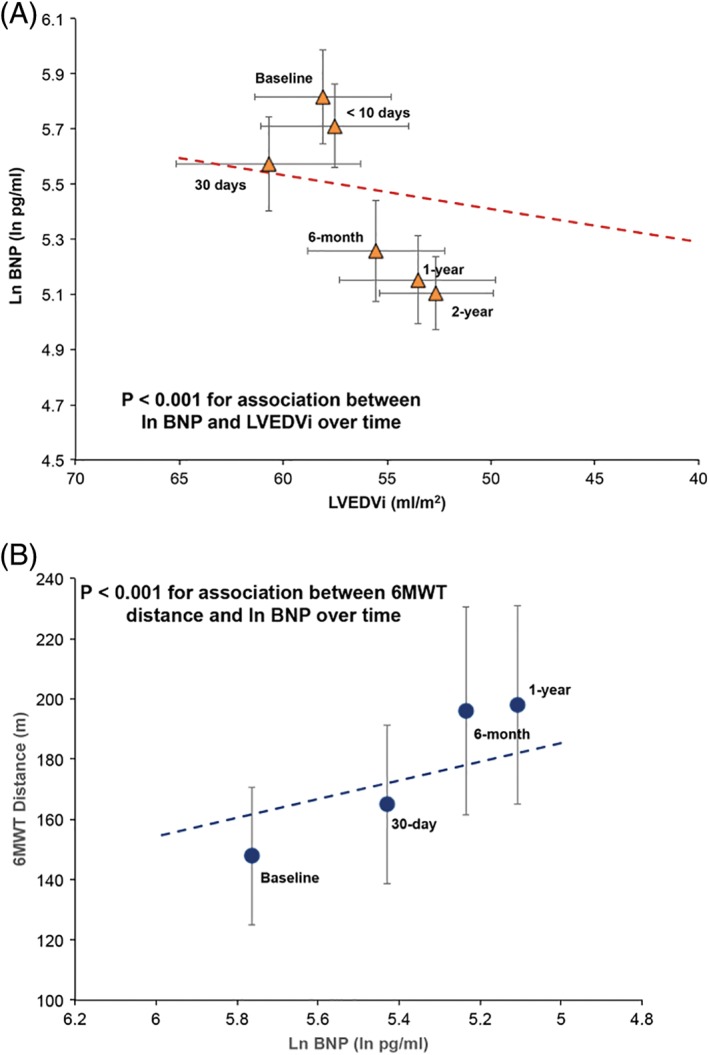
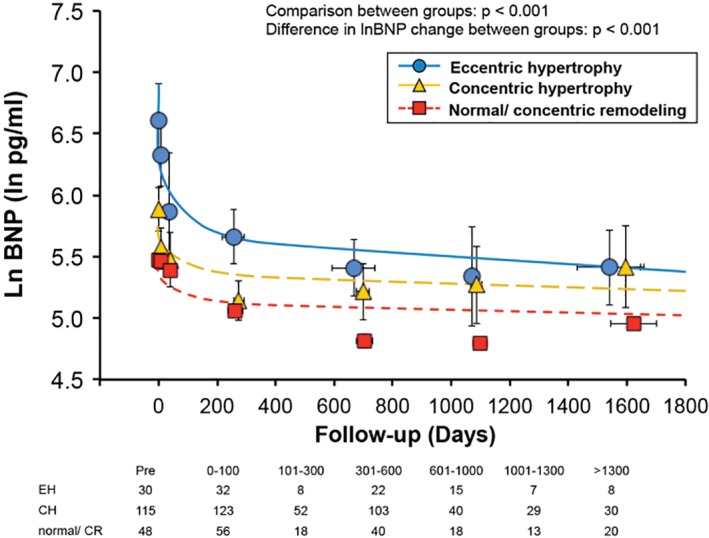
At baseline, 30 patients (16%) had EH, 115 (60%) had CH, 37 (19%) had CR, and 11 (6%) had normal LV geometry. After TAVR, BNP decreased in the first 30 days, with further improvement during follow-up. Patients with EH had higher BNP at baseline (P < 0.01) and a greater subsequent decrease (P < 0.001). During the median follow-up of 1331 days (interquartile range: 632-1678), 119 (62%) patients died. BNP showed a time-dependent association with all-cause mortality both in a univariable (hazards ratio [HR] 1.24, 95% confidence interval [CI]: 1.04-1.47, P = 0.017), and in a multivariable model with Society of Thoracic Surgeons score and baseline BNP forced into the analysis (HR 1.32, 95% CI: 1.001-1.73, P = 0.049). Elevated BNP was associated with a larger LV end-diastolic volume index (P < 0.001) and shorter 6-minute walk test distance (P = 0.013) throughout follow-up.
In patients with AS, BNP was associated with LV remodeling phenotypes and functional status before and after TAVR. Elevated BNP levels were associated with poor prognosis.
我们旨在评估经导管主动脉瓣置换术(TAVR)治疗的主动脉瓣狭窄(AS)患者中B型利钠肽(BNP)的纵向变化。
从我们的TAVR数据库中,我们确定了193例连续的重度症状性AS患者,他们接受了TAVR治疗,并使用连续的BNP水平和超声心动图进行前瞻性随访。根据左心室(LV)重塑类型,将患者分为具有正常LV质量和相对壁厚的亚组,或表现为向心性重塑(CR)、向心性肥厚(CH)和离心性肥厚(EH)的亚组。
基线时,30例患者(16%)有EH,115例(60%)有CH,37例(19%)有CR,11例(6%)LV几何形状正常。TAVR后,BNP在最初30天内下降,随访期间进一步改善。EH患者基线时BNP较高(P < 0.01),随后下降幅度更大(P < 0.001)。在1331天的中位随访期(四分位间距:632 - 1678天)内,119例(62%)患者死亡。BNP在单变量分析(风险比[HR] 1.24,95%置信区间[CI]:1.04 - 1.47,P = 0.017)和将胸外科医师协会评分和基线BNP纳入分析的多变量模型中(HR 1.32,95% CI:1.001 - 1.73,P = 0.049)均显示与全因死亡率存在时间依赖性关联。在整个随访过程中,BNP升高与更大的LV舒张末期容积指数(P < 0.001)和更短的6分钟步行试验距离(P = 0.013)相关。
在AS患者中,BNP与TAVR前后的LV重塑表型和功能状态相关。BNP水平升高与预后不良相关。