The School of Biomedical Sciences, Institute of Health and Biomedical Innovation, Queensland University of Technology, Kelvin Grove, Queensland, Australia.
Translational Research Institute, Brisbane, Queensland, Australia.
Cancer Med. 2018 Dec;7(12):5910-5919. doi: 10.1002/cam4.1832. Epub 2018 Nov 22.
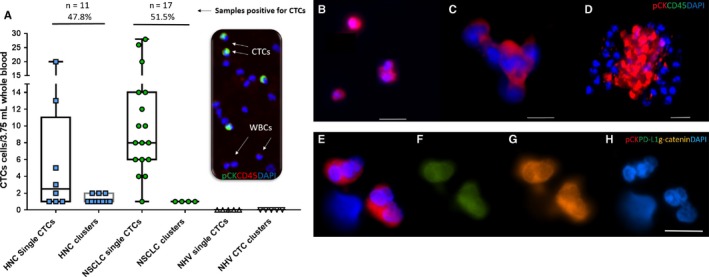
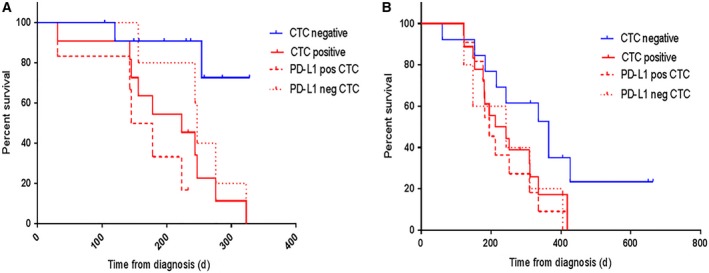
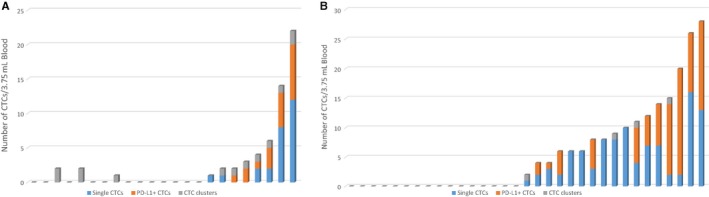
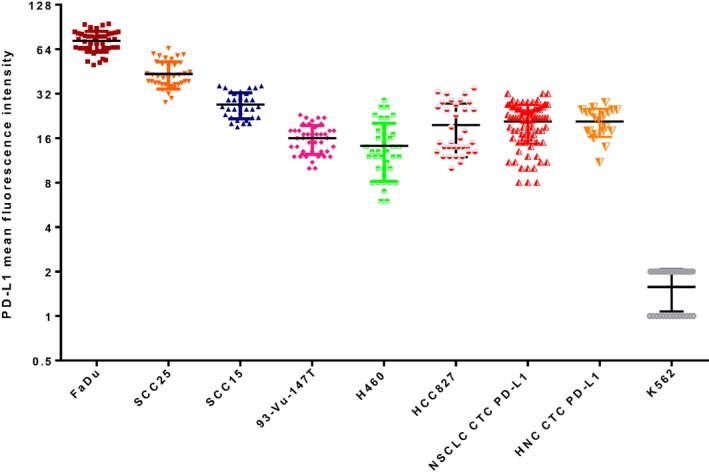
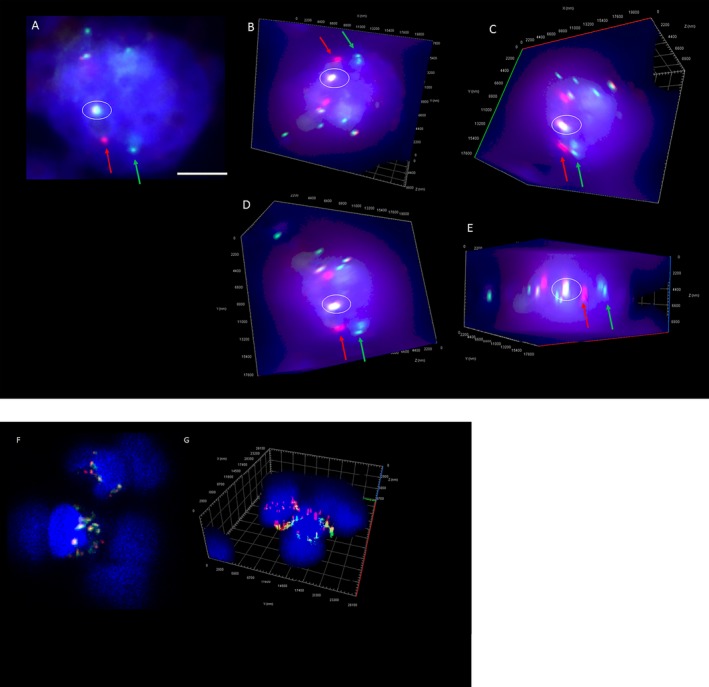
Tumor biopsy is the gold standard for the assessment of clinical biomarkers for treatment. However, tumors change dynamically in response to therapy, and there remains a need for a more representative biomarker that can be assayed over the course of treatment. Circulating tumor cells (CTCs) may provide clinically important and comprehensive tumoral information that is predictive of treatment response and outcome. Blood samples were processed for CTCs from 56 patients using the ClearCell FX system. Captured cells were phenotyped for CTC clusters and markers for immunotherapy (PD-L1) CTC chromosomal architecture (ALK, EGFR). CTCs were isolated in 11/23 (47.8%) of head and neck cancer (HNC) patients and 17/33 (51.5%) of non-small-cell lung cancer (NSCLC) patients. CTCs were determined to be PD-L1-positive in 6/11 (54.4%) HNC and 11/17 (64.7%) NSCLC cases, respectively. 3D chromosomal DNA FISH for ALK and EGFR molecular targets showed better resolution than in 2D when imaging CTCs. HNC CTC-positive patients had shorter progression-free survival (PFS) (hazard ratio[HR]: 4.946; 95% confidence internal[CI]:1.571-15.57; P = 0.0063), and PD-L1-positive CTCs were found to be significantly associated with worse outcome ([HR]:5.159; 95% [CI]:1.011-26.33; P = 0.0485). In the advanced stage NSCLC patient cohort, PFS was not found to be associated with CTCs prior to therapy ([HR]:2.246; 95% [CI]:0.9565-5.273; P = 0.0632), nor the presence of PD-L1 expression ([HR]:1.646; 95% [CI]:0.5128-5.283; P = 0.4023). This study demonstrated that CTCs are predictive of poorer outcomes in HNC and provides distinct and separate utility for CTCs in HNC and NSCLC, which may be more representative of the disease burden and overall survival than the parameters used to measure them.
肿瘤活检是评估治疗临床生物标志物的金标准。然而,肿瘤在治疗过程中会发生动态变化,因此仍然需要一种更具代表性的生物标志物,可以在治疗过程中进行检测。循环肿瘤细胞(CTC)可能提供具有临床意义且全面的肿瘤信息,这些信息可预测治疗反应和结果。使用 ClearCell FX 系统从 56 名患者的血液样本中处理 CTC。对捕获的细胞进行 CTC 簇和免疫治疗标志物(PD-L1)的表型分析,以及 CTC 染色体结构(ALK、EGFR)。在 23 名头颈部癌(HNC)患者中有 11 名(47.8%)和 33 名非小细胞肺癌(NSCLC)患者中有 17 名(51.5%)分离出 CTC。在 11 名 HNC 患者中有 6 名(54.4%)和 17 名 NSCLC 患者中有 11 名(64.7%)被确定为 PD-L1 阳性。与 2D 成像相比,3D 染色体 DNA FISH 用于 ALK 和 EGFR 分子靶点的检测分辨率更好。HNC CTC 阳性患者的无进展生存期(PFS)更短(风险比[HR]:4.946;95%置信区间[CI]:1.571-15.57;P=0.0063),并且 PD-L1 阳性 CTC 与更差的预后显著相关([HR]:5.159;95% CI:1.011-26.33;P=0.0485)。在晚期 NSCLC 患者队列中,治疗前 CTC 与 PFS 无关([HR]:2.246;95% CI:0.9565-5.273;P=0.0632),PD-L1 表达也与 PFS 无关([HR]:1.646;95% CI:0.5128-5.283;P=0.4023)。这项研究表明,CTC 可预测 HNC 患者的不良结局,并为 HNC 和 NSCLC 中的 CTC 提供独特且独立的效用,与用于测量 CTC 的参数相比,这可能更能代表疾病负担和总生存期。