Department of Ophthalmology, Zhejiang Provincial People's Hospital, People's Hospital of Hangzhou Medical College, Hangzhou, Zhejiang 310014, P.R. China.
Department of Ophthalmology, The Second Hospital of Jilin University, Changchun, Jilin 130041, P.R. China.
Int J Mol Med. 2019 Feb;43(2):936-944. doi: 10.3892/ijmm.2018.4027. Epub 2018 Dec 12.
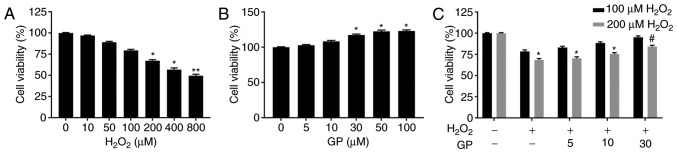
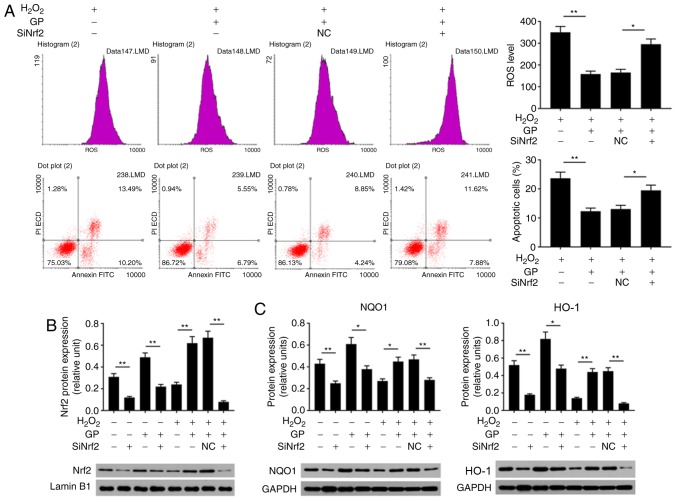
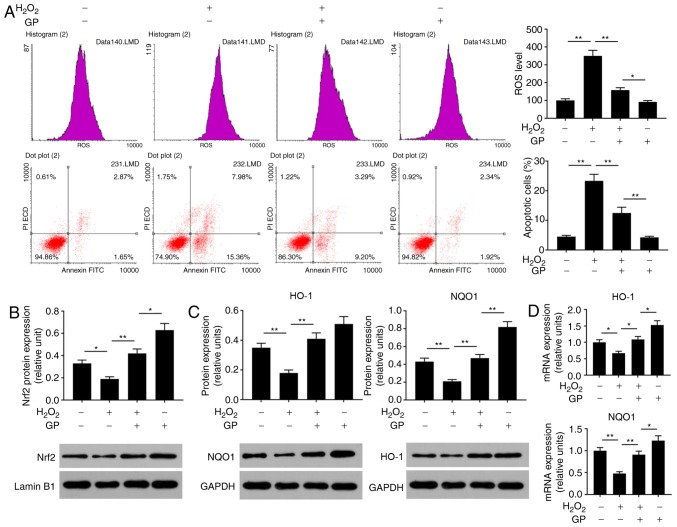
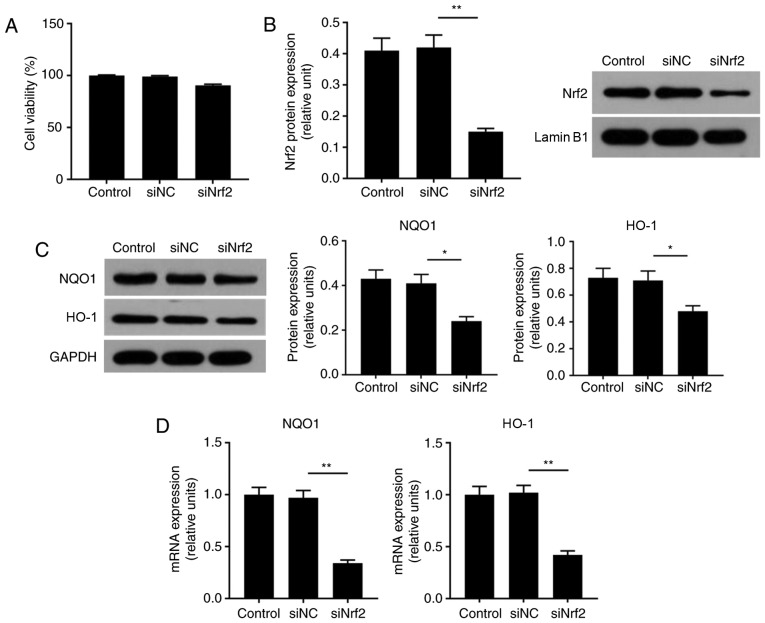
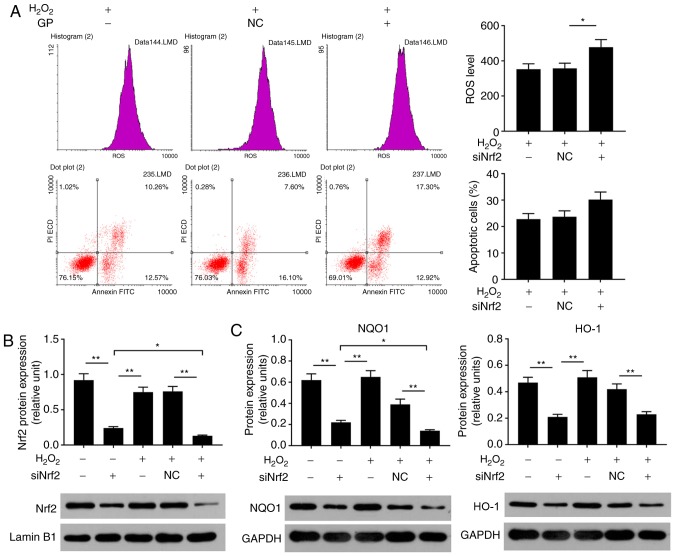
Oxidative stress serves a vital function in the pathogenesis of age‑related macular degeneration (AMD); genipin (GP) possesses antioxidative properties. The present study aimed to investigate the effects of GP on retinal pigment epithelial (RPE) cells induced by H2O2 and the underlying mechanism. ARPE‑19 cells were subjected to H2O2 treatment to induce oxidative damage. Cell viability was determined via an MTT assay. Reactive oxygen species (ROS) levels and cell apoptosis were detected by flow cytometry. Nuclear factor‑erythroid 2‑related factor‑2 (Nrf2) signaling‑associated and the expression of apoptosis‑associated factors were measured using reverse transcription‑quantitative polymerase chain reaction assay and western blotting. The results revealed that 200 µM H2O2 and 30 µM GP were determined to be the optimal concentrations for subsequent experimentation. GP reversed the inhibitory effects of H2O2 by promoting cell viability, attenuating ROS accumulation and cell apoptosis, and increased the expression of Nrf2, heme oxygenase‑1 (HO‑1) and NAD(P)H: Quinine oxidoreductase 1 (NQO1); Nrf2 silencing inhibited HO‑1 and NQO1 expression. In addition, Nrf2 silencing enhanced the effects of H2O2 by promoting ROS production and cell apoptosis. Compared with H2O2, Nrf2 silencing further decreased the expression levels of B‑cell lymphoma‑2 (Bcl‑2), but increased that of Bcl‑2‑associated X protein and cleaved‑caspase‑3. The results of the present study revealed that Nrf2 silencing attenuated the protective effects of GP on H2O2‑induced injury in ARPE‑19 cells by promoting apoptosis and oxidation. Collectively, GP attenuated oxidative damage induced by H2O2 in ARPE‑19 cells. Furthermore, the molecular mechanism may be associated with the Nrf2 signaling pathway. The findings of the present study nay provide insight into a potential therapeutic agent for the treatment of AMD.
氧化应激在年龄相关性黄斑变性(AMD)的发病机制中起着至关重要的作用;京尼平(GP)具有抗氧化作用。本研究旨在探讨 GP 对 H2O2诱导的视网膜色素上皮(RPE)细胞的作用及其机制。将 ARPE-19 细胞用 H2O2 处理以诱导氧化损伤。通过 MTT 测定法测定细胞活力。通过流式细胞术检测活性氧(ROS)水平和细胞凋亡。使用逆转录-定量聚合酶链反应(RT-qPCR)测定和蛋白质印迹法测定核因子-红细胞 2 相关因子-2(Nrf2)信号相关和凋亡相关因子的表达。结果表明,确定 200µM H2O2 和 30µM GP 为后续实验的最佳浓度。GP 通过促进细胞活力、减轻 ROS 积累和细胞凋亡来逆转 H2O2 的抑制作用,增加 Nrf2、血红素加氧酶-1(HO-1)和 NAD(P)H:醌氧化还原酶 1(NQO1)的表达;Nrf2 沉默抑制 HO-1 和 NQO1 的表达。此外,Nrf2 沉默通过促进 ROS 产生和细胞凋亡增强了 H2O2 的作用。与 H2O2 相比,Nrf2 沉默进一步降低了 B 细胞淋巴瘤-2(Bcl-2)的表达水平,但增加了 Bcl-2 相关 X 蛋白和裂解的 caspase-3 的表达。本研究结果表明,Nrf2 沉默通过促进细胞凋亡和氧化来减弱 GP 对 H2O2 诱导的 ARPE-19 细胞损伤的保护作用。综上所述,GP 减轻了 H2O2 诱导的 ARPE-19 细胞氧化损伤。此外,其分子机制可能与 Nrf2 信号通路有关。本研究的结果可能为 AMD 的治疗提供一种潜在的治疗药物。