Foye Una, Hazlett D E, Irving Pauline
Centre of Psychiatry, Queen Mary University of London, London, UK.
Centre for Mental Health Research, School of Health Sciences, City, University of London, Northampton Square, London, EC1V 0HB, UK.
Eat Weight Disord. 2019 Apr;24(2):299-306. doi: 10.1007/s40519-018-0629-4. Epub 2018 Dec 19.
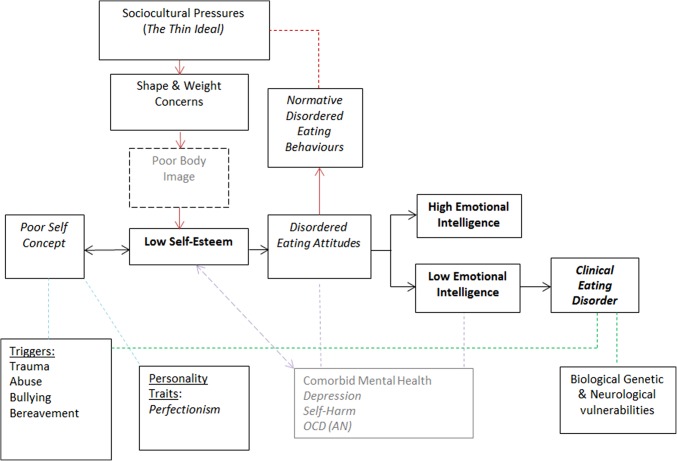
This study aims to explore the role of Emotional Intelligence (EI) and specific facets that may underpin the aetiology of disordered eating attitudes and behaviours, as a means to understand what aspects of these deficits to target within treatments.
Participants were recruited from the UK and Ireland. Among the sample of 355 participants, 84% were women and 16% were men. Regarding age, 59% were between 18 and 29, 30% were between 30 and 49, and 11% were 50 or older. Using a cross-sectional design, participants completed the Schutte Self-Report Emotional Intelligence Test to measure levels of trait EI and The Eating Attitudes Test (EAT-26) as a measure of eating disorder risk and the presence of disordered eating attitudes.
EAT-26 scores were negatively correlated with total EI scores and with the following EI subscales: appraisal of own emotions, regulation of emotions, utilisation of emotions, and optimism. Also, compared to those without an eating disorder history, participants who reported having had an eating disorder had significantly lower total EI scores and lower scores on four EI subscales: appraisal of others emotions, appraisal of own emotions, regulation of emotions, and optimism.
Considering these findings, EI (especially appraisal of own emotions, regulation of emotions, and optimism) may need to be addressed by interventions and treatments for eating disorders.
Level V, descriptive cross-sectional study.
本研究旨在探讨情商(EI)及其特定方面在饮食失调态度和行为病因学中可能所起的作用,以此作为了解在治疗中应针对这些缺陷的哪些方面的一种手段。
参与者从英国和爱尔兰招募。在355名参与者的样本中,84%为女性,16%为男性。在年龄方面,59%在18至29岁之间,30%在30至49岁之间,11%为50岁及以上。采用横断面设计,参与者完成了舒特自我报告情商测试以测量特质情商水平,并完成了饮食态度测试(EAT - 26)以衡量饮食失调风险和饮食失调态度的存在情况。
EAT - 26得分与总情商得分以及以下情商子量表呈负相关:对自身情绪的评估、情绪调节、情绪利用和乐观。此外,与没有饮食失调病史的参与者相比,报告有饮食失调病史的参与者总情商得分显著更低,并且在四个情商子量表上得分也更低:对他人情绪的评估、对自身情绪的评估、情绪调节和乐观。
考虑到这些发现,对于饮食失调的干预和治疗可能需要关注情商(尤其是对自身情绪的评估、情绪调节和乐观)。
V级,描述性横断面研究。