Fujian Key Laboratory for Translational Research in Cancer and Neurodegenerative Diseases, Institute for Translational Medicine, School of Basic Medical Sciences, Fujian Medical University, Fuzhou, Fujian 350122, China.
Division of Translational Therapeutics, Department of Medicine, Beth Israel Deaconess Medical Center, Harvard Medical School, Boston, MA 02215, United States.
Recent Pat Anticancer Drug Discov. 2019;14(2):144-157. doi: 10.2174/1574892814666181218170257.
Death-Associated Protein Kinase 1 (DAPK1) plays an important role in apoptosis, tumor suppression and neurodegeneration including Alzheimer's Disease (AD).
This review will describe the diverse roles of DAPK1 in the development of cancer and AD, and the current status of drug development targeting DAPK1-based therapies.
Reports of DAPK1 regulation, function and substrates were analyzed using genetic DAPK1 manipulation and chemical DAPK1 modulators.
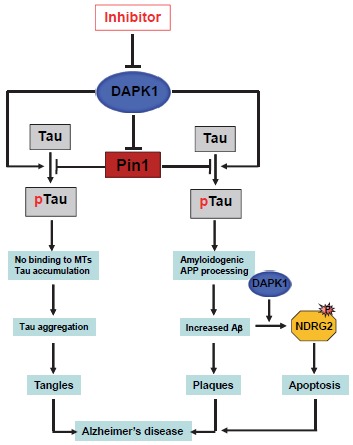
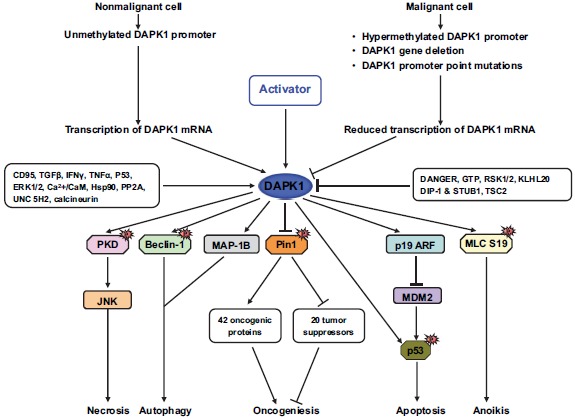
DAPK1 expression and activity are deregulated in cancer and AD. It is down-regulated and/or inactivated by multiple mechanisms in many human cancers, and elicits a protective effect to counteract numerous death stimuli in cancer, including activation of the master regulator Pin1. Moreover, loss of DAPK1 expression has correlated strongly with tumor recurrence and metastasis, suggesting that lack of sufficient functional DAPK1 might contribute to cancer. In contrast, DAPK1 is highly expressed in the brains of most human AD patients and has been identified as one of the genetic factors affecting susceptibility to late-onset AD. The absence of DAPK1 promotes efficient learning and better memory in mice and prevents the development of AD by acting on many key proteins including Pin1 and its downstream targets tau and APP. Recent patents show that DAPK1 modulation might be used to treat both cancer and AD.
DAPK1 plays a critical role in diverse physiological processes and importantly, its deregulation is implicated in the pathogenesis of either cancer or AD. Therefore, manipulating DAPK1 activity and/or expression may be a promising therapeutic option for cancer or AD.
死亡相关蛋白激酶 1(DAPK1)在细胞凋亡、肿瘤抑制和神经退行性变(包括阿尔茨海默病,AD)中发挥重要作用。
本综述将描述 DAPK1 在癌症和 AD 发展中的多种作用,以及基于 DAPK1 的治疗方法的药物开发的现状。
利用基因 DAPK1 操作和化学 DAPK1 调节剂分析 DAPK1 调节、功能和底物的报告。
DAPK1 的表达和活性在癌症和 AD 中失调。在许多人类癌症中,它通过多种机制被下调和/或失活,并且在癌症中对许多死亡刺激产生保护作用,包括主调控因子 Pin1 的激活。此外,DAPK1 表达的缺失与肿瘤复发和转移密切相关,这表明缺乏足够功能的 DAPK1 可能导致癌症。相反,DAPK1 在大多数人类 AD 患者的大脑中高表达,并且已被鉴定为影响迟发性 AD 易感性的遗传因素之一。缺乏 DAPK1 可通过作用于许多关键蛋白(包括 Pin1 及其下游靶标 tau 和 APP)促进小鼠的有效学习和更好的记忆,并预防 AD 的发展。最近的专利表明,DAPK1 调节可能用于治疗癌症和 AD。
DAPK1 在多种生理过程中发挥关键作用,重要的是,其失调与癌症或 AD 的发病机制有关。因此,操纵 DAPK1 的活性和/或表达可能是癌症或 AD 的一种有前途的治疗选择。