da Silva Patricia B, de Freitas Eduardo Sinésio, Solcia Mariana Cristina, de Souza Paula Carolina, da Silva Monize Martins, Batista Alzir Azevedo, Eismann Carlos E, Rolisola Ana Marta C M, Menegário Amauri A, Cardoso Rosilene Fressatti, Chorilli Marlus, Pavan Fernando R
School of Pharmaceutical Sciences, Universidade Estadual Paulista, Araraquara, Brazil.
Department of Chemistry, Universidade Federal de São Carlos, São Carlos, Brazil.
Front Microbiol. 2018 Dec 6;9:2930. doi: 10.3389/fmicb.2018.02930. eCollection 2018.
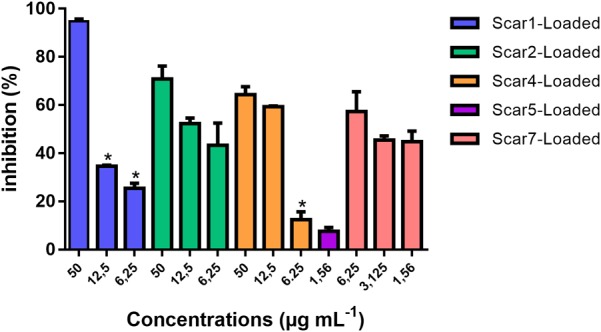
Tuberculosis (TB) is an infectious, airborne disease caused by the bacterium that mainly affects the lungs. Fortunately, tuberculosis is a curable disease, and in recent years, death rates for this disease have decreased. However, the existence of antibiotic-resistant strains and the occurrence of co-infections with human immunodeficiency virus (HIV), have led to increased mortality in recent years. Another area of concern is that one-third of the world's population is currently infected with in its latent state, serving as a potential reservoir for active TB. In an effort to address the failure of current TB drugs, greater attention is being given to the importance of bioinorganic chemistry as an ally in new research into the development of anti-TB drugs. Ruthenium (Ru) is a chemical element that can mimic iron (Fe) in the body. In previous studies involving the following heteroleptic Ru complexes, [Ru(pic)(dppb)(bipy)]PF (SCAR1), [Ru(pic)(dppb)(Me-bipy)]PF (SCAR2), [Ru(pic)(dppb)(phen)]PF (SCAR4), -[Ru(pic)(dppe)]PF (SCAR5), and [Ru(pic)(dppe)(phen)]PF (SCAR7), we observed excellent anti-TB activity, moderate cell-toxicity, and a lack of oral bioavailability in an model of these complexes. Therefore, the objective of this study was to evaluate the toxicity and oral bioavailability of these complexes by loading them into a nanostructured lipid system. The nanostructured lipid system was generated using different ratios of surfactant (soybean phosphatidylcholine, Eumulgin, and sodium oleate), aqueous phase (phosphate buffer with a concentration of 1X and pH 7.4), and oil (cholesterol) to generate a system for the incorporation of Ru(II) compounds. The anti-TB activity of the compounds was determined using a microdilution assay with Resazurin (REMA) against strains of s HRv and clinical isolates resistant. Cytotoxicity assay using J774.A1 cells (ATCC TIB-67) and intra-macrophage activity were performed. The oral bioavailability assay was used to analyze blood collected from female BALB/C mice. Plasma collected from the same mice was analyzed via inductively coupled plasma mass spectrometry (ICP-MS) to quantify the number of Ru ions. The complexes loaded into the nanostructured lipid system maintained activity and toxicity was found to be reduced compared with the compounds that were not loaded. The complexes showed intra-macrophagic activity and were orally bioavailable.
结核病(TB)是一种由细菌引起的传染性空气传播疾病,主要影响肺部。幸运的是,结核病是一种可治愈的疾病,近年来,这种疾病的死亡率有所下降。然而,耐抗生素菌株的存在以及与人类免疫缺陷病毒(HIV)合并感染的发生,导致近年来死亡率上升。另一个令人担忧的领域是,目前世界三分之一的人口处于潜伏感染状态,成为活动性结核病的潜在储存库。为了解决当前结核病药物的疗效不佳问题,生物无机化学作为抗结核病药物开发新研究的盟友,其重要性正受到更多关注。钌(Ru)是一种能在体内模拟铁(Fe)的化学元素。在先前涉及以下杂配钌配合物的研究中,[Ru(pic)(dppb)(bipy)]PF(SCAR1)、[Ru(pic)(dppb)(Me - bipy)]PF(SCAR2)、[Ru(pic)(dppb)(phen)]PF(SCAR4)、-[Ru(pic)(dppe)]PF(SCAR5)和[Ru(pic)(dppe)(phen)]PF(SCAR7),我们在这些配合物的动物模型中观察到了出色的抗结核活性、适度的细胞毒性以及缺乏口服生物利用度。因此,本研究的目的是通过将这些配合物负载到纳米结构脂质系统中来评估它们的毒性和口服生物利用度。使用不同比例的表面活性剂(大豆磷脂酰胆碱、聚山梨酯和油酸钠)、水相(浓度为1X且pH值为7.4的磷酸盐缓冲液)和油(胆固醇)生成纳米结构脂质系统,以构建用于掺入Ru(II)化合物的体系。使用刃天青(REMA)微量稀释法针对敏感的H37Rv菌株和临床分离耐药菌株测定化合物的抗结核活性。使用J774.A1细胞(ATCC TIB - 67)进行细胞毒性测定和巨噬细胞内活性测定。口服生物利用度测定用于分析从雌性BALB/C小鼠采集的血液。通过电感耦合等离子体质谱(ICP - MS)分析从同一小鼠采集的血浆,以定量Ru离子的数量。负载到纳米结构脂质系统中的配合物保持了活性,并且发现与未负载的化合物相比毒性降低。这些配合物表现出巨噬细胞内活性并且具有口服生物利用度。