Kim Hye-Jin, Kim Jin-Woo, Jang Soong-Nang, Kim Kyung Do, Yoo Jun-Il, Ha Yong-Chan
Red Cross College of Nursing, Chung-Ang University, Seoul, Korea.
Department of Orthopaedic Surgery, Eulji Medical Center, Eulji University College of Medicine, Seoul, Korea.
J Bone Metab. 2018 Nov;25(4):267-274. doi: 10.11005/jbm.2018.25.4.267. Epub 2018 Nov 30.
This prospective cohort study used nationwide claims data to investigate the incidence of fall and fragility fractures in association with urinary incontinence (UI) in the elderly, and to compare mortality after fragility fractures in elderly patients with or without incontinence.
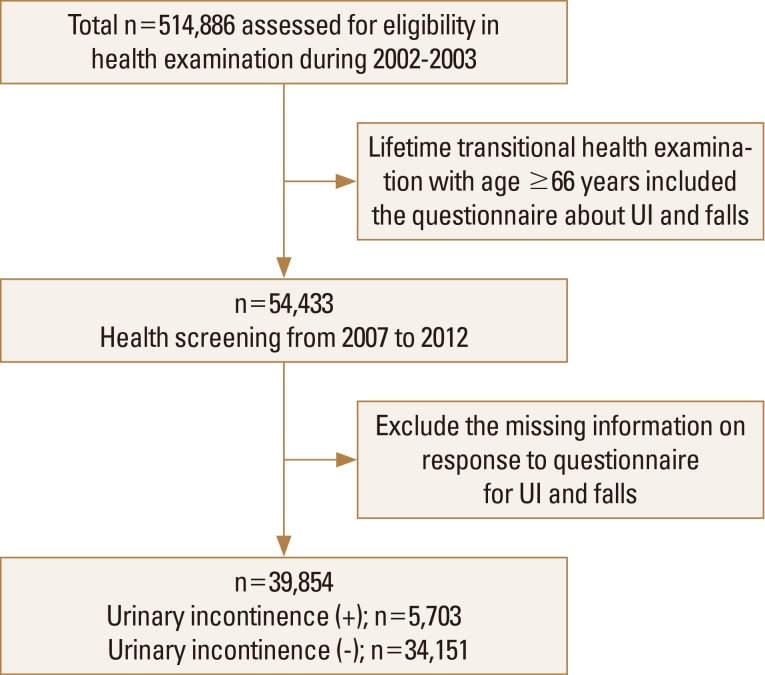
A total of 39,854 Korean adults (age, 66-80 years) who participated in health examinations between 2007 and 2012 and were followed up until 2015 were analyzed. Patient and comparison groups were classified according to the presence or absence of UI. The cumulative incidence of osteoporotic fragility fractures and falls in the 2 groups was assessed and compared. Hazard ratios for fragility fractures were calculated for the risk of UI in association with falls using a Cox proportional hazards model.
Of 39,854 elderly participants, 5,703 were classified in the UI group, while 34,151 were placed in the comparison group. Fall rates were significantly higher (20.8%) in the incontinence group than in the comparison group (4.7%) (<0.001). Women in the incontinence group (13.9%) showed a significantly higher incidence of all types of fragility fractures than those in the comparison group (11.8%) (=0.005). After adjustment for confounders, UI was not a significant risk factor for fragility fractures in men (=0.878) or women (=0.324).
This study demonstrated that elderly women with UI have a significantly higher incidence of osteoporotic fragility fractures. In addition, elderly women are at higher risk for falls.
这项前瞻性队列研究使用全国索赔数据,调查老年人跌倒及脆性骨折与尿失禁(UI)的关联,并比较有无尿失禁的老年脆性骨折患者的死亡率。
分析了2007年至2012年间参加健康检查并随访至2015年的39854名韩国成年人(年龄66 - 80岁)。根据有无尿失禁对患者组和对照组进行分类。评估并比较两组骨质疏松性脆性骨折和跌倒的累积发生率。使用Cox比例风险模型计算与跌倒相关的尿失禁风险导致脆性骨折的风险比。
在39854名老年参与者中,5703人被归类为尿失禁组,34151人被归类为对照组。失禁组的跌倒率(20.8%)显著高于对照组(4.7%)(<0.001)。失禁组女性(13.9%)所有类型脆性骨折的发生率显著高于对照组女性(11.8%)(=0.005)。在对混杂因素进行调整后,尿失禁在男性(=0.878)或女性(=0.324)中并非脆性骨折的显著危险因素。
本研究表明,患有尿失禁的老年女性骨质疏松性脆性骨折的发生率显著更高。此外,老年女性跌倒风险更高。