From Memorial Sloan Kettering Cancer Center and Weill Cornell Medical Center (M.M.G., W.D.T., N.H., N.P.A., R.A.L., Y.M., R.Y.) and Columbia University Vagellos College of Physicians and Surgeons and New York Presbyterian Hospital (L.H.S., G.K.S.), New York, and Northwell Cancer Institute and Cold Spring Harbor Laboratory, Lake Success (R.G.M.) - all in New York; Alliance Statistics and Data Center, Mayo Clinic, Rochester, MN (M.R.M.); Washington University School of Medicine, St. Louis (B.A.V.T.); M.D. Anderson Cancer Center, University of Texas, Houston (V.R.); Mayo Clinic in Florida, Jacksonville (S.A.); Yale University, New Haven, CT (H.A.D.); University Health Network Princess Margaret Cancer Centre, Toronto (A.A.G.); University of Iowa-Holden Comprehensive Cancer Center, Iowa City (M.M.M.); University of Alabama at Birmingham Cancer Center, Birmingham (R.M.C.); Fox Chase Cancer Center, Philadelphia (S.M.); Georgetown University, Lombardi Comprehensive Cancer Center, Washington, DC (M.J.P.); Duke Cancer Institute, Duke University Medical Center, Durham (R.F.R.), and Lineberger Comprehensive Cancer Center, University of North Carolina, Chapel Hill (E.B.) - both in North Carolina; Dayton National Cancer Institute Community Oncology Research Program, Dayton, OH (T.S.); National Cancer Institute, Bethesda, MD (J.J.W.); and the Alliance Statistics and Data Center, Mayo Clinic, Scottsdale, AZ (A.C.D.).
N Engl J Med. 2018 Dec 20;379(25):2417-2428. doi: 10.1056/NEJMoa1805052.
Desmoid tumors (also referred to as aggressive fibromatosis) are connective tissue neoplasms that can arise in any anatomical location and infiltrate the mesentery, neurovascular structures, and visceral organs. There is no standard of care.
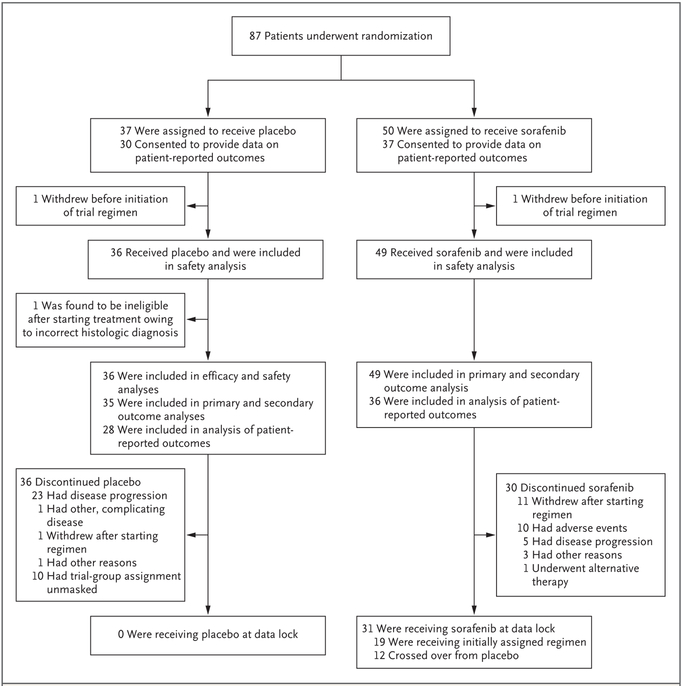
In this double-blind, phase 3 trial, we randomly assigned 87 patients with progressive, symptomatic, or recurrent desmoid tumors to receive either sorafenib (400-mg tablet once daily) or matching placebo. Crossover to the sorafenib group was permitted for patients in the placebo group who had disease progression. The primary end point was investigator-assessed progression-free survival; rates of objective response and adverse events were also evaluated.
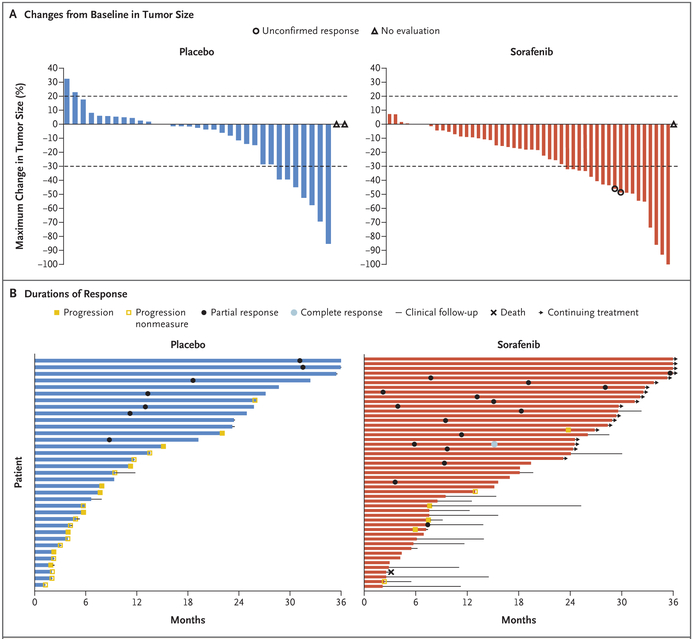
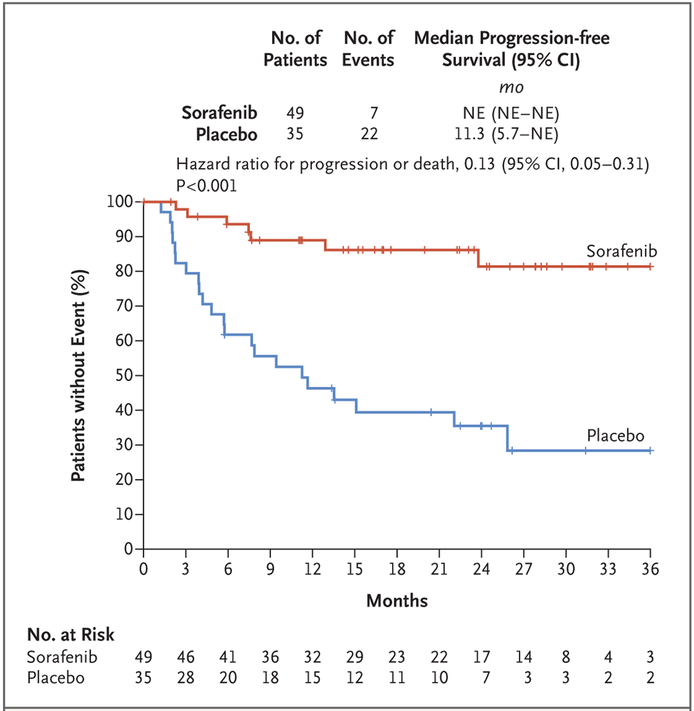
With a median follow-up of 27.2 months, the 2-year progression-free survival rate was 81% (95% confidence interval [CI], 69 to 96) in the sorafenib group and 36% (95% CI, 22 to 57) in the placebo group (hazard ratio for progression or death, 0.13; 95% CI, 0.05 to 0.31; P<0.001). Before crossover, the objective response rate was 33% (95% CI, 20 to 48) in the sorafenib group and 20% (95% CI, 8 to 38) in the placebo group. The median time to an objective response among patients who had a response was 9.6 months (interquartile range, 6.6 to 16.7) in the sorafenib group and 13.3 months (interquartile range, 11.2 to 31.1) in the placebo group. The objective responses are ongoing. Among patients who received sorafenib, the most frequently reported adverse events were grade 1 or 2 events of rash (73%), fatigue (67%), hypertension (55%), and diarrhea (51%).
Among patients with progressive, refractory, or symptomatic desmoid tumors, sorafenib significantly prolonged progression-free survival and induced durable responses. (Funded by the National Cancer Institute and others; ClinicalTrials.gov number, NCT02066181 .).
韧带样纤维瘤(也称为侵袭性纤维瘤病)是一种结缔组织肿瘤,可发生于任何解剖部位,并浸润肠系膜、神经血管结构和内脏器官。目前尚无标准治疗方法。
在这项双盲、3 期临床试验中,我们将 87 例患有进行性、有症状或复发性韧带样纤维瘤的患者随机分为索拉非尼(400mg 片剂,每日一次)或匹配安慰剂组。对于疾病进展的安慰剂组患者,允许交叉至索拉非尼组。主要终点为研究者评估的无进展生存期;客观缓解率和不良事件的发生率也进行了评估。
中位随访 27.2 个月后,索拉非尼组的 2 年无进展生存率为 81%(95%置信区间[CI],69 至 96),安慰剂组为 36%(95%CI,22 至 57)(进展或死亡的风险比,0.13;95%CI,0.05 至 0.31;P<0.001)。在交叉之前,索拉非尼组的客观缓解率为 33%(95%CI,20 至 48),安慰剂组为 20%(95%CI,8 至 38)。在有缓解的患者中,客观缓解的中位时间为索拉非尼组 9.6 个月(四分位距,6.6 至 16.7),安慰剂组 13.3 个月(四分位距,11.2 至 31.1)。客观缓解仍在继续。接受索拉非尼治疗的患者中,最常见的不良事件为 1 级或 2 级皮疹(73%)、疲劳(67%)、高血压(55%)和腹泻(51%)。
在患有进行性、难治性或有症状的韧带样纤维瘤的患者中,索拉非尼显著延长了无进展生存期,并诱导了持久缓解。(由美国国立癌症研究所等资助;ClinicalTrials.gov 编号,NCT02066181)。