Department of Physics, University of California, San Diego, 9500 Gilman Drive, Mail Code 0379, La Jolla, CA, 92093-0379, USA.
Department of Biology, The Catholic University of America, 620 Michigan Ave. NE, Washington, DC, 20064, USA.
Nat Commun. 2018 Dec 21;9(1):5434. doi: 10.1038/s41467-018-07834-2.
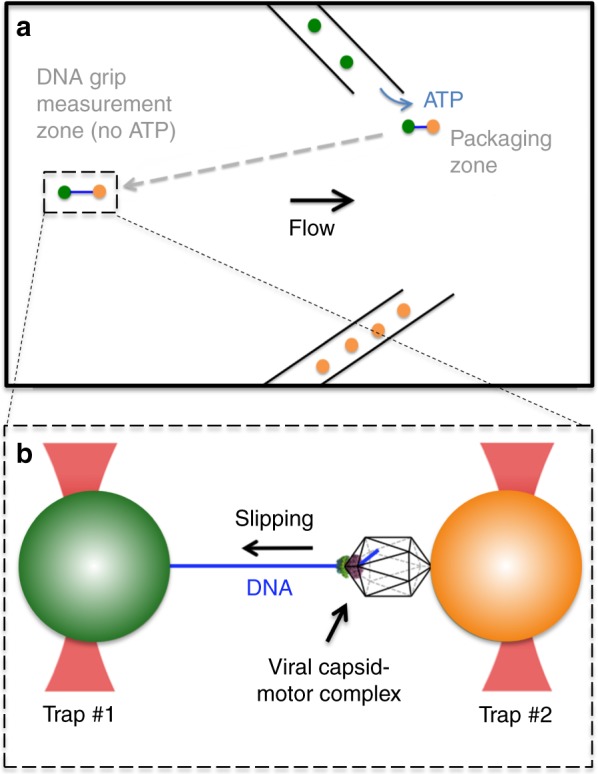
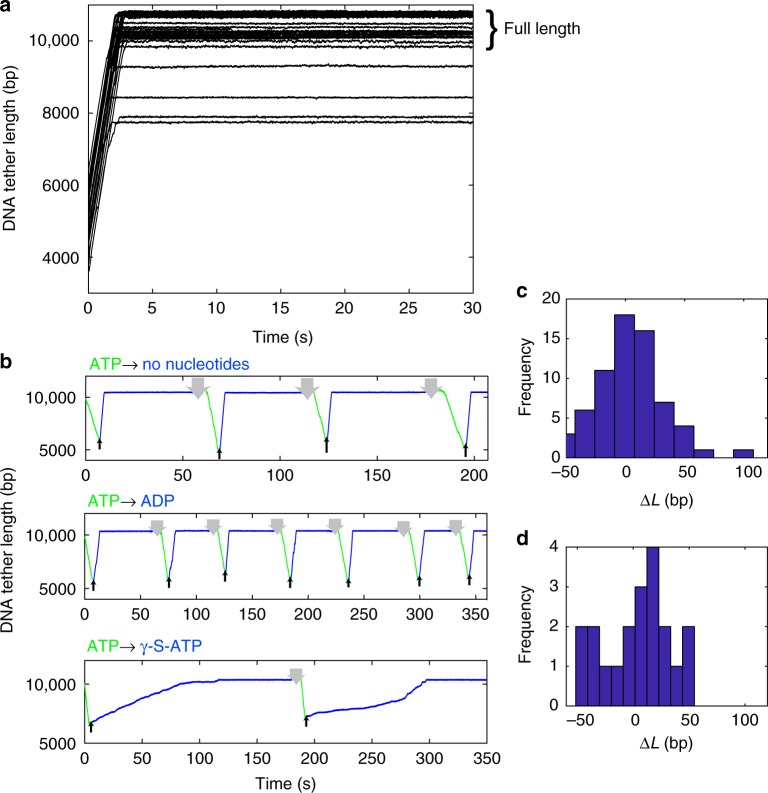
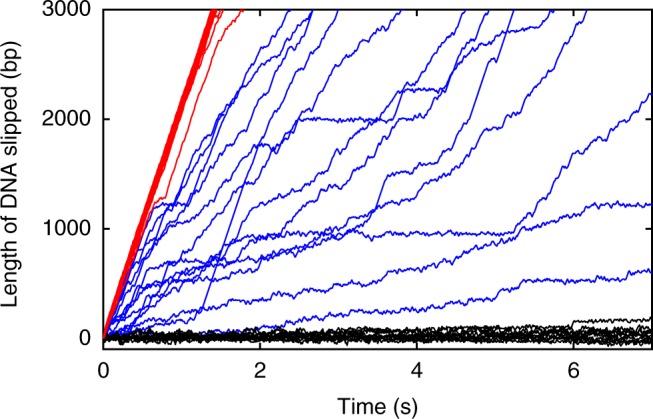
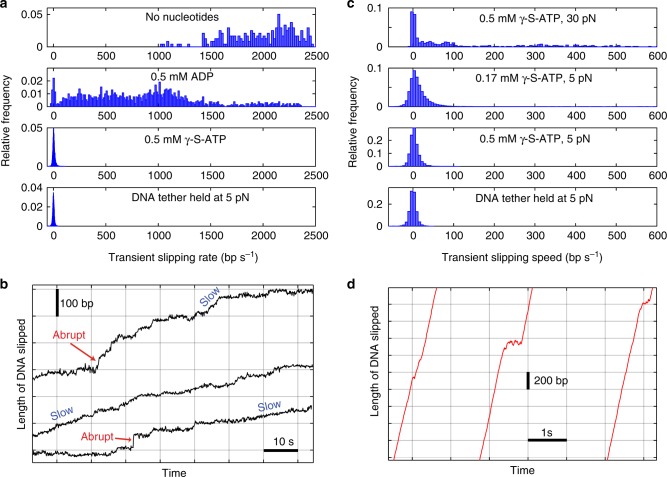
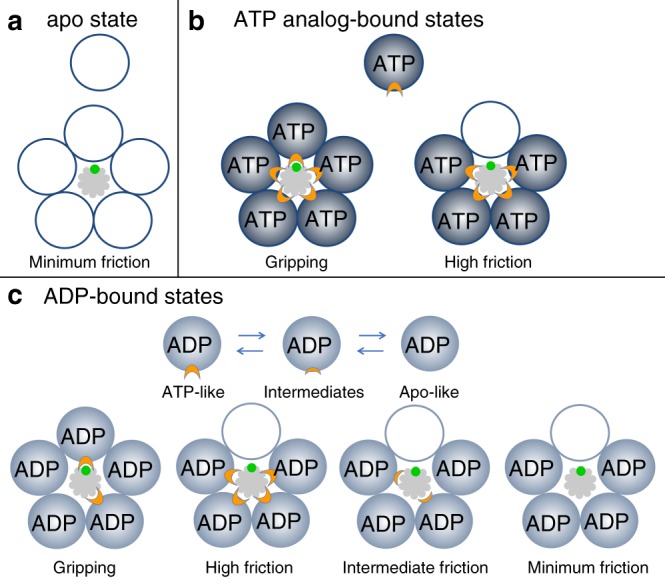
ATP-powered viral packaging motors are among the most powerful biomotors known. Motor subunits arranged in a ring repeatedly grip and translocate the DNA to package viral genomes into capsids. Here, we use single DNA manipulation and rapid solution exchange to quantify how nucleotide binding regulates interactions between the bacteriophage T4 motor and DNA substrate. With no nucleotides, there is virtually no gripping and rapid slipping occurs with only minimal friction resisting. In contrast, binding of an ATP analog engages nearly continuous gripping. Occasional slips occur due to dissociation of the analog from a gripping motor subunit, or force-induced rupture of grip, but multiple other analog-bound subunits exert high friction that limits slipping. ADP induces comparably infrequent gripping and variable friction. Independent of nucleotides, slipping arrests when the end of the DNA is about to exit the capsid. This end-clamp mechanism increases the efficiency of packaging by making it essentially irreversible.
ATP 驱动的病毒包装马达是已知的最强大的生物马达之一。排列成环形的马达亚基反复抓取并转运 DNA,将病毒基因组包装到衣壳中。在这里,我们使用单 DNA 操作和快速溶液交换来定量核苷酸结合如何调节噬菌体 T4 马达和 DNA 底物之间的相互作用。在没有核苷酸的情况下,几乎没有抓取,只有最小的摩擦力导致快速滑动。相比之下,结合 ATP 类似物会导致几乎连续的抓取。由于从抓取马达亚基中解离或力诱导的抓取断裂,偶尔会发生滑动,但多个其他结合类似物的亚基会产生限制滑动的高摩擦力。ADP 诱导类似的抓取频率和可变摩擦力。独立于核苷酸,当 DNA 的末端即将离开衣壳时,滑动会停止。这种末端夹机制通过使其基本上不可逆来提高包装效率。