Department of Orthopaedics, University of Maryland School of Medicine, Baltimore, MD, 21201, USA.
Center for Childhood Cancer and Blood Diseases, The Research Institute at Nationwide Children's Hospital, Columbus, OH, 43205, USA.
Biochem Biophys Res Commun. 2019 Jan 29;509(1):235-240. doi: 10.1016/j.bbrc.2018.12.111. Epub 2018 Dec 20.
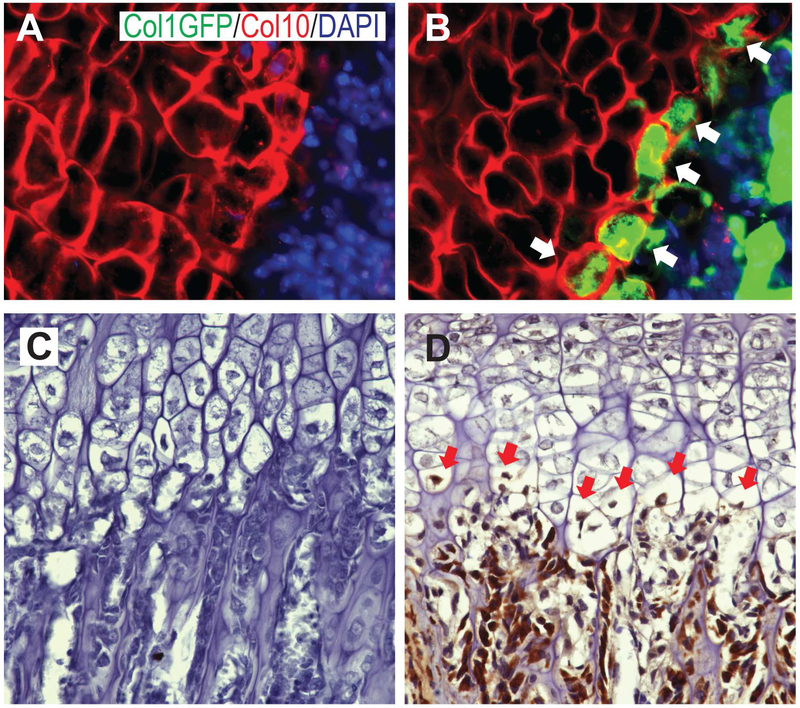
Osteogenesis imperfecta (OI) is a hereditary bone disorder most commonly caused by autosomal dominant mutations in genes encoding type I collagen. In addition to bone fragility, patients suffer from impaired longitudinal bone growth. It has been demonstrated that in OI, an accumulation of mutated type I collagen in the endoplasmic reticulum (ER) induces ER stress in osteoblasts, causing osteoblast dysfunction leading to bone fragility. We hypothesize that ER stress is also induced in the growth plate where bone growth is initiated, and examined a mouse model of dominant OI that carries a G610C mutation in the procollagen α2 chain. The results demonstrated that G610C OI mice had significantly shorter long bones with growth plate abnormalities including elongated total height and hypertrophic zone. Moreover, we found that mature hypertrophic chondrocytes expressed type I collagen and ER dilation was more pronounced compared to wild type littermates. The results from in vitro chondrocyte cultures demonstrated that the maturation of G610C OI hypertrophic chondrocytes was significantly suppressed and ER stress related genes were upregulated. Given that the alteration of hypertrophic chondrocyte activity often causes dwarfism, our findings suggest that hypertrophic chondrocyte dysfunction induced by ER stress may be an underlying cause of growth deficiency in G610C OI mice.
成骨不全症(OI)是一种遗传性骨骼疾病,最常见的原因是编码 I 型胶原的基因的常染色体显性突变。除了骨骼脆弱外,患者还存在纵向骨骼生长受损的问题。已经证明,在 OI 中,突变型 I 型胶原在内质网(ER)中的积累会诱导成骨细胞中的 ER 应激,导致成骨细胞功能障碍,从而导致骨骼脆弱。我们假设 ER 应激也会在启动骨骼生长的生长板中诱导产生,因此研究了携带前胶原α2 链 G610C 突变的显性 OI 小鼠模型。结果表明,G610C OI 小鼠的长骨明显较短,生长板异常,包括总高度延长和肥大区。此外,我们发现成熟的肥大软骨细胞表达 I 型胶原,与野生型同窝仔相比 ER 扩张更为明显。软骨细胞体外培养的结果表明,G610C OI 肥大软骨细胞的成熟明显受到抑制,与 ER 应激相关的基因上调。鉴于肥大软骨细胞活性的改变常常导致侏儒症,我们的发现表明,由 ER 应激引起的肥大软骨细胞功能障碍可能是 G610C OI 小鼠生长缺陷的潜在原因。