Biodiversity Research Cluster, Department of Biology, Faculty of Science, Mahidol University, Rama 6 Road, Bangkok, 10400, Thailand.
Center of Excellence for Vectors and Vector-Borne Diseases, Faculty of Science, Mahidol University at Salaya, Phutthamonthon 4 Road, Nakhon Pathom, 73170, Thailand.
Parasit Vectors. 2018 Dec 27;11(1):670. doi: 10.1186/s13071-018-3259-9.
Coxiella bacteria were identified from various tick species across the world. Q fever is a zoonotic disease caused by the bacteria Coxiella burnetii that most commonly infects a variety of mammals. Non-mammalian hosts, such as birds, have also been reported to be infected with the pathogenic form of "Candidatus Coxiella avium". This research increases the list of tick species that have been found with Coxiella-like bacteria in Thailand.
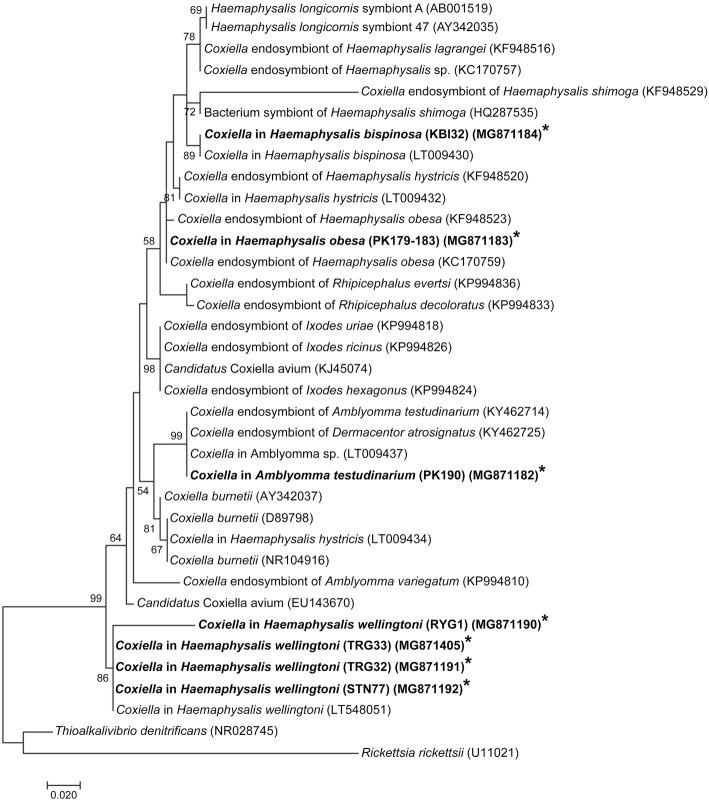
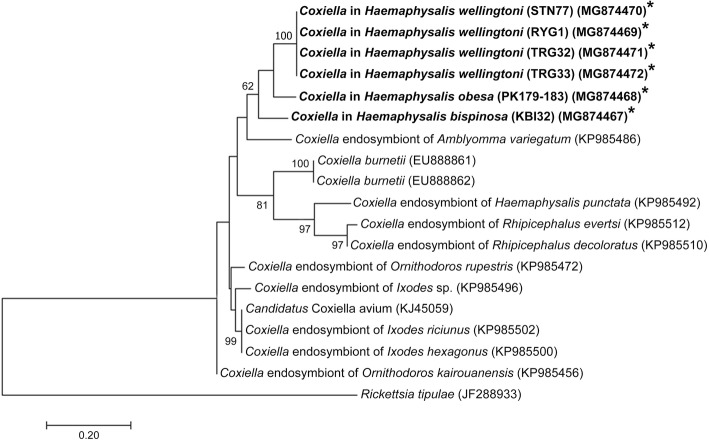
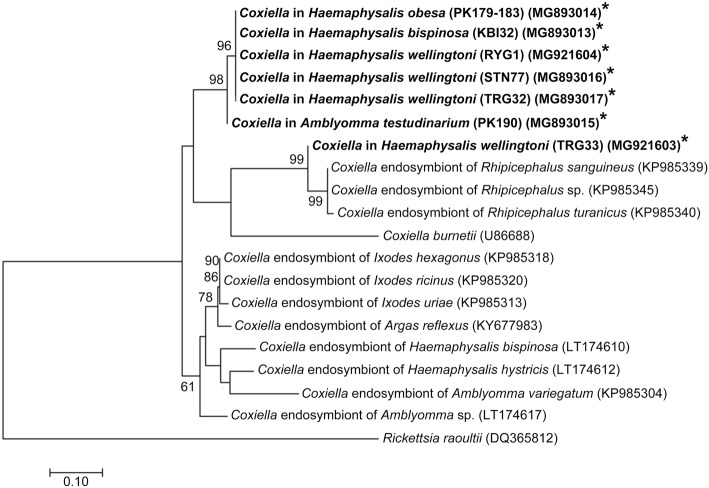
A total of 69 ticks were collected from 27 domestic fowl (Gallus gallus domesticus), 2 jungle fowl (Gallus gallus) and 3 Siamese firebacks (Lophura diardi) at 10 locations (provinces) in Thailand. Ticks were identified and PCR was used to amplify Coxiella bacteria 16S rRNA, groEL and rpoB genes from the extracted tick DNA. MEGA6 was used to construct phylogenetic trees via a Maximum Likelihood method.
The phylogenetic analysis based on the 16S rRNA gene showed that the Coxiella sequences detected in this study grouped in the same clade with Coxiella sequences from the same tick genus (or species) reported previously. In contrast, rpoB gene of the Coxiella bacteria detected in this study did not cluster together with the same tick genus reported previously. Instead, they clustered by geographical distribution (Thai cluster and Malaysian cluster). In addition, phylogenetic analysis of the groEL gene (the chaperonin family) showed that all Coxiella bacteria found in this study were grouped in the same clade (three sister groups).
To our knowledge, we found for the first time rpoB genes of Coxiella-like bacteria in Haemaphysalis wellingtoni ticks forming two distinct clades by phylogenetic analysis. This may be indicative of a horizontal gene transfer event.
柯克斯体细菌已在世界各地的各种蜱种中被鉴定出来。Q 热是一种由细菌柯克斯体引起的人畜共患病,最常见于多种哺乳动物感染。非哺乳动物宿主,如鸟类,也被报道感染了致病性的“鸟分枝杆菌”。这项研究增加了在泰国发现的带有柯克斯体样细菌的蜱种列表。
从泰国 10 个地点(省份)的 27 只家鸡(Gallus gallus domesticus)、2 只丛林鸡(Gallus gallus)和 3 只暹罗火背鸡(Lophura diardi)中采集了 69 只蜱虫。从提取的蜱虫 DNA 中使用 PCR 扩增柯克斯体细菌 16S rRNA、groEL 和 rpoB 基因,以鉴定蜱虫。使用 MEGA6 通过最大似然法构建系统发育树。
基于 16S rRNA 基因的系统发育分析表明,本研究中检测到的柯克斯体序列与先前报道的同一蜱属(或种)的柯克斯体序列聚集在同一分支中。相比之下,本研究中检测到的柯克斯体细菌的 rpoB 基因没有与先前报道的同一蜱属聚集在一起。相反,它们按地理位置(泰国群和马来西亚群)聚类。此外,groEL 基因(伴侣蛋白家族)的系统发育分析表明,本研究中发现的所有柯克斯体细菌都聚集在同一分支中(三个姐妹群)。
据我们所知,我们首次在韦氏血蜱中发现 rpoB 基因的柯克斯体样细菌,通过系统发育分析形成两个不同的分支。这可能表明发生了水平基因转移事件。