Merrill Joan T, Furie Richard, Werth Victoria P, Khamashta Munther, Drappa Jorn, Wang Liangwei, Illei Gabor, Tummala Raj
Arthritis & Clinical Immunology Program, Oklahoma Medical Research Foundation, Oklahoma City, Oklahoma, USA.
Division of Rheumatology, Department of Medicine, Zucker School of Medicine at Hofstra/Northwell, Northwell Health, Great Neck, New York, USA.
Lupus Sci Med. 2018 Nov 26;5(1):e000284. doi: 10.1136/lupus-2018-000284. eCollection 2018.
This post hoc analysis compared anifrolumab 300 mg every 4 weeks with placebo on rash and arthritis measures with different stringency in patients with moderate to severe SLE (phase IIb; MUSE; NCT01438489). Subgroups were analysed by type I interferon gene signature (IFNGS test-high or test-low).
Rash was measured with the SLE Disease Activity Index 2000 (SLEDAI-2K), British Isles Lupus Assessment Group (BILAG) Index and modified Cutaneous Lupus Erythematosus Disease Area and Severity Index (mCLASI). Arthritis was evaluated using SLEDAI-2K, BILAG and swollen and tender joint counts. Outcomes were measured at week 52.
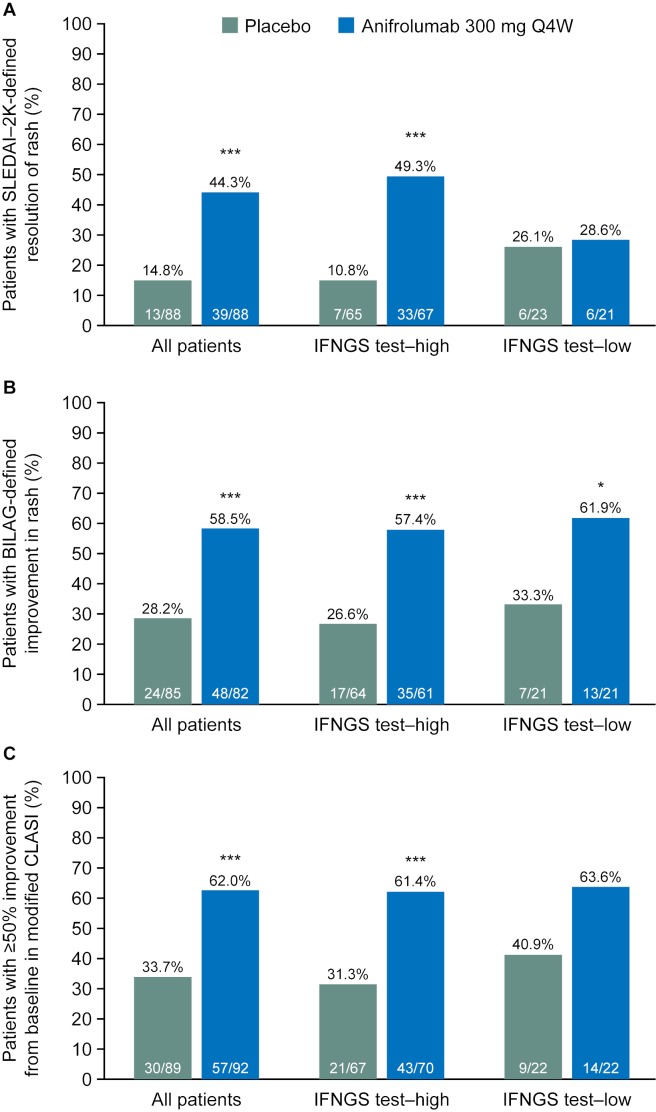
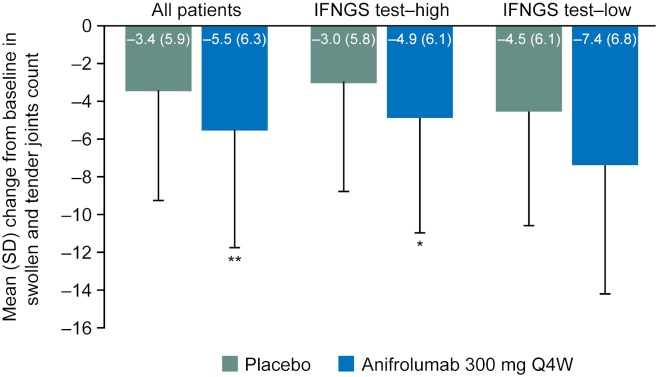
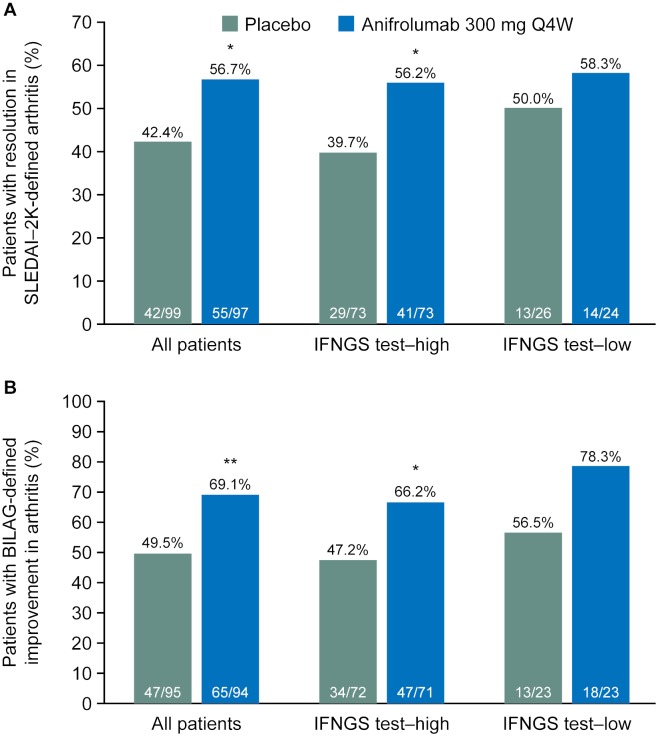
More anifrolumab-treated patients demonstrated resolution of rash by SLEDAI-2K versus placebo: 39/88 (44.3%) versus 13/88 (14.8%), OR (90% CI) 4.56 (2.48 to 8.39), p<0.001; improvement of BILAG: 48/82 (58.5%) versus 24/85 (28.2%), OR (90% CI) 3.59 (2.08 to 6.19), p<0.001; and ≥50% improvement by mCLASI: 57/92 (62.0%) versus 30/89 (33.7%), OR (90% CI) 3.31 (1.97 to 5.55), p<0.001. More anifrolumab-treated patients had improved arthritis by SLEDAI-2K versus placebo: 55/97 (56.7%) versus 42/99 (42.4%), OR (90% CI) 1.88 (1.16 to 3.04), p=0.032; and BILAG: 65/94 (69.1%) versus 47/95 (49.5%), OR (90% CI) 2.47 (1.48 to 4.12), p=0.003; and mean (SD) swollen and tender joint reductions: -5.5 (6.3) versus -3.4 (5.9), p=0.004. Comparable results were demonstrated in IFNGS test-high patients (n=151). In IFNGS test-low patients (n=50), substantial numerical differences in partial rash and arthritis responses were observed in anifrolumab-treated patients versus placebo, with statistical significance only for rash by BILAG in this small population.
Anifrolumab treatment was associated with improvements versus placebo in specific SLE features of arthritis and rash using measures of different stringency. Although driven by robust data in the prevalent IFNGS test-high population, further evaluation in IFNGS test-low patients is warranted.
本事后分析比较了每4周一次300mg阿尼鲁单抗与安慰剂对中度至重度系统性红斑狼疮患者(IIb期;MUSE;NCT01438489)皮疹和关节炎的不同严格程度指标的影响。通过I型干扰素基因特征(IFNGS检测高或检测低)对亚组进行分析。
使用系统性红斑狼疮疾病活动指数2000(SLEDAI-2K)、不列颠群岛狼疮评估组(BILAG)指数和改良的皮肤红斑狼疮疾病面积和严重程度指数(mCLASI)来测量皮疹。使用SLEDAI-2K、BILAG以及肿胀和压痛关节计数来评估关节炎。在第52周测量结果。
与安慰剂相比,更多接受阿尼鲁单抗治疗的患者通过SLEDAI-2K显示皮疹消退:39/88(44.3%)对13/88(14.8%),OR(90%CI)4.56(2.48至8.39),p<0.001;BILAG改善:48/82(58.5%)对24/85(28.2%),OR(90%CI)3.59(2.08至6.),p<0.001;以及mCLASI改善≥50%:57/92(62.0%)对30/89(33.7%),OR(90%CI)3.31(1.97至5.55),p<0.001。与安慰剂相比,更多接受阿尼鲁单抗治疗的患者通过SLEDAI-2K显示关节炎改善:55/97(56.7%)对42/99(42.4%),OR(90%CI)1.88(1.16至3.04),p=0.032;以及BILAG:65/94(69.1%)对47/95(49.5%),OR(90%CI)2.47(1.4至4.12),p=0.003;以及平均(标准差)肿胀和压痛关节减少:-5.5(6.3)对-3.4(5.9),p=0.004。在IFNGS检测高的患者(n=151)中也显示了类似结果。在IFNGS检测低的患者(n=50)中,接受阿尼鲁单抗治疗的患者与安慰剂相比,在部分皮疹和关节炎反应方面存在显著的数值差异,在这个小群体中仅BILAG皮疹具有统计学意义。
使用不同严格程度的指标,阿尼鲁单抗治疗与安慰剂相比,在关节炎和皮疹的特定系统性红斑狼疮特征方面有所改善。尽管在普遍的IFNGS检测高的人群中有强有力的数据支持,但仍有必要对IFNGS检测低的患者进行进一步评估。