National Center of Epidemiology and CIBERNED, Carlos III Institute of Health, Madrid, Spain.
Analysis Group, Inc., New York, New York, USA.
Mov Disord. 2019 Feb;34(2):236-245. doi: 10.1002/mds.27579. Epub 2018 Dec 27.
Parkinson's disease is a progressive, disabling neurodegenerative disorder associated with significant economic burden for patients and caregivers. The objective of this study was to compare the direct and indirect economic burden of Parkinson's patients' caregivers with demographically matched controls in the United States, in the 5 years after first diagnosis of Parkinson's disease.
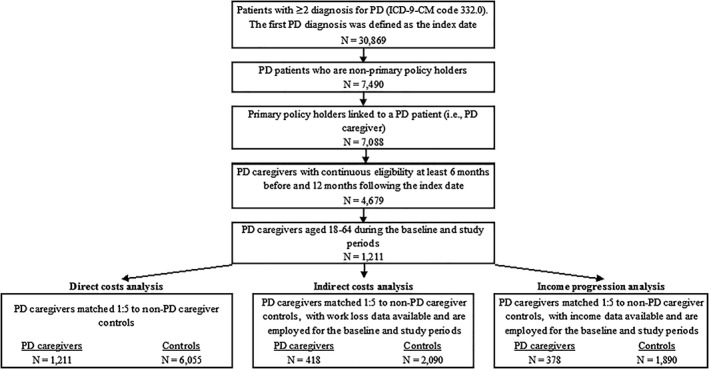
Policyholders (18-64 years old) linked to a Parkinson's disease patient (≥2 diagnoses of Parkinson's disease; first diagnosis is the index date) from January 1, 1998 to March 31, 2014, were selected from a private-insurer claims database and categorized as Parkinson's caregivers. Eligible Parkinson's caregivers were matched 1:5 to policyholders with a non-Parkinson's dependent (controls). Multivariable regression adjusted for baseline characteristics estimated direct costs (all-cause insurer cost [medical and prescription] and comorbidity-related medical costs; patient out-of-pocket costs) and indirect costs (disability and medically related absenteeism costs). Income progression was also compared between cohorts.
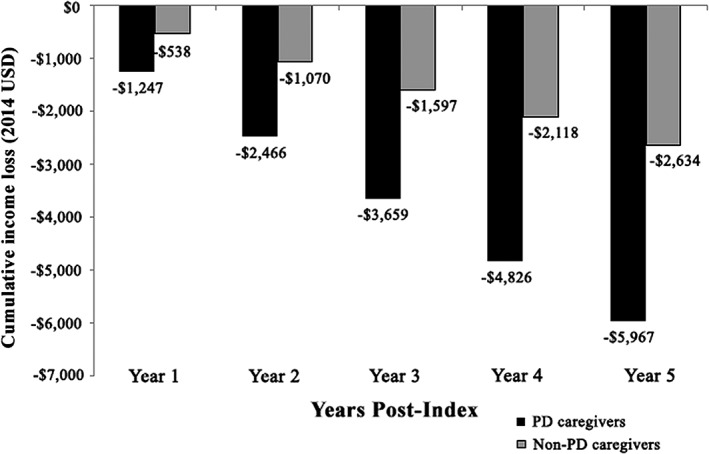
A total of 1211 eligible Parkinson's caregivers (mean age, 56 years; 54% female) were matched to 6055 controls. In adjusted analyses, Parkinson's caregivers incurred significantly higher year 1 total all-cause insurer costs ($8999 vs $7117) and medical costs ($7081 vs $5568) (both P < 0.01) and higher prescription costs (range for years 1-5, $2506-2573 vs $1405-$1687) and total out-of-pocket costs ($1259-1585 vs $902-$1192) in years 1-5 (all P < 0.01). Parkinson's caregivers had significantly higher adjusted indirect costs in years 1-3 (range for years 1-3, $2054-$2464 vs $1681-$1857; all P < 0.05) and higher cumulative income loss over 5 years ($5967 vs $2634 by year 5; P for interaction = 0.03).
Parkinson's caregivers exhibited higher direct and indirect costs and greater income loss compared with matched controls. © 2018 International Parkinson and Movement Disorder Society © 2018 The Authors. Movement Disorders published by Wiley Periodicals, Inc. on behalf of International Parkinson and Movement Disorder Society.
帕金森病是一种进行性、致残性神经退行性疾病,给患者和护理人员带来了巨大的经济负担。本研究的目的是比较美国帕金森病患者护理人员与年龄匹配的对照组在帕金森病首次诊断后 5 年内的直接和间接经济负担。
从 1998 年 1 月 1 日至 2014 年 3 月 31 日,从私人保险公司的理赔数据库中选择了与帕金森病患者(≥2 次帕金森病诊断;首次诊断为索引日期)相关的投保人(18-64 岁),并将其归类为帕金森病护理人员。符合条件的帕金森病护理人员与患有非帕金森病的受抚养人(对照组)按 1:5 匹配。多变量回归调整了基线特征,以估计直接成本(所有原因保险成本[医疗和处方]和与合并症相关的医疗成本;患者自付费用)和间接成本(残疾和与医疗相关的旷工成本)。还比较了两组之间的收入进展情况。
共有 1211 名符合条件的帕金森病护理人员(平均年龄 56 岁,54%为女性)与 6055 名对照组相匹配。在调整后的分析中,帕金森病护理人员的第一年总所有原因保险费用($8999 与 $7117)和医疗费用($7081 与 $5568)显著较高(均 P <0.01),处方费用也较高(第 1-5 年的范围为$2506-2573 与 $1405-1687),第一年至第五年的总自付费用也较高($1259-1585 与 $902-1192)(均 P <0.01)。帕金森病护理人员在第 1-3 年的调整后间接费用也显著较高(第 1-3 年的范围为$2054-$2464 与 $1681-$1857;均 P <0.05),并且在 5 年内的累积收入损失也更高(第 5 年时为$5967 与 $2634;交互 P 值=0.03)。
与对照组相比,帕金森病护理人员表现出更高的直接和间接成本以及更大的收入损失。© 2018 国际帕金森病和运动障碍学会 © 2018 作者。运动障碍由 Wiley Periodicals,Inc. 代表国际帕金森病和运动障碍学会出版。