Ramakumari Nuthalapati, Indumathi Bobbala, Katkam Shiva Krishna, Kutala Vijay Kumar
Department of Cardiology, Nizam's Institute of Medical Sciences, Panjagutta, Hyderabad, India.
Department of Cardiology, Nizam's Institute of Medical Sciences, Panjagutta, Hyderabad, India.
Indian Heart J. 2018 Dec;70 Suppl 3(Suppl 3):S120-S125. doi: 10.1016/j.ihj.2018.07.009. Epub 2018 Aug 10.
Statins are the most commonly prescribed medications for the treatment of atherosclerotic cardiovascular disease. Statin-associated adverse effects occur in ∼10% of patients and are associated with polymorphisms in several key genes coding for transporters and metabolizing enzymes that affect statin pharmacokinetics. In the present study, we examine the association between cytochrome P450 3A53 (CYP3A53) T>C (rs776746), COQ G>C (rs4693075), and SLCO1B1 T>C (rs4149056) genetic variants with the risk of myopathy in South Indian patients on statin therapy.
A total of 202 patients on atorvastatin or rosuvastatin therapy for 12 years were recruited in the study. Genotyping of drug metabolic CYP3A5*3 gene variant and drug transporter genes COQ G>C (rs4693075) and SLCO1B1 T>C (rs4149056) was analyzed by Sanger's sequencing.
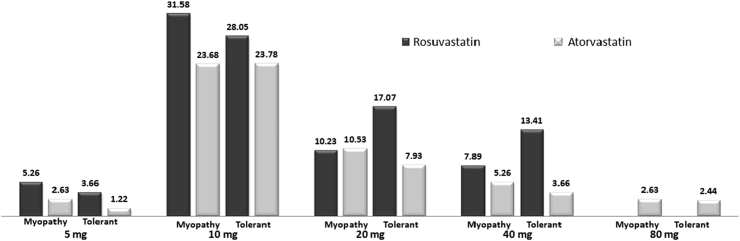
In our study subjects, the percentage of patients diagnosed to have statin-induced myopathy was 18%. The majority of the patients were on 10 mg/day dose of either atorvastatin or rosuvastatin. The homozygous nonexpressors genotype CYP3A5*3/3 frequency of the CYP3A5 polymorphism was higher in patients with myopathy. But we could not find association of CYP3A5, COQ, and SLCO1B1 gene polymorphisms with either rosuvastatin or atorvastatin.
Our results clearly demonstrate that the frequency of CYP3A5*3 splicing variant is higher in myopathy group than in the tolerant group. We did not find significant association of genetic polymorphisms in CYP3A5, COQ, and SLCO1B1 with atorvastatin- or rosuvastatin-induced myopathy.
他汀类药物是治疗动脉粥样硬化性心血管疾病最常用的处方药。约10%的患者会出现他汀类药物相关的不良反应,这些不良反应与影响他汀类药物药代动力学的几种关键转运蛋白和代谢酶编码基因的多态性有关。在本研究中,我们调查了细胞色素P450 3A53(CYP3A53)T>C(rs776746)、辅酶Q(COQ)G>C(rs4693075)和有机阴离子转运多肽1B1(SLCO1B1)T>C(rs4149056)基因变异与接受他汀类药物治疗的南印度患者发生肌病风险之间的关联。
本研究共纳入202例接受阿托伐他汀或瑞舒伐他汀治疗12年的患者。通过桑格测序法分析药物代谢CYP3A5*3基因变异以及药物转运蛋白基因COQ G>C(rs4693075)和SLCO1B1 T>C(rs4149056)的基因分型。
在我们的研究对象中,被诊断为他汀类药物诱导性肌病的患者比例为18%。大多数患者服用的是每日10毫克剂量的阿托伐他汀或瑞舒伐他汀。肌病患者中CYP3A5多态性的纯合无表达型基因型CYP3A5*3/3频率较高。但我们未发现CYP3A5、COQ和SLCO1B1基因多态性与瑞舒伐他汀或阿托伐他汀之间存在关联。
我们的结果清楚地表明,肌病组中CYP3A5*3剪接变异的频率高于耐受组。我们未发现CYP3A5、COQ和SLCO1B1基因多态性与阿托伐他汀或瑞舒伐他汀诱导的肌病之间存在显著关联。