Dagli-Hernandez Carolina, de Freitas Renata Caroline Costa, Marçal Elisangela da Silva Rodrigues, Gonçalves Rodrigo Marques, Faludi Andre Arpad, Borges Jéssica Bassani, Bastos Gisele Medeiros, Los Bruna, Mori Augusto Akira, Bortolin Raul Hernandes, Ferreira Glaucio Monteiro, de Oliveira Victor Fernandes, Hirata Thiago Dominguez Crespo, Hirata Mario Hiroyuki, Hirata Rosario Dominguez Crespo
Department of Clinical and Toxicological Analyses, School of Pharmaceutical Sciences, University of Sao Paulo, Sao Paulo, Brazil.
Institute Dante Pazzanese of Cardiology, Sao Paulo, Brazil.
Ann Transl Med. 2021 Jan;9(1):76. doi: 10.21037/atm-20-5540.
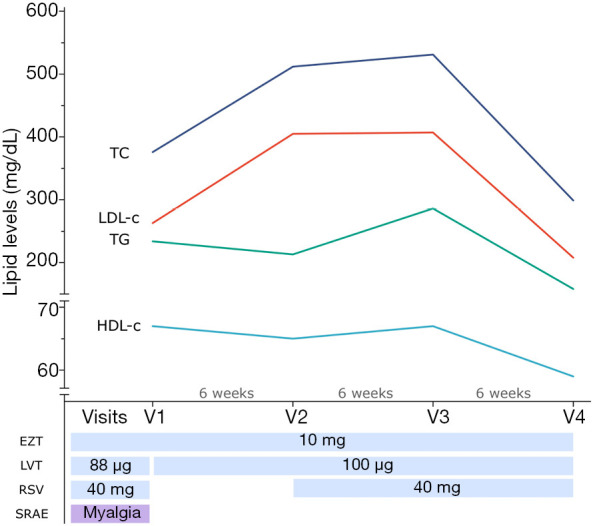
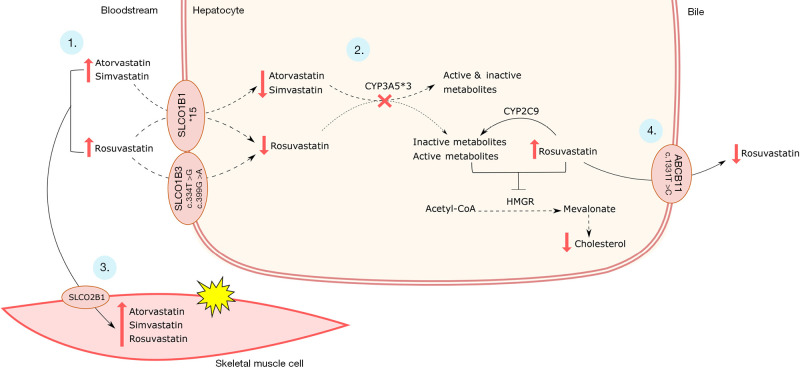
Statins are the most widely used cholesterol-lowering drugs for cardiovascular diseases prevention. However, some patients are refractory to treatment, whereas others experience statin-related adverse events (SRAE). It has been increasingly important to identify pharmacogenetic biomarkers for predicting statin response and adverse events. This case report describes a female patient with familial hypercholesterolemia (FH) who showed late response to rosuvastatin and experienced myalgia on statin treatment. In the first visit (V1), the patient reported myalgia to rosuvastatin 40 mg, which was interrupted for a 6-week wash-out period. In V2, rosuvastatin 20 mg was reintroduced, but her lipid profile did not show any changes after 6 weeks (V3) (LDL-c: 402 407 mg/dL). Her lipid profile markedly improved after 12 weeks of treatment (V4) (LDL-c: 208 mg/dL), suggesting a late rosuvastatin response. Her adherence to treatment was similar in V1 and V3 and no drug interactions were detected. Pharmacogenetic analysis revealed that the patient carries low-activity variants in , (rs4149117 and rs7311358), and rs2287622, and the non-functional variant in . The combined effect of variants in pharmacokinetics-related genes may have contributed to the late response to rosuvastatin and statin-related myalgia. Therefore, they should be considered when assessing a patient's response to statin treatment. To the best of our knowledge, this is the first report of a pharmacogenetic analysis on a case of late rosuvastatin response.
他汀类药物是预防心血管疾病最广泛使用的降胆固醇药物。然而,一些患者对治疗无效,而另一些患者则会出现他汀类药物相关不良事件(SRAE)。识别用于预测他汀类药物反应和不良事件的药物遗传学生物标志物变得越来越重要。本病例报告描述了一名患有家族性高胆固醇血症(FH)的女性患者,她对瑞舒伐他汀反应迟缓,并在他汀类药物治疗期间出现肌痛。在首次就诊(V1)时,患者报告服用40mg瑞舒伐他汀后出现肌痛,该药物停用6周进行洗脱期。在V2时,重新开始服用20mg瑞舒伐他汀,但6周后(V3)她的血脂谱没有任何变化(低密度脂蛋白胆固醇:402±407mg/dL)。治疗12周后(V4)她的血脂谱明显改善(低密度脂蛋白胆固醇:208mg/dL),表明对瑞舒伐他汀反应迟缓。她在V1和V3的治疗依从性相似,未检测到药物相互作用。药物遗传学分析显示,该患者携带SLCO1B1(rs4149117和rs7311358)、ABCB1(rs2287622)的低活性变体,以及CYP2C9的无功能变体。药代动力学相关基因变体的综合作用可能导致了对瑞舒伐他汀的迟发性反应和他汀类药物相关肌痛。因此,在评估患者对他汀类药物治疗的反应时应考虑这些因素。据我们所知,这是首例关于瑞舒伐他汀迟发性反应病例的药物遗传学分析报告。