Geraei Ehsan, Mazaheri Elaheh, Karimi Maryam
Department of Knowledge and Information Science, School of Literature and Humanities, Lorestan University, Khorramabad, Iran.
Department of Librarianship and Medical Information Sciences, School of Management and Medical Information Sciences and Student Research Committee, Isfahan University of Medical Sciences, Isfahan, Iran.
J Res Med Sci. 2018 Nov 28;23:97. doi: 10.4103/jrms.JRMS_36_18. eCollection 2018.
This study aimed to use social network analysis (SNA) indicators and clique analysis to investigate collaboration between different departments and research centers in Journal of Research in Medical Sciences (JRMS) in 2012-2016.
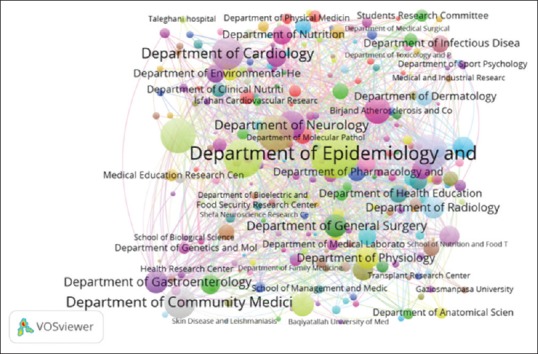
The study was a scientometric study using micro- and macro-indicators of SNA to investigate the performance of departments and research centers in JRMS. The population consisted of 1073 articles published in JRMS in 2012-2016. Ravar Matrix, UCINET, and VOSviewer software were used for data analysis.
According to the productivity and triple centrality indicators, "Department of Epidemiology and Biostatistics," "Department of Pathology," and Department of "Internal Medicine" allocated the first three ranks. Analyzing the cliques of co-authorship network for departments and research centers showed that this network consists of 19 cliques with at least 7 members in each clique. Furthermore, only 30 nodes (8.90% of all nodes in the network) had the presence in minimum clique size of at least 7.
Given the importance and position of scientific collaboration in medical research and its effect on other performance indicators such as efficiency, effectiveness, and number of citations, it is necessary for policy-makers to propose new strategies for improving scientific collaboration.
本研究旨在运用社会网络分析(SNA)指标和派系分析,调查2012 - 2016年《医学科学研究杂志》(JRMS)不同部门和研究中心之间的合作情况。
本研究是一项科学计量学研究,使用SNA的微观和宏观指标来调查JRMS中各部门和研究中心的表现。研究对象包括2012 - 2016年在JRMS上发表的1073篇文章。使用Ravar Matrix、UCINET和VOSviewer软件进行数据分析。
根据生产力和三重中心性指标,“流行病学与生物统计学系”“病理学系”和“内科”系位列前三。对部门和研究中心共同作者网络的派系分析表明,该网络由19个派系组成,每个派系至少有7名成员。此外,只有30个节点(占网络中所有节点的8.90%)出现在最小派系规模至少为7的情况中。
鉴于科学合作在医学研究中的重要性和地位及其对其他绩效指标(如效率、效果和被引次数)的影响,政策制定者有必要提出改善科学合作的新策略。