Health Economics Group, College of Medicine and Health, University of Exeter, Exeter, EX1 2LU, UK.
Liverpool School of Tropical Medicine, Pembroke Place, Liverpool, L3 5QA, UK.
Eur J Health Econ. 2019 Jun;20(4):559-568. doi: 10.1007/s10198-018-1017-8. Epub 2018 Dec 31.
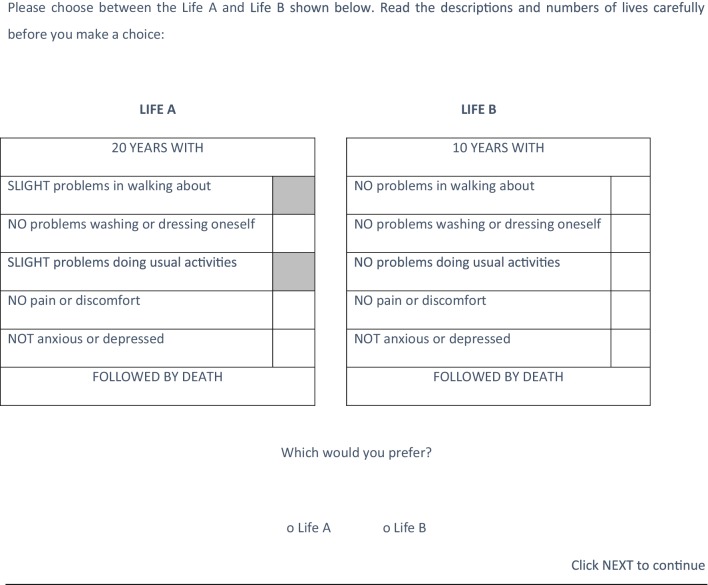
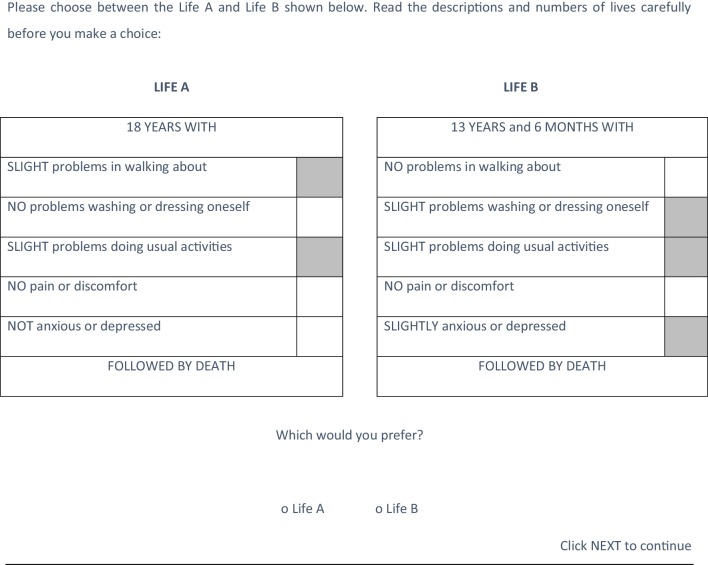
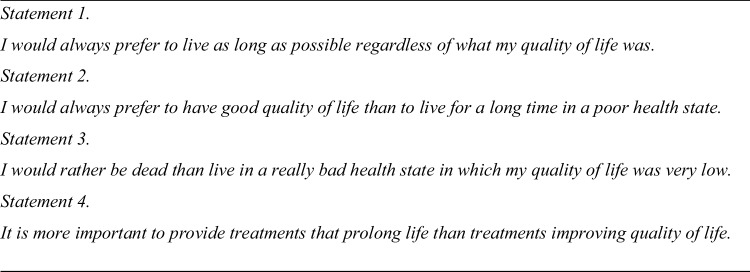
Previous research has shown that demographics, beliefs, and self-reported own health influence TTO values. Our hypothesis is that attitudes towards length and quality of life influence TTO values, but should no longer affect a set of related choices that are based on respondents' own TTO scores. A representative sample of 1339 respondents was asked their level of agreement to four statements relating to the importance of quality and length of life. Respondents then went on to value 4 EQ-5D 5L states using an online interactive survey and a related set of 6 pairwise health-related choice questions, set up, so that respondents should be indifferent between choice options. We explored the impact of attitudes using regression analysis for TTO values and a logit model for choices. TTO values were correlated with the attitudes and were found to have a residual impact on the choices. In particular, those respondents who preferred quality of life over length of life gave less weight to the differences in years and more weight to differences in quality of life in these choice. We conclude that although the TTO responses reflect attitudes, these attitudes continue to affect health-related choices.
先前的研究表明,人口统计学特征、信仰和自我报告的健康状况会影响 TTO 值。我们的假设是,对生命长度和质量的态度会影响 TTO 值,但不应再影响基于受访者自身 TTO 得分的一组相关选择。我们对 1339 名受访者进行了代表性调查,询问他们对与生命质量和长度的重要性相关的四项陈述的同意程度。然后,受访者通过在线互动调查和一组相关的 6 个基于健康的成对选择问题来评估 4 个 EQ-5D 5L 状态,这些选择问题的设置应使受访者在选择选项之间保持中立。我们使用回归分析研究了 TTO 值的态度影响,使用对数模型研究了选择的态度影响。TTO 值与态度相关,并对选择有残留影响。特别是那些更看重生命质量而非长度的受访者,在这些选择中,他们对年限差异的重视程度较低,对生活质量差异的重视程度较高。我们得出的结论是,尽管 TTO 反应反映了态度,但这些态度仍会影响与健康相关的选择。