Milosevic Goran, Kotur Nikola, Krstovski Nada, Lazic Jelena, Zukic Branka, Stankovic Biljana, Janic Dragana, Katsila Theodora, Patrinos George P, Pavlovic Sonja, Dokmanovic Lidija
University Children's Hospital, Belgrade, Serbia.
Laboratory for Molecular Biomedicine, Institute of Molecular Genetics and Genetic Engineering, University of Belgrade, Belgrade, Serbia.
J Med Biochem. 2018 Jul 1;37(3):320-327. doi: 10.1515/jomb-2017-0060. eCollection 2018 Jul.
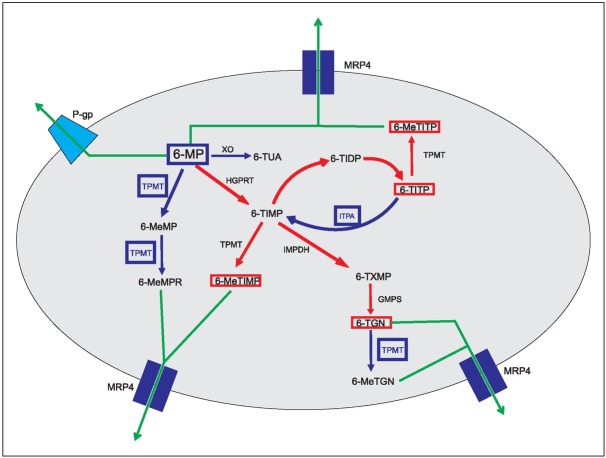
Acute lymphoblastic leukemia is the most common childhood malignancy. Optimal use of anti leukemic drugs has led to less toxicity and adverse reactions, and a higher survival rate. Thiopurine drugs, including 6-mercaptopurine, are mostly used as antileukemic medications in the maintenance phase of treatment for children with acute lymphoblastic leukemia. For those patients, TPMT genotype- tailored 6-mercaptopurine therapy is already implemented in the treatment protocols. We investigated the role of TPMT, ITPA, ABCC4 and ABCB1 genetic variants as predictors of outcome and 6-mercaptopurine induced toxicity during the maintenance phase of treatment in pediatric acute lymphoblastic leukemia.
Sixty-eight children with acute lymphoblastic leukemia were enrolled in this study. Patients have been treated according to ALL IC-BFM 2002 or ALL IC-BFM 2009 protocols. Toxicity and adverse events have been monitored via surrogate markers (off-therapy weeks, episodes of leu - ko penia and average 6-mercaptopurine dose) and a prob- abilistic model was employed to predict overall 6-mercaptopurine related toxicity.
We confirmed that patients with acute lymphoblastic leukemia that carry inactive TPMT allele(s) require 6- mercaptopurine dose reduction. ITPA and ABCC4 genetic variants failed to show an association with 6-mercapto - purine induced toxicity during the maintenance phase. Carriers of ABCB1 variant allele experienced greater hepatotoxicity. The probabilistic model Neural net which considered all the analysed genetic variants was assessed to be the best prediction model. It was able to discriminate ALL patients with good and poor 6-mercaptopurin tolerance in 71% of cases (AUC=0.71).
This study contributes to the design of a panel of pharmacogenetic markers for predicting thiopurineinduced toxicity in pediatric ALL.
急性淋巴细胞白血病是儿童最常见的恶性肿瘤。抗白血病药物的优化使用降低了毒性和不良反应,并提高了生存率。硫嘌呤类药物,包括6-巯基嘌呤,在儿童急性淋巴细胞白血病治疗的维持阶段大多用作抗白血病药物。对于这些患者,治疗方案中已实施根据硫嘌呤甲基转移酶(TPMT)基因型调整的6-巯基嘌呤治疗。我们研究了TPMT、次黄嘌呤-鸟嘌呤磷酸核糖转移酶(ITPA)、ATP结合盒转运体C4(ABCC4)和ATP结合盒转运体B1(ABCB1)基因变异作为儿童急性淋巴细胞白血病治疗维持阶段预后和6-巯基嘌呤诱导毒性预测指标的作用。
本研究纳入了68例急性淋巴细胞白血病患儿。患者按照急性淋巴细胞白血病国际柏林-法兰克福-明斯特协作组(ALL IC-BFM)2002或ALL IC-BFM 2009方案进行治疗。通过替代指标(治疗中断周数、白细胞减少发作次数和平均6-巯基嘌呤剂量)监测毒性和不良事件,并采用概率模型预测总体6-巯基嘌呤相关毒性。
我们证实,携带无活性TPMT等位基因的急性淋巴细胞白血病患者需要降低6-巯基嘌呤剂量。ITPA和ABCC4基因变异在维持阶段未显示与6-巯基嘌呤诱导的毒性相关。ABCB1变异等位基因携带者肝毒性更大。考虑所有分析基因变异的概率模型神经网络被评估为最佳预测模型。它能够在71%的病例中区分6-巯基嘌呤耐受性良好和较差的急性淋巴细胞白血病患者(曲线下面积=0.71)。
本研究有助于设计一组药物遗传学标志物,用于预测儿童急性淋巴细胞白血病中硫嘌呤诱导的毒性。