Department of Radiation Oncology, Yonsei Cancer Center, Seoul, Korea.
Department of Internal Medicine, Yonsei University College of Medicine, Seoul, Korea.
Gut Liver. 2019 May 15;13(3):315-324. doi: 10.5009/gnl18254.
BACKGROUND/AIMS: Endoscopic resection is a standard treatment for stage T1a esophageal cancer, with esophagectomy or radical radiation therapy (RT) performed for stage T1b lesions. This study aimed to compare treatment outcomes of each modality for clinical stage T1 esophageal cancer.
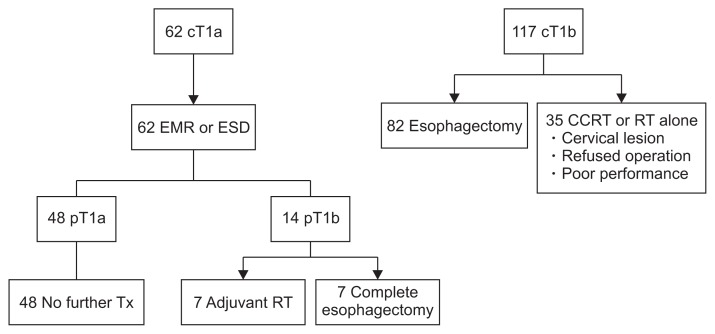
In total, 179 patients with clinical T1N0M0-stage esophageal cancer treated from 2006 to 2016 were retrospectively evaluated. Sixty-two patients with clinical T1a-stage cancer underwent endoscopic resection. Among 117 patients with clinical T1b-stage cancer, 82 underwent esophagectomy, and 35 received chemoradiotherapy or RT. We compared overall survival (OS) and recurrence-free survival (RFS) rates for each treatment modality.
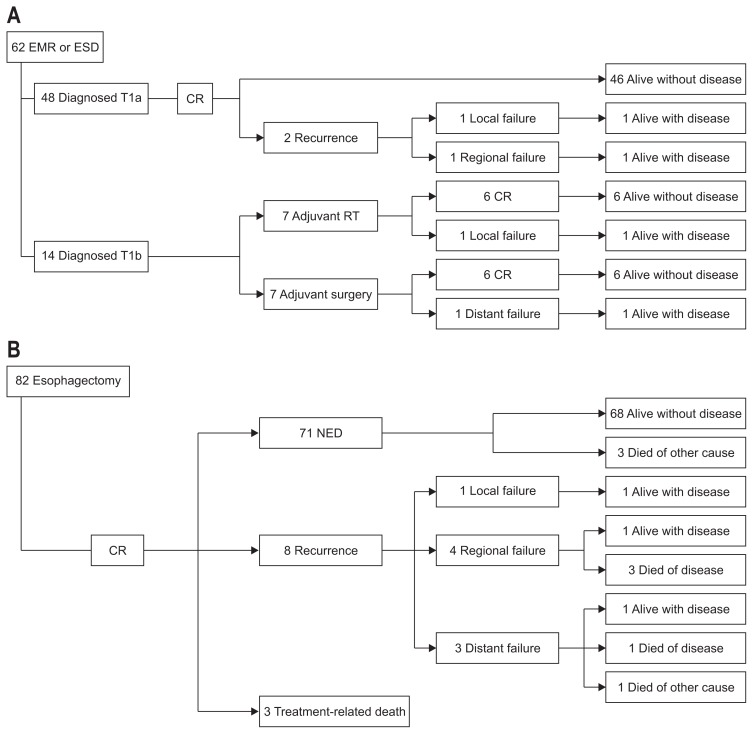
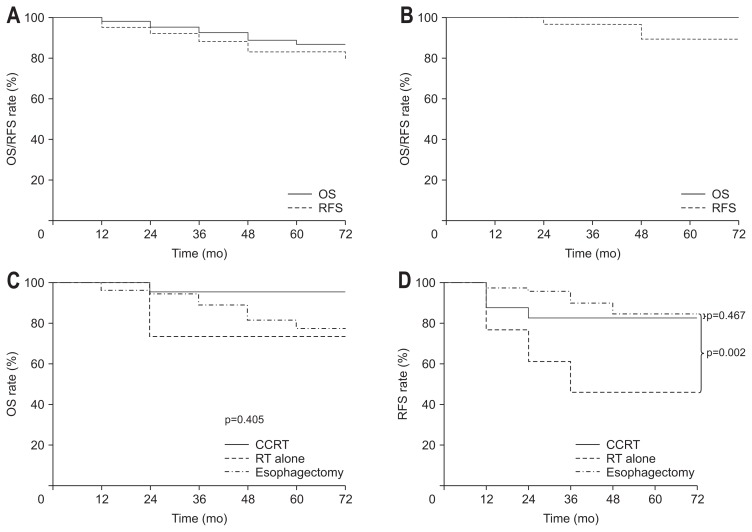
The median follow-up time was 32 months (range, 1 to 120 months). The 5-year OS and RFS rates for patients with stage T1a cancer receiving endoscopic resection were 100% and 85%, respectively. For patients with stage T1b, the 5-year OS and RFS rates were 78% and 77%, respectively, for the esophagectomy group; 80% and 44%, respectively, for the RT alone group; and 96% and 80%, respectively, for the chemoradiation group. The esophagectomy group showed significantly higher RFS than the RT alone group (p=0.04). There was no significant difference in RFS between the esophagectomy and chemoradiation groups (p=0.922). Grade 4 or higher treatment-related complications occurred in four patients who underwent esophagectomy.
Endoscopic resection appeared to be an adequate treatment for patients with T1a-stage esophageal cancer. The multidisciplinary approach involving chemoradiation was comparable to esophagectomy in terms of survival outcome without serious complications for T1b-stage esophageal cancer.
背景/目的:内镜切除术是 T1a 期食管癌的标准治疗方法,T1b 期病变则行食管切除术或根治性放疗(RT)。本研究旨在比较每种治疗方法对临床 T1 期食管癌的治疗效果。
回顾性评估了 2006 年至 2016 年期间接受治疗的 179 例临床 T1N0M0 期食管癌患者。62 例临床 T1a 期癌症患者接受内镜切除术。在 117 例临床 T1b 期癌症患者中,82 例行食管切除术,35 例行放化疗或 RT。我们比较了每种治疗方法的总生存率(OS)和无复发生存率(RFS)。
中位随访时间为 32 个月(范围,1 至 120 个月)。接受内镜切除术的 T1a 期癌症患者的 5 年 OS 和 RFS 率分别为 100%和 85%。对于 T1b 期患者,食管切除术组的 5 年 OS 和 RFS 率分别为 78%和 77%;RT 组分别为 80%和 44%;放化疗组分别为 96%和 80%。食管切除术组的 RFS 显著高于 RT 组(p=0.04)。食管切除术组与放化疗组的 RFS 差异无统计学意义(p=0.922)。行食管切除术的 4 例患者发生 4 级或更高级别的治疗相关并发症。
内镜切除术似乎是 T1a 期食管癌患者的一种充分治疗方法。对于 T1b 期食管癌,多学科治疗方法(包括放化疗)与食管切除术在生存结果方面相当,且无严重并发症。