Division of Thoracic Surgery, Department of Surgery, Taipei Veterans General Hospital and School of Medicine, National Yang-Ming University, Taipei, Taiwan.
Department of Pathology and Laboratory Medicine, Taipei Veterans General Hospital, Taipei, Taiwan.
Thorac Cancer. 2019 Feb;10(2):312-320. doi: 10.1111/1759-7714.12957. Epub 2019 Jan 2.
Although the lower lobes of the lungs occupy half of the chest on both sides, the prognostic value of tumor location in lung cancer in the lower lobe has not been well demonstrated. This study investigated the prognostic value of tumor location (basal vs. superior) in patients with resected lung adenocarcinoma in the lower lobe.
A total of 207 patients undergoing lobectomy for lung adenocarcinoma in the lower lobe were included in the study. The association between tumor location and mediastinal lymph node metastasis was analyzed. Prognostic factors of overall survival and probability of freedom from recurrence (FFR) were also investigated.
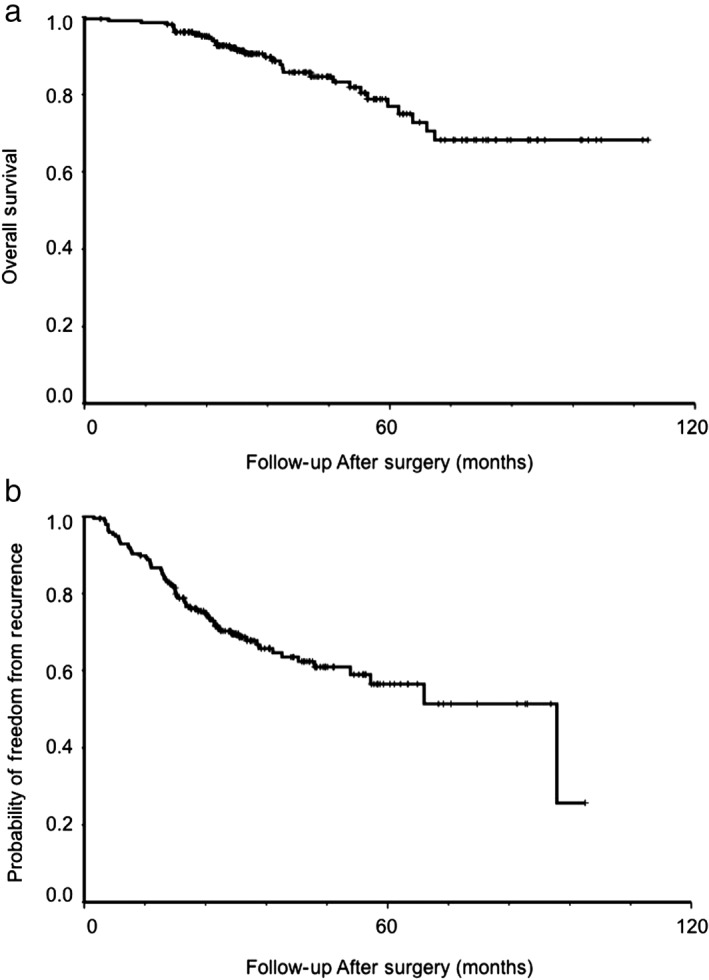
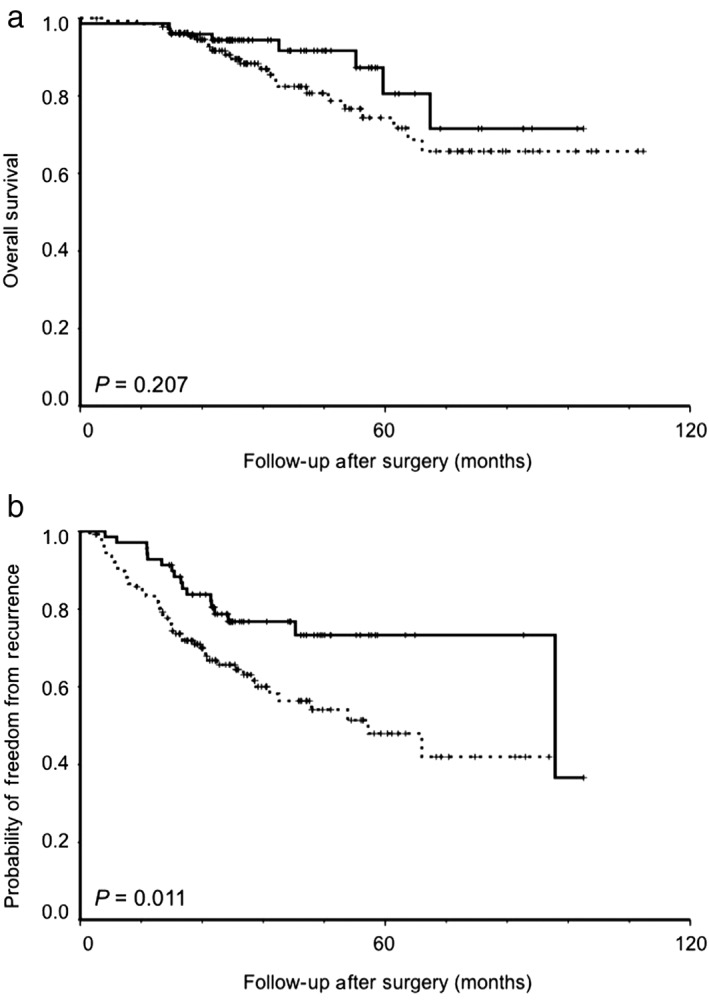
During follow-up, 71 (34.3%) patients developed recurrence. Patients with basal segment tumors had a significantly higher possibility of developing N2 lymph node metastasis than those with superior segment tumors (P = 0.025). Univariate analysis showed that location in the basal (vs. superior) segment was a significant prognostic factor for a lower probability of FFR (P = 0.013). Basal (vs. superior) segment remained a significant prognostic factor for a lower probability of FFR (P = 0.010) in multivariate analysis.
Basal segment tumors have a significantly higher possibility of developing N2 lymph node metastasis than superior segment tumors in resected lung adenocarcinoma in the lower lobe. Tumor location at the basal segment was a significant prognostic factor for a lower probability of FFR. This information is useful for patient stratification of risk of postoperative recurrence.
尽管肺部的下叶占据了两侧胸部的一半,但肺癌中下叶肿瘤位置的预后价值尚未得到充分证明。本研究旨在探讨下肺叶肺腺癌切除术后肿瘤位置(基底段与上叶段)对患者预后的影响。
共纳入 207 例接受下肺叶肺腺癌肺叶切除术的患者。分析肿瘤位置与纵隔淋巴结转移的关系。同时,探讨总生存和无复发生存率(FFR)的预后因素。
随访期间,71 例(34.3%)患者发生复发。基底段肿瘤患者发生 N2 淋巴结转移的可能性明显高于上叶段肿瘤患者(P=0.025)。单因素分析显示,基底段(而非上叶段)肿瘤位置是 FFR 较低的显著预后因素(P=0.013)。多因素分析显示,基底段(而非上叶段)肿瘤位置仍是 FFR 较低的显著预后因素(P=0.010)。
与上叶段肿瘤相比,下肺叶切除的肺腺癌中基底段肿瘤发生 N2 淋巴结转移的可能性明显更高。肿瘤位于基底段是 FFR 较低的显著预后因素。这些信息有助于对术后复发风险进行患者分层。