
转录爆发动力学的基因组编码。
Genomic encoding of transcriptional burst kinetics.
机构信息
Department of Cell and Molecular Biology, Karolinska Institutet, Stockholm, Sweden.
Ludwig Institute for Cancer Research, Stockholm, Sweden.
出版信息
Nature. 2019 Jan;565(7738):251-254. doi: 10.1038/s41586-018-0836-1. Epub 2019 Jan 2.
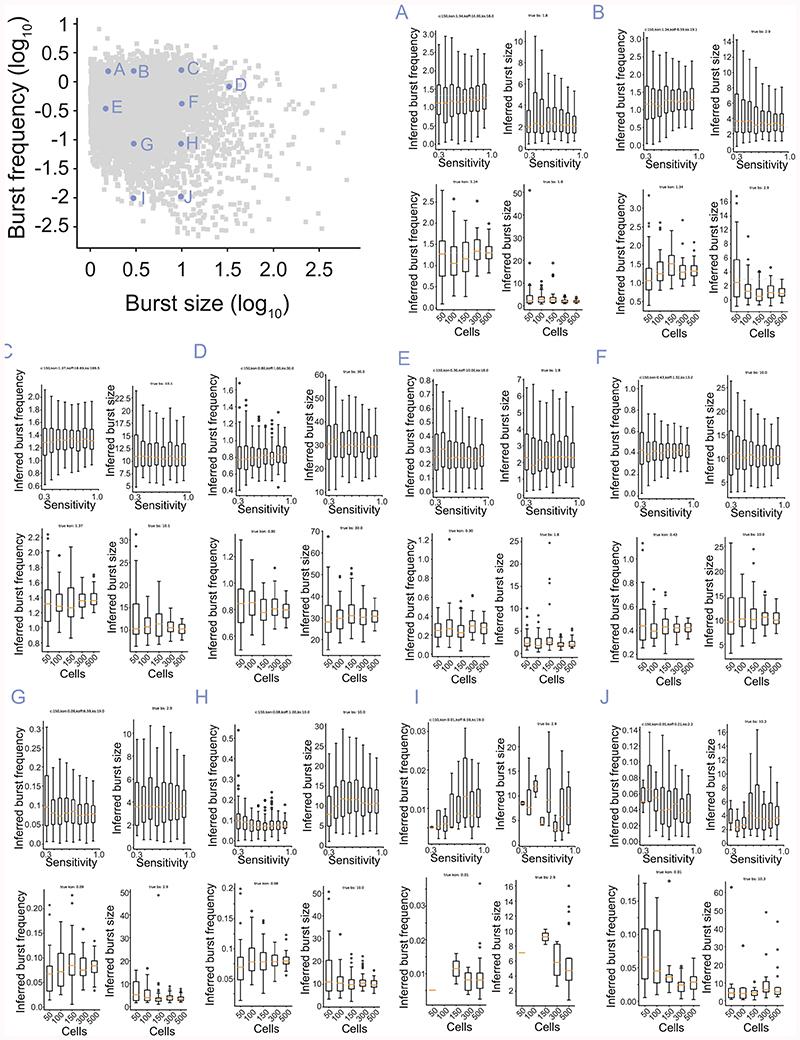
Mammalian gene expression is inherently stochastic, and results in discrete bursts of RNA molecules that are synthesized from each allele. Although transcription is known to be regulated by promoters and enhancers, it is unclear how cis-regulatory sequences encode transcriptional burst kinetics. Characterization of transcriptional bursting, including the burst size and frequency, has mainly relied on live-cell or single-molecule RNA fluorescence in situ hybridization recordings of selected loci. Here we determine transcriptome-wide burst frequencies and sizes for endogenous mouse and human genes using allele-sensitive single-cell RNA sequencing. We show that core promoter elements affect burst size and uncover synergistic effects between TATA and initiator elements, which were masked at mean expression levels. Notably, we provide transcriptome-wide evidence that enhancers control burst frequencies, and demonstrate that cell-type-specific gene expression is primarily shaped by changes in burst frequencies. Together, our data show that burst frequency is primarily encoded in enhancers and burst size in core promoters, and that allelic single-cell RNA sequencing is a powerful model for investigating transcriptional kinetics.
哺乳动物的基因表达本质上是随机的,导致从每个等位基因合成离散的 RNA 分子爆发。尽管转录已知受到启动子和增强子的调控,但尚不清楚顺式调控序列如何编码转录爆发动力学。转录爆发的特征描述,包括爆发大小和频率,主要依赖于选定基因座的活细胞或单个分子 RNA 荧光原位杂交记录。在这里,我们使用等位基因敏感的单细胞 RNA 测序来确定内源性小鼠和人类基因的全转录组爆发频率和大小。我们表明核心启动子元件影响爆发大小,并揭示了 TATA 和起始元件之间的协同作用,这些作用在平均表达水平下被掩盖了。值得注意的是,我们提供了全转录组证据,表明增强子控制爆发频率,并证明细胞类型特异性基因表达主要由爆发频率的变化决定。总之,我们的数据表明,爆发频率主要编码在增强子中,爆发大小主要编码在核心启动子中,等位基因单细胞 RNA 测序是研究转录动力学的有力模型。




 Zotero 插件