Department of Neuropediatrics and Muscle Disorders, Medical Center - University of Freiburg, Faculty of Medicine, University of Freiburg, Freiburg, Germany.
Department of Neonatology, University Children's Hospital Basel UKBB, University of Basel, Basel, Switzerland.
PLoS One. 2019 Jan 3;14(1):e0210004. doi: 10.1371/journal.pone.0210004. eCollection 2019.
Primary blood coagulation and wound sealing are orchestrated by von Willebrand factor (VWF), a large multimeric glycoprotein. Upon release of arginine vasopressin (AVP), VWF containing high molecular weight multimers is secreted. By measuring copeptin, the C-terminal part of the AVP prohormone, we recently found strongly increased AVP levels in children with febrile seizures (FS) as compared to children with fever but without seizures. It is unknown if increased AVP levels in FS are of any biological function. Therefore, our a priori hypothesis was that children with FS have increased VWF parameters in parallel with higher AVP levels.
We conducted a prospective, cross-sectional study of children aged between 6 months and 5 years. Children that presented at our emergency department with fever or a recent FS (within four hours) were evaluated to be included to the study. We measured serum copeptin and VWF parameters, including analyses of VWF:Antigen (WVF:Ag), VWF:collagen binding activity (VWF:CB) and VWF multimers in children with FS, febrile infections without seizures and additionally, in a non-febrile control group.
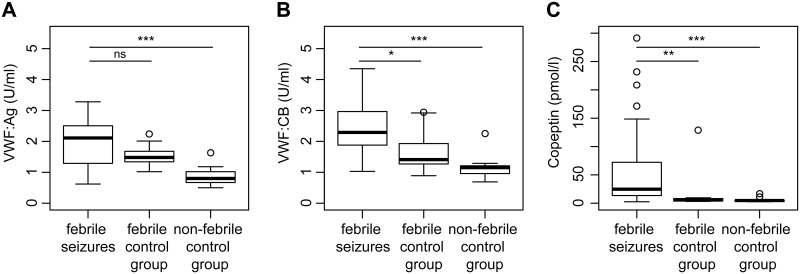
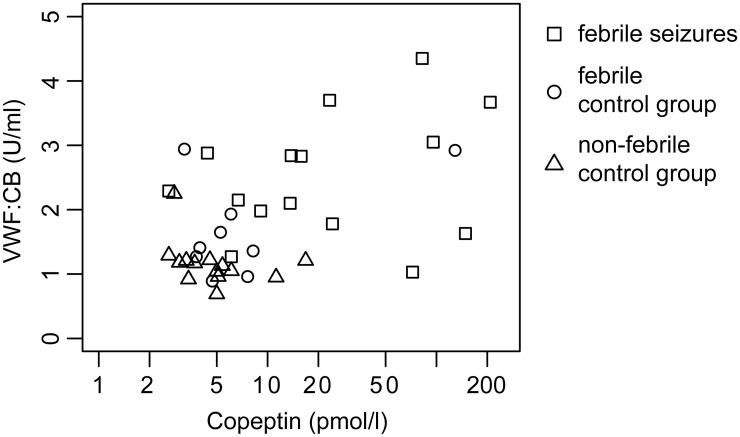
We included 54 children in our study, 30 with FS, 10 in the febrile control group, and 14 in the non-febrile control group. Serum copeptin levels were significantly higher in children with FS (median [IQR] 24.73 pmol/l [13.65-68.65]) compared to the febrile control group (5.66 pmol/l [4.15-8.07], p = 0.002) and the non-febrile control group (4.78 pmol/l [3.33-5.3], p<0.001). VWF:CB levels were also significantly higher in children with FS (VWF:CB 2.29 U/ml [1.88-2.97]) as compared to the febrile (VWF:CB 1.41 U/ml [1.27-1.93], p = 0.048) and the non-febrile control group (VWF:CB 1.15 U/ml [0.98-1.21], p<0.001). VWF:Ag tended to be higher in children with FS compared to both control groups. Multivariate regression analysis revealed FS and copeptin as major determinants of VWF:CB.
Our results suggest that increased secretion of AVP in children with FS is associated with higher plasma levels of VWF parameters. Especially VWF:CB may serve as additional biomarker in the diagnosis of FS.
原发性凝血和伤口密封由血管性血友病因子(VWF)协调,VWF 是一种大型多聚体糖蛋白。血管加压素(AVP)释放后,富含高分子量多聚体的 VWF 被分泌。通过测量 AV 前体激素 C 端部分的 copeptin,我们最近发现热性惊厥(FS)患儿的 AVP 水平明显升高,而发热但无惊厥的患儿的 AVP 水平升高。尚不清楚 FS 中升高的 AVP 水平是否具有任何生物学功能。因此,我们的先验假设是 FS 患儿的 VWF 参数与更高的 AVP 水平平行增加。
我们进行了一项前瞻性、横断面研究,纳入年龄在 6 个月至 5 岁之间的儿童。我们评估了因发热或近期 FS(4 小时内)就诊于我院急诊科的儿童是否符合纳入研究标准。我们测量了 FS 患儿、发热感染无惊厥患儿和非发热对照组患儿的血清 copeptin 和 VWF 参数,包括 VWF:抗原(VWF:Ag)、VWF:胶原结合活性(VWF:CB)和 VWF 多聚体分析。
我们纳入了 54 名患儿进行研究,其中 30 名患有 FS,10 名在发热对照组,14 名在非发热对照组。FS 患儿的血清 copeptin 水平明显高于发热对照组(中位数[IQR]24.73 pmol/l [13.65-68.65])(p = 0.002)和非发热对照组(4.78 pmol/l [3.33-5.3])(p<0.001)。FS 患儿的 VWF:CB 水平也明显高于发热对照组(VWF:CB 2.29 U/ml [1.88-2.97])(p = 0.048)和非发热对照组(VWF:CB 1.15 U/ml [0.98-1.21])(p<0.001)。与对照组相比,FS 患儿的 VWF:Ag 水平也有升高趋势。多变量回归分析显示 FS 和 copeptin 是 VWF:CB 的主要决定因素。
我们的研究结果表明,FS 患儿中 AVP 的分泌增加与 VWF 参数的血浆水平升高有关。特别是 VWF:CB 可能作为 FS 诊断的额外生物标志物。