Xiaolong Xie, Yang Wu, Qi Wang, Yiyang Zhao, Bo Xiang
Department of Pediatric Surgery, West China Hospital, Sichuan University, China.
Medicine (Baltimore). 2019 Jan;98(1):e13826. doi: 10.1097/MD.0000000000013826.
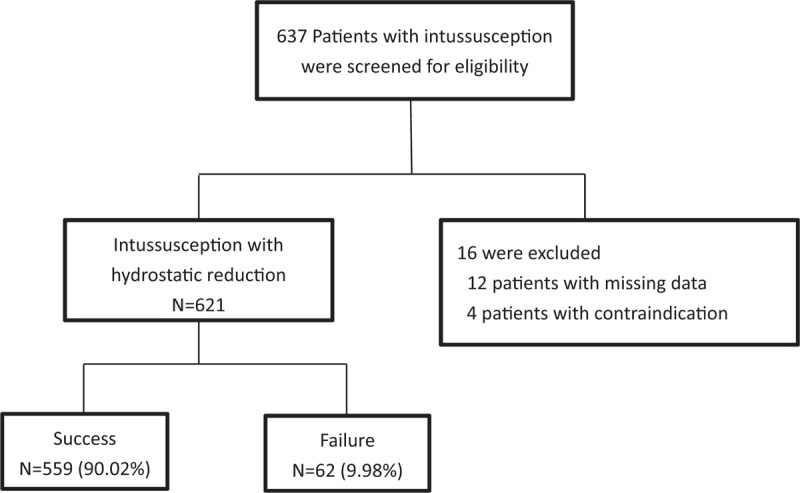
The aim of this current study was to explore the risk factors associated with failure of hydrostatic reduction of intussusception in pediatric patients.Patients with intussusception treated with hydrostatic reduction from January 2010 to December 2016 were retrospectively analyzed. Candidates for inclusion in the study were children from 0 to 18 who were diagnosed with intussusception and treated with hydrostatic reduction. We excluded the patients who had contraindications for hydrostatic reduction, which included peritonitis, perforation signs, and non-responsive shock that required surgery. The data collected included: demographic data (sex, age, and bodyweight), symptoms (vomiting, abdominal pain, rectal bleeding, diarrhea, distention, constipation, and duration of symptoms), signs (temperature, palpable mass, and location of the mass), and other investigations (white blood cell counts, neutrophils, electrolytes, and ultrasound findings).The risk factors for failure of hydrostatic reduction of intussusception were analyzed using the univariable analysis and the multivariable analysis. In the univariable model, the significant risk factors for failure of hydrostatic reduction of intussusception analyzed were age, bodyweight, duration of symptoms, rectal bleeding, constipation, palpable abdominal mass, poor prognosis signs on ultrasound scans and location of mass (the P value for each parameter are stated in ). After the multivariable analysis was done, we found that the significant risk factors for failure of hydrostatic reduction of intussusception were an age of under 1-year-old (OR = 3.915, P = .027), duration of symptoms more than or equal to 48 h (OR = 0.056, P < .001), rectal bleeding (OR = 0.283, P = .003), constipation (OR = 0.086, P < .001), palpable abdominal mass (OR = 0.370, P = .010), and location of mass (left over right side) (OR = 13.782, P < .001).(Table is included in full-text article.)Our study found that an age of under 1-year-old, a duration of symptoms of more than or equal to 48 h, rectal bleeding, constipation, palpable abdominal mass and location of mass (left over right side) were risk factors for the failure of hydrostatic reduction of intussusception.
本研究的目的是探讨小儿肠套叠水压复位失败的相关危险因素。对2010年1月至2016年12月期间接受水压复位治疗的肠套叠患者进行回顾性分析。纳入研究的对象为0至18岁被诊断为肠套叠并接受水压复位治疗的儿童。我们排除了有水压复位禁忌证的患者,这些禁忌证包括腹膜炎、穿孔体征以及需要手术治疗的无反应性休克。收集的数据包括:人口统计学数据(性别、年龄和体重)、症状(呕吐、腹痛、直肠出血、腹泻、腹胀、便秘以及症状持续时间)、体征(体温、可触及肿块及肿块位置)以及其他检查(白细胞计数、中性粒细胞、电解质和超声检查结果)。使用单因素分析和多因素分析来分析肠套叠水压复位失败的危险因素。在单因素模型中,分析得出的肠套叠水压复位失败的显著危险因素为年龄、体重、症状持续时间、直肠出血、便秘、可触及腹部肿块、超声扫描预后不良体征及肿块位置(各参数的P值在文中列出)。进行多因素分析后,我们发现肠套叠水压复位失败的显著危险因素为年龄小于1岁(OR = 3.915,P = 0.027)、症状持续时间大于或等于48小时(OR = 0.056,P < 0.001)、直肠出血(OR = 0.283,P = 0.003)、便秘(OR = 0.086,P < 0.001)、可触及腹部肿块(OR = 0.370,P = 0.010)以及肿块位置(左侧多于右侧)(OR = 13.782,P < 0.001)。(表格包含在全文中)我们的研究发现,年龄小于1岁、症状持续时间大于或等于48小时、直肠出血、便秘、可触及腹部肿块以及肿块位置(左侧多于右侧)是肠套叠水压复位失败的危险因素。