Meinig School of Biomedical Engineering, Cornell University, Ithaca, New York, United States of America.
PLoS One. 2019 Jan 4;14(1):e0204295. doi: 10.1371/journal.pone.0204295. eCollection 2019.
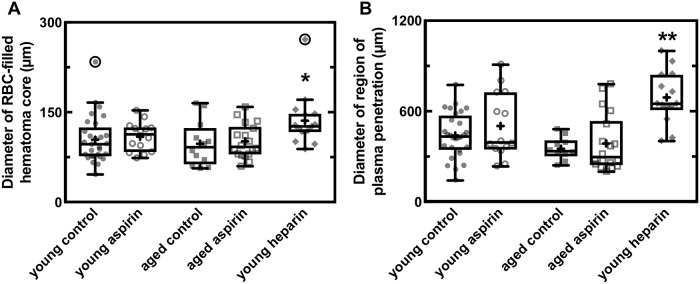
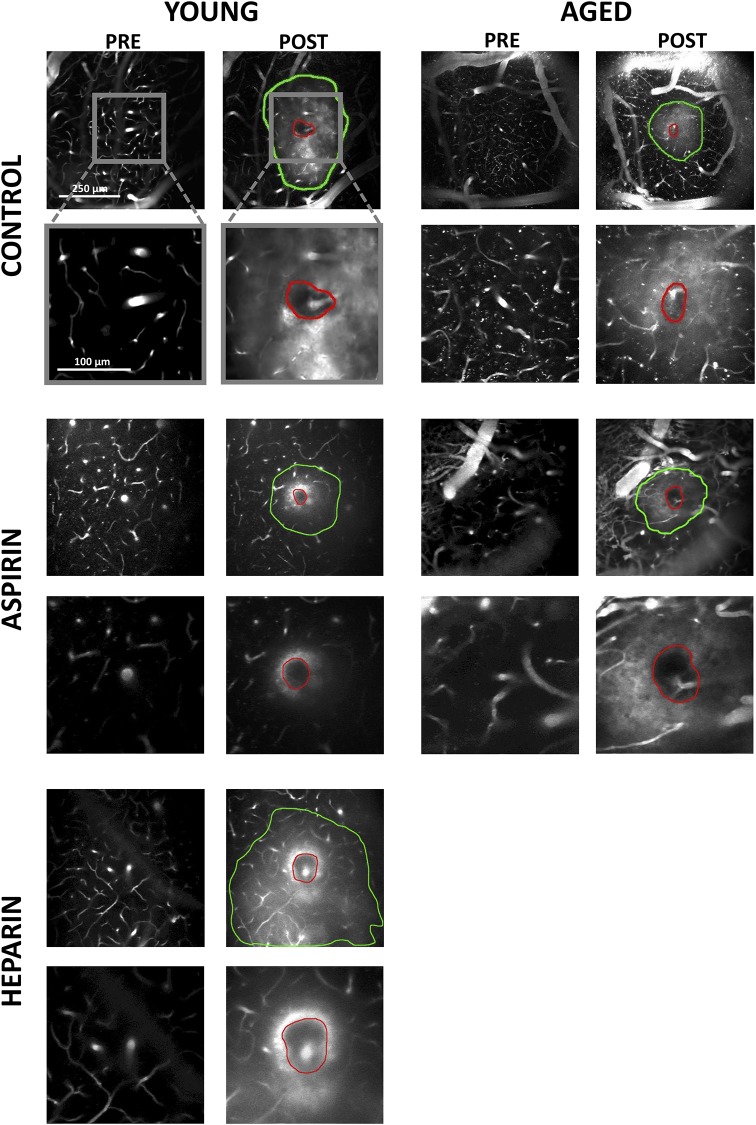
Microhemorrhages are common in the aging brain and are thought to contribute to cognitive decline and the development of neurodegenerative diseases, such as Alzheimer's disease. Chronic aspirin therapy is widespread in older individuals and decreases the risk of coronary artery occlusions and stroke. There remains a concern that such aspirin usage may prolong bleeding after a vessel rupture in the brain, leading to larger bleeds that cause more damage to the surrounding tissue. Here, we aimed to understand the influence of aspirin usage on the size of cortical microhemorrhages and explored the impact of age. We used femtosecond laser ablation to rupture arterioles in the cortex of both young (2-5 months old) and aged (18-29 months old) mice dosed on aspirin in their drinking water and measured the extent of penetration of both red blood cells and blood plasma into the surrounding tissue. We found no difference in microhemorrhage size for both young and aged mice dosed on aspirin, as compared to controls (hematoma diameter = 104 +/- 39 (97 +/- 38) μm in controls and 109 +/- 25 (101 +/- 28) μm in aspirin-treated young (aged) mice; mean +/- SD). In contrast, young mice treated with intravenous heparin had an increased hematoma diameter of 136 +/- 44 μm. These data suggest that aspirin does not increase the size of microhemorrhages, supporting the safety of aspirin usage.
微出血在衰老的大脑中很常见,据认为它们会导致认知能力下降和神经退行性疾病(如阿尔茨海默病)的发展。慢性阿司匹林治疗在老年人中广泛应用,可以降低冠状动脉闭塞和中风的风险。人们仍然担心,这种阿司匹林的使用可能会延长大脑血管破裂后的出血时间,导致更大的出血,从而对周围组织造成更大的损伤。在这里,我们旨在了解阿司匹林使用对皮质微出血大小的影响,并探讨年龄的影响。我们使用飞秒激光烧蚀来破坏年轻(2-5 个月大)和年老(18-29 个月大)小鼠皮层中的小动脉,这些小鼠在饮用水中服用阿司匹林,并测量红细胞和血浆渗透到周围组织的程度。与对照组相比,服用阿司匹林的年轻和年老小鼠的微出血大小没有差异(血肿直径=对照组 104 +/- 39(97 +/- 38)μm,阿司匹林治疗的年轻(年老)小鼠 109 +/- 25(101 +/- 28)μm;平均值 +/- SD)。相比之下,静脉注射肝素治疗的年轻小鼠的血肿直径增加到 136 +/- 44 μm。这些数据表明,阿司匹林不会增加微出血的大小,支持阿司匹林使用的安全性。