Institut Clínic d´Oftalmología (ICOF), Hospital Clinic, Barcelona, Spain.
Departmento de Oftalmología, Hospital Vall de Hebron, Barcelona, Spain.
PLoS One. 2019 Jan 4;14(1):e0209997. doi: 10.1371/journal.pone.0209997. eCollection 2019.
To evaluate the long-term cumulative probability of intraocular pressure (IOP) elevation with the intravitreal dexamethasone implant (IDI) when used to treat different indications: diabetic macular edema, uveitis, retinal vein occlusion.
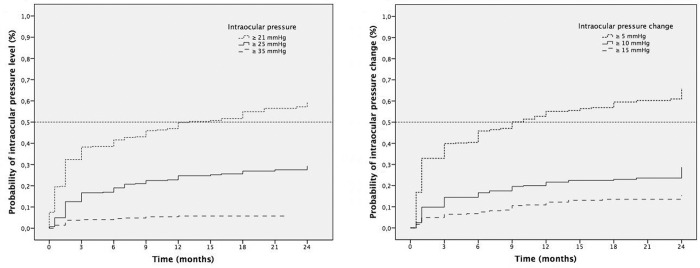
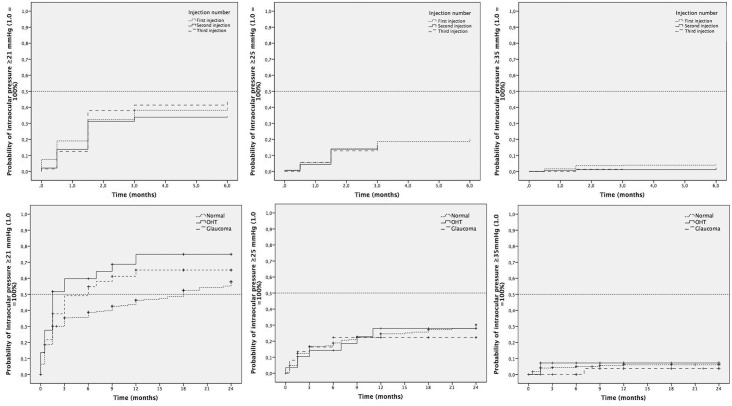
705 IDI injections (429 eyes) were assessed and Kaplan-Meier graphs were generated to assess: the probability of different levels of IOP elevation (IOP≥21, ≥25 or ≥35 mmHg), IOP change ≥10 mmHg, initiation of IOP-lowering treatment, glaucoma surgery, IOP change with repeat injections and IOP elevation in eyes with glaucoma and ocular hypertension (OHT).
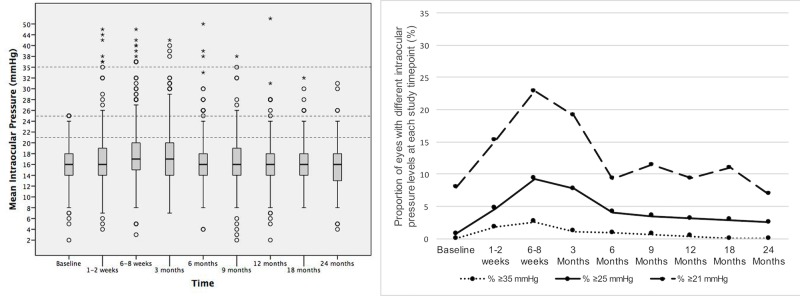
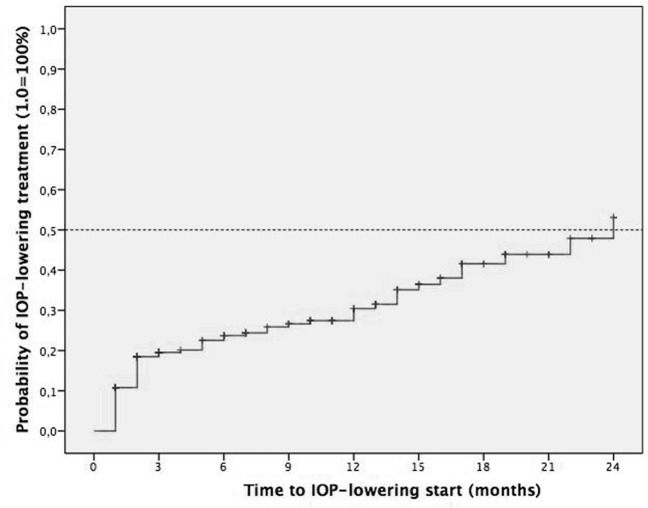
The cumulative probability of IOP ≥21, ≥25 and ≥35 mmHg was 50%-60%, 25%-30% and 6%-7% at 12-24 months, respectively. The probability of initiating IOP-lowering medication was 31%-54% at 12-24 months. Glaucoma and OHT eyes had a higher probability of mild IOP elevation (≥21 mmHg, 65.1%, 75% and 57.8%, p = 0.01), yet a similar moderate (≥25 mmHg, 22.3%, 28% and 30.2%, p = 0.91) and severe elevation of IOP (≥35 mmHg, 3.7%, 7.1% and 4%, p = 0.71) as normal eyes. Glaucoma surgery was required in only 0.9% cases (4/429). At baseline, 8.8% of the treated eyes had glaucoma, 6.7% OHT and 16.9% were already on IOP-lowering medication.
In the long-term (24 months), IOP elevation is common, generally mild (30% IOP, ≥25 mmHg) and well-tolerated, resolving with topical treatment (54%) and rarely requiring surgery (0.9%).
评估玻璃体内注射地塞米松植入物(IDI)治疗不同适应证(糖尿病性黄斑水肿、葡萄膜炎、视网膜静脉阻塞)的患者眼压(IOP)升高的长期累积概率。
对 705 次 IDI 注射(429 只眼)进行评估,并生成 Kaplan-Meier 图以评估:不同眼压升高水平(IOP≥21mmHg、≥25mmHg 或≥35mmHg)的概率、IOP 变化≥10mmHg、开始降眼压治疗、青光眼手术、重复注射时的 IOP 变化以及青光眼和高眼压(OHT)眼中的 IOP 升高。
在 12-24 个月时,IOP≥21mmHg、≥25mmHg 和≥35mmHg 的累积概率分别为 50%-60%、25%-30%和 6%-7%。在 12-24 个月时,开始使用降眼压药物的概率为 31%-54%。青光眼和 OHT 眼发生轻度 IOP 升高(≥21mmHg)的概率较高(65.1%、75%和 57.8%,p=0.01),但中度(≥25mmHg)和重度(≥35mmHg)IOP 升高的概率相似(22.3%、28%和 30.2%,p=0.91 和 3.7%、7.1%和 4%,p=0.71)。仅 0.9%(4/429)的病例需要进行青光眼手术。在基线时,8.8%的治疗眼患有青光眼,6.7%患有 OHT,16.9%已使用降眼压药物。
在长期(24 个月)内,IOP 升高很常见,通常为轻度(30%的 IOP≥25mmHg),且患者可耐受,通过局部治疗(54%)解决,很少需要手术(0.9%)。