Finnmark Hospital Trust, Kirkenes, Norway.
Institute of Clinical Medicine, University of Oslo, Oslo, Norway.
BMC Cardiovasc Disord. 2019 Jan 5;19(1):4. doi: 10.1186/s12872-018-0989-8.
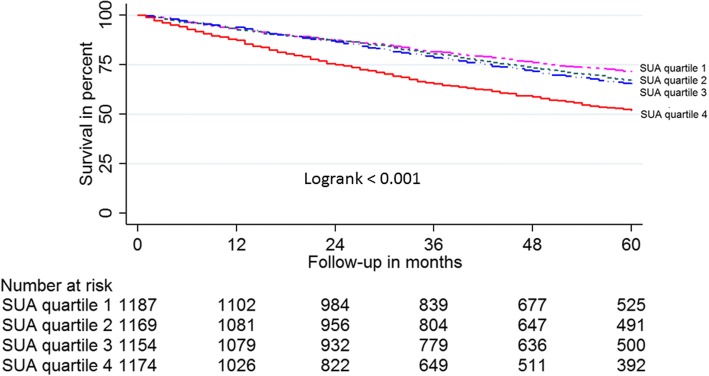
Elevated serum uric acid (SUA) is associated with poor prognosis in patients with cardiovascular disease, yet it is still not decided whether the role of SUA is causal or only reflects an underlying disease. The purpose of the study was to investigate if SUA was an independent predictor of 5-year all-cause mortality in a propensity score matched cohort of chronic heart failure (HF) outpatients. Furthermore, to assess whether gender or renal function modified the effect of SUA.
Patients (n = 4684) from the Norwegian Heart Failure Registry with baseline SUA were included in the study. Individuals in the highest gender-specific SUA quartile were propensity score matched 1:1 with patients in the lowest three SUA quartiles. The propensity score matching procedure created 928 pairs of patients (73.4% males, mean age 71.4 ± 11.5 years) with comparable baseline characteristics. Kaplan Meier and Cox regression analyses were used to investigate the independent effect of SUA on all-cause mortality.
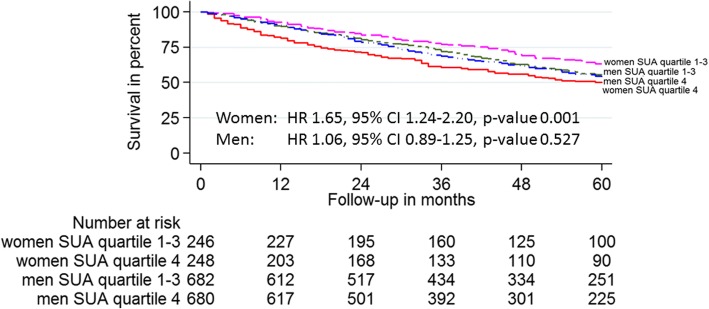
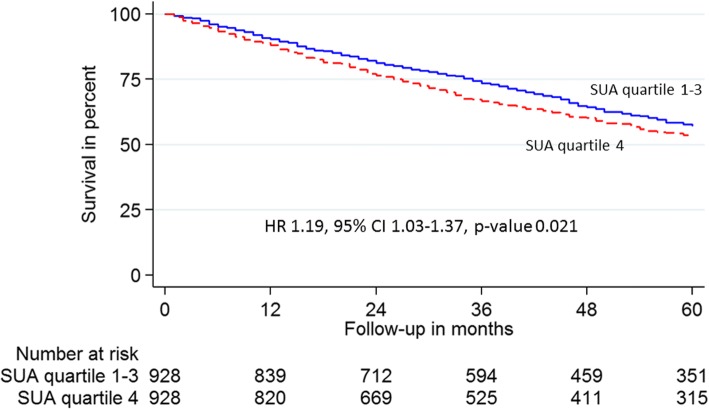
SUA in the highest quartile was an independent predictor of all-cause mortality in HF outpatients (hazard ratio (HR) 1.19, 95% confidence interval (CI) 1.03-1.37, p-value 0.021). Gender was found to interact the relationship between SUA and all-cause mortality (p-value for interaction 0.007). High SUA was an independent predictor of all-cause mortality in women (HR 1.65, 95% CI 1.24-2.20, p-value 0.001), but not in men (HR 1.06, 95% CI 0.89-1.25, p-value 0.527). Renal function did not influence the relationship between SUA and all-cause mortality (p-value for interaction 0.539).
High SUA was independently associated with inferior 5-year survival in Norwegian HF outpatients. The finding was modified by gender and high SUA was only an independent predictor of 5-year all-cause mortality in women, not in men.
血清尿酸(SUA)升高与心血管疾病患者的预后不良有关,但 SUA 的作用是因果关系还是仅反映潜在疾病仍未确定。本研究的目的是在慢性心力衰竭(HF)门诊患者的倾向评分匹配队列中,调查 SUA 是否是 5 年全因死亡率的独立预测因子。此外,评估性别或肾功能是否改变了 SUA 的作用。
纳入了挪威心力衰竭登记处基线时 SUA 升高的患者(n=4684)。根据性别特异性 SUA 四分位数将最高四分位数的个体与最低三分位数的患者进行倾向评分 1:1 匹配。倾向评分匹配程序创建了 928 对患者(73.4%为男性,平均年龄 71.4±11.5 岁),具有相似的基线特征。Kaplan-Meier 和 Cox 回归分析用于研究 SUA 对全因死亡率的独立影响。
SUA 最高四分位数是 HF 门诊患者全因死亡率的独立预测因子(危险比(HR)1.19,95%置信区间(CI)1.03-1.37,p 值 0.021)。性别被发现与 SUA 和全因死亡率之间的关系存在交互作用(交互作用 p 值 0.007)。高 SUA 是女性全因死亡率的独立预测因子(HR 1.65,95%CI 1.24-2.20,p 值 0.001),但不是男性(HR 1.06,95%CI 0.89-1.25,p 值 0.527)。肾功能不影响 SUA 与全因死亡率之间的关系(交互作用 p 值 0.539)。
高 SUA 与挪威 HF 门诊患者 5 年生存率降低独立相关。这一发现受性别影响,并且高 SUA 仅是女性而不是男性 5 年全因死亡率的独立预测因子。