Sieburth Leslie E, Vincent Jessica N
School of Biological Sciences, University of Utah, Salt Lake City, UT, USA.
F1000Res. 2018 Dec 17;7. doi: 10.12688/f1000research.16203.1. eCollection 2018.
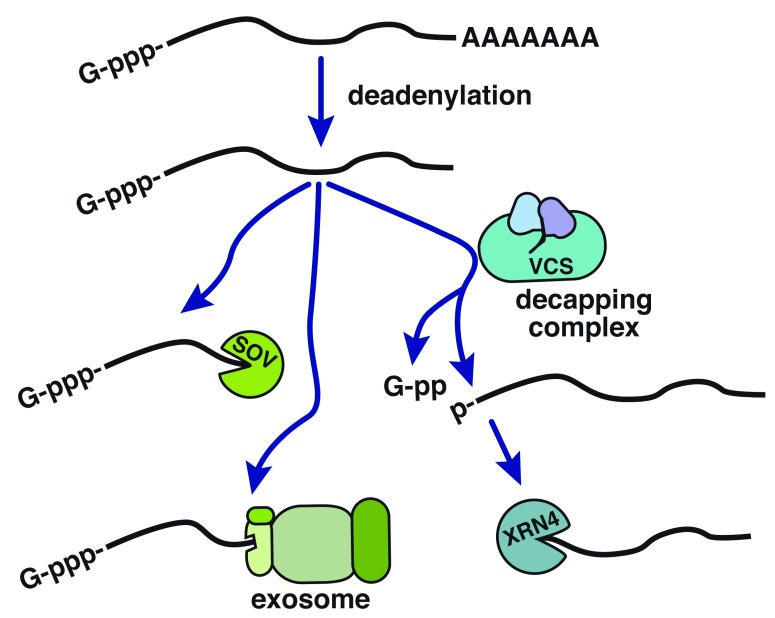
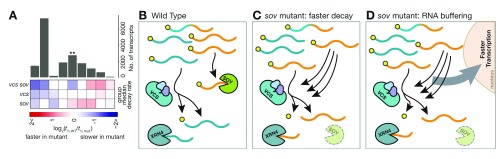
Gene expression is typically quantified as RNA abundance, which is influenced by both synthesis (transcription) and decay. Cytoplasmic decay typically initiates by deadenylation, after which decay can occur through any of three cytoplasmic decay pathways. Recent advances reveal several mechanisms by which RNA decay is regulated to control RNA abundance. mRNA can be post-transcriptionally modified, either indirectly through secondary structure or through direct modifications to the transcript itself, sometimes resulting in subsequent changes in mRNA decay rates. mRNA abundances can also be modified by tapping into pathways normally used for RNA quality control. Regulated mRNA decay can also come about through post-translational modification of decapping complex subunits. Likewise, mRNAs can undergo changes in subcellular localization (for example, the deposition of specific mRNAs into processing bodies, or P-bodies, where stabilization and destabilization occur in a transcript- and context-dependent manner). Additionally, specialized functions of mRNA decay pathways were implicated in a genome-wide mRNA decay analysis in Arabidopsis. Advances made using plants are emphasized in this review, but relevant studies from other model systems that highlight RNA decay mechanisms that may also be conserved in plants are discussed.
基因表达通常以RNA丰度来量化,而RNA丰度受合成(转录)和降解两者影响。细胞质降解通常通过去腺苷酸化启动,之后降解可通过三种细胞质降解途径中的任何一种发生。最近的进展揭示了几种调节RNA降解以控制RNA丰度的机制。mRNA可以进行转录后修饰,要么通过二级结构间接修饰,要么通过对转录本本身进行直接修饰,有时会导致mRNA降解速率随后发生变化。mRNA丰度也可以通过利用通常用于RNA质量控制的途径来修饰。受调控的mRNA降解也可以通过脱帽复合体亚基的翻译后修饰来实现。同样,mRNA可以经历亚细胞定位的变化(例如,特定mRNA沉积到加工小体或P小体中,在那里,转录本和环境依赖的方式发生稳定和不稳定)。此外,在拟南芥的全基因组mRNA降解分析中,mRNA降解途径的特殊功能也有所涉及。本综述强调了利用植物取得的进展,但也讨论了来自其他模型系统的相关研究,这些研究突出了可能在植物中也保守的RNA降解机制。