Department of Animal Science, Michigan State University, East Lansing 48824, MI.
Poult Sci. 2019 May 1;98(5):1935-1946. doi: 10.3382/ps/pey574.
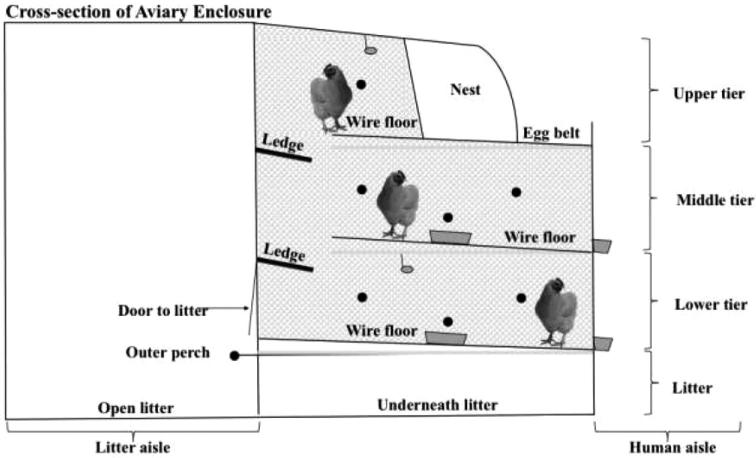
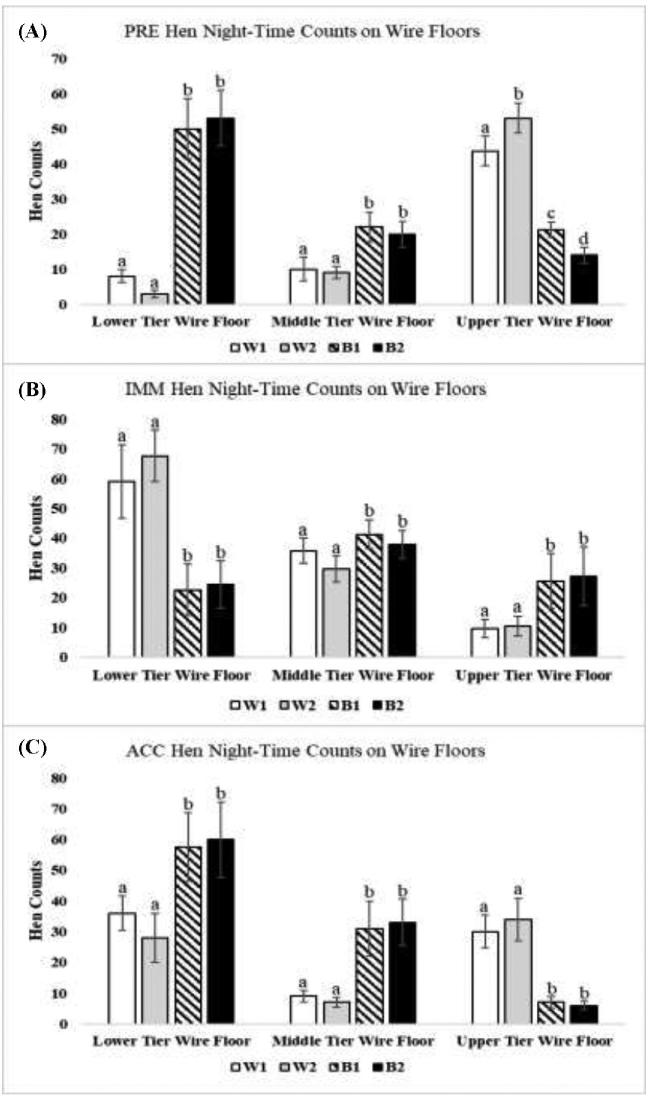
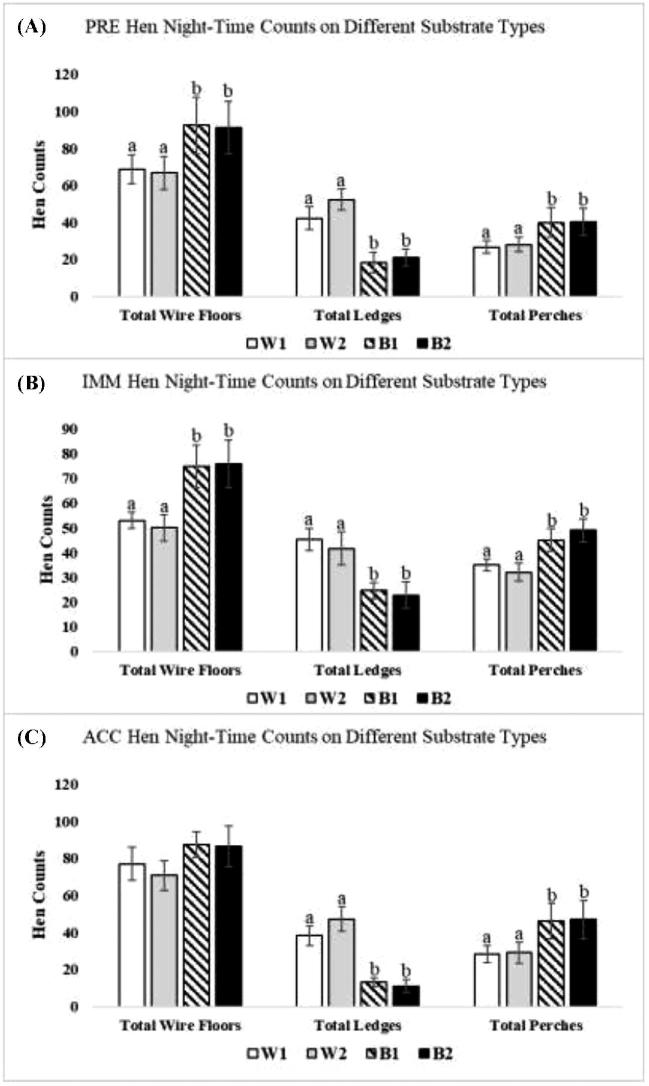
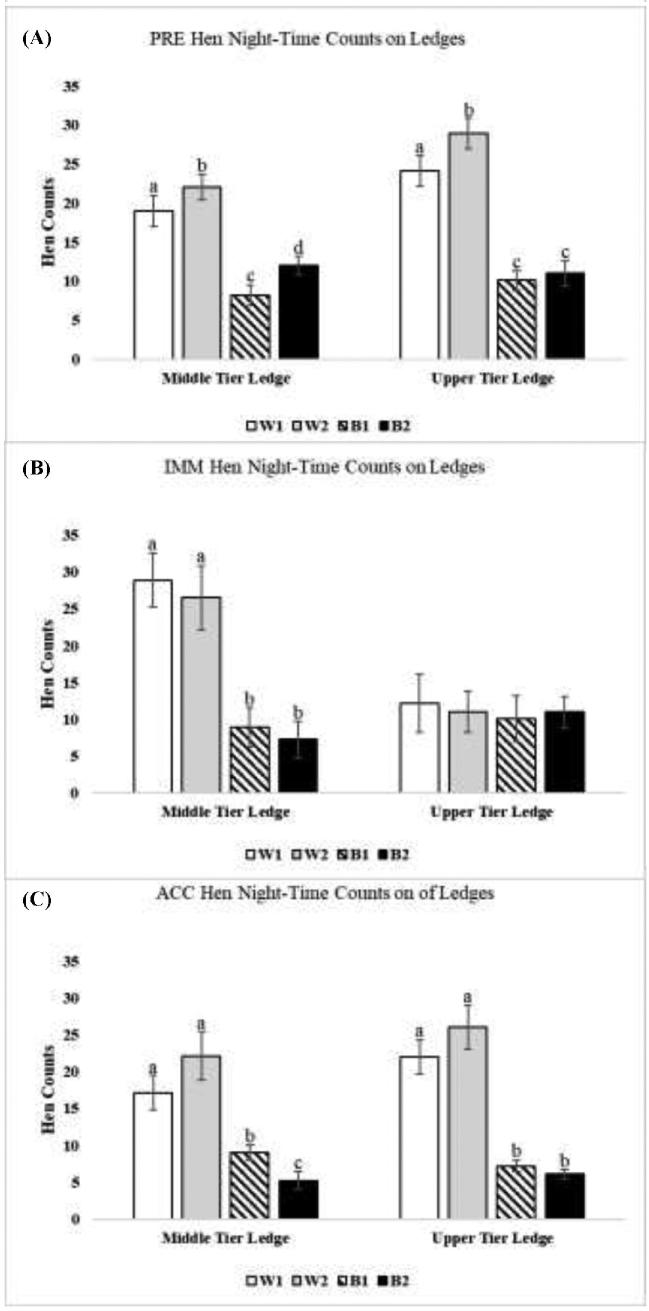
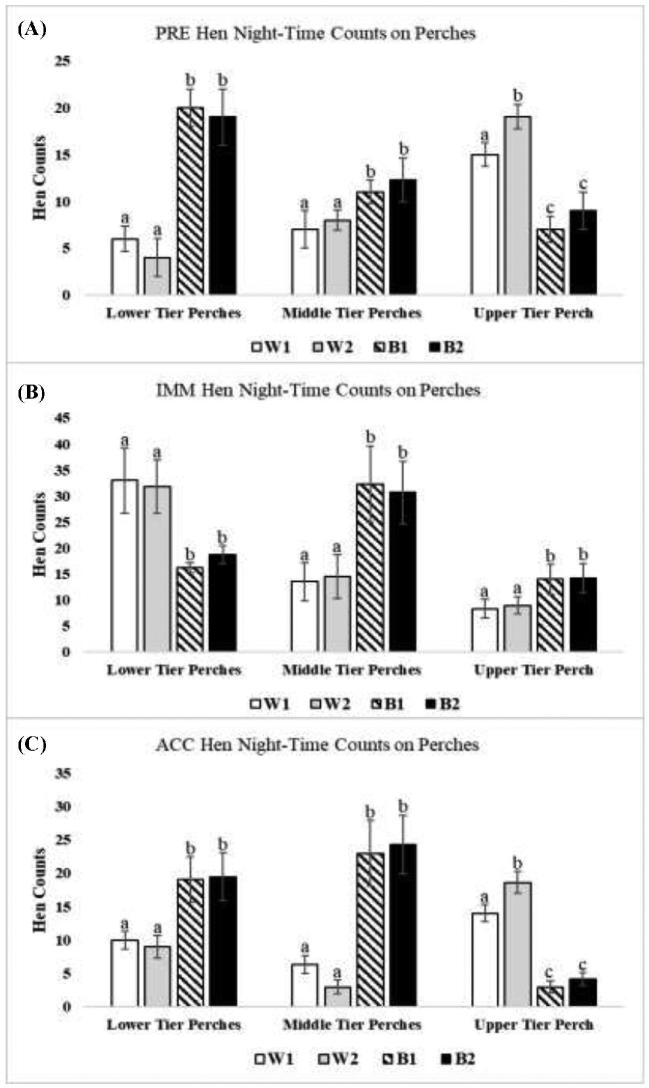
Multi-tiered aviaries for laying hens are designed to provide resources, such as perches, that allow birds to perform natural behaviors, thus improving their welfare. This research examined nighttime roosting heights and substrates used by laying hens of 4 genetic strains (Dekalb White: W1, Hy-Line W36: W2, Hy-Line Brown: B1, Bovans Brown: B2), in multitier aviaries (144 hens/unit, 4 units/strain) at 25 to 28 wk of age (peak lay). Influence of litter provision on roosting patterns of the strains was also tested. Direct observations of hens' nighttime roosting patterns on wire floors, ledges and perches across tiers were conducted before (PRE), immediately after (IMM), and 3 wk after (ACC) hens gained access to litter. During all periods, more W1 and W2 hens roosted on middle and upper ledges than B1 and B2 hens (all P≤0.05), while more B1 and B2 hens used perches throughout the aviary than W1 and W2 hens (all P≤0.05). W1 (15±1.9, 14±3.36) and W2 (19±2.1, 18±2.6) hens occupied perches in the upper tier in greater numbers than B1 (7±3.2, 3±4.6) and B2 (11±2.1, 5±3.36) hens during PRE (P = 0.01) and ACC (P = 0.02) periods, respectively. B1 and B2 hens occupied wire floors in larger numbers than W1 and W2 hens during PRE (P = 0.02) and IMM (P = 0.03) periods, though this difference disappeared in the ACC period. During the IMM period, more W1 and W2 roosted in the lower tier, while more B1 and B2 hens were observed in the middle and upper tiers (all P ≤ 0.05). These findings demonstrate the importance of perches for B1 and B2 hens and space to roost higher in aviary units for W1 and W2 hens during the night, and underscore the need to consider aviary design, management practices, and preferences of different hen strains to ensure good hen welfare in aviaries.
多层鸡舍专为产蛋母鸡设计,旨在提供栖木等资源,让鸟类能够表现出自然行为,从而提高它们的福利。本研究在 25 至 28 周龄(产蛋高峰期)时,检查了 4 个遗传品系(Dekalb White:W1、Hy-Line W36:W2、Hy-Line Brown:B1、Bovans Brown:B2)的产蛋母鸡在多层鸡舍中的夜间栖息高度和使用的垫料。还测试了垫料对鸡只栖息模式的影响。在母鸡获得垫料之前(PRE)、立即之后(IMM)和 3 周后(ACC),对母鸡在金属丝地板、栖木和梯子上的夜间栖息模式进行了直接观察。在所有时期,W1 和 W2 母鸡比 B1 和 B2 母鸡更喜欢栖息在中层和上层栖木(均 P≤0.05),而 B1 和 B2 母鸡比 W1 和 W2 母鸡更喜欢使用整个鸡舍的栖木(均 P≤0.05)。W1(15±1.9、14±3.36)和 W2(19±2.1、18±2.6)母鸡在上层梯子上栖息的数量多于 B1(7±3.2、3±4.6)和 B2(11±2.1、5±3.36)母鸡在 PRE(P=0.01)和 ACC(P=0.02)期间,B1 和 B2 母鸡在 PRE(P=0.02)和 IMM(P=0.03)期间在金属丝地板上的栖息数量多于 W1 和 W2 母鸡,但在 ACC 期间,这种差异消失了。在 IMM 期间,W1 和 W2 母鸡更多地栖息在下层,而 B1 和 B2 母鸡更多地栖息在中层和上层(均 P≤0.05)。这些发现表明,对于 B1 和 B2 母鸡来说,栖木非常重要,而对于 W1 和 W2 母鸡来说,在夜间鸡舍中需要有较高的栖息空间,这突显了需要考虑鸡舍设计、管理实践和不同母鸡品系的偏好,以确保鸡在鸡舍中的福利良好。