Cui Xiaoyu, Zhao Zeyin, Zhang Gejun, Chen Shuo, Zhao Yue, Lu Jiao
Sino-Dutch Biomedical and Information Engineering School, Northeastern University, Shenyang 110167, China.
Authors contributed equally to this work.
Biomed Opt Express. 2018 Aug 9;9(9):4175-4183. doi: 10.1364/BOE.9.004175. eCollection 2018 Sep 1.
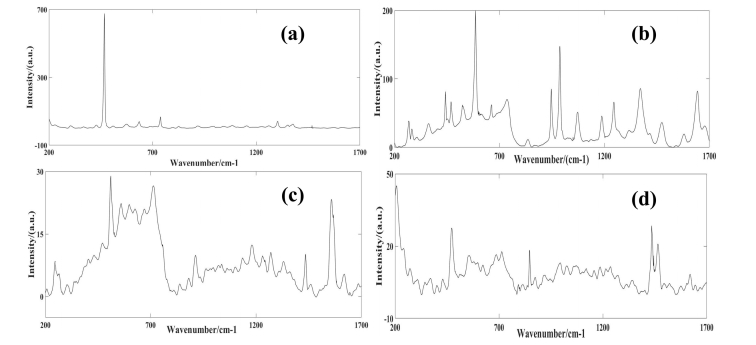
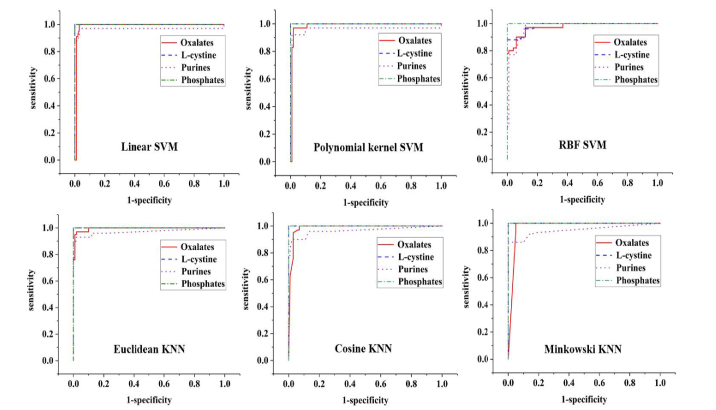
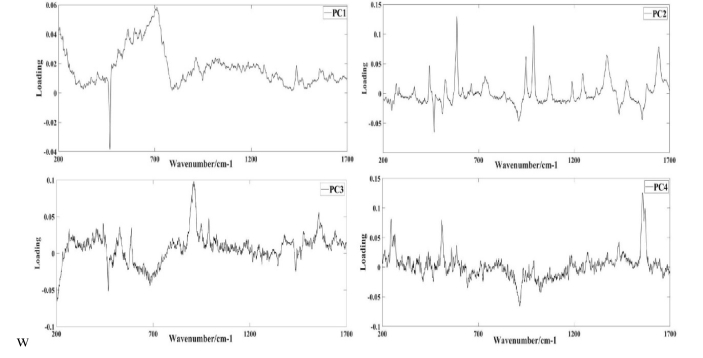
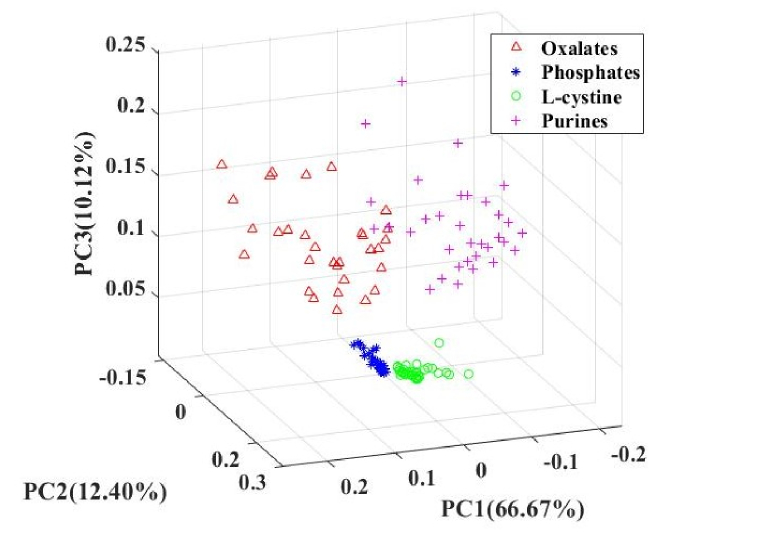
The number of patients with kidney stones worldwide is increasing, and it is particularly important to facilitate accurate diagnosis methods. Accurate analysis of the type of kidney stones plays a crucial role in the patient's follow-up treatment. This study used microscopic Raman spectroscopy to analyze and classify the different mineral components present in kidney stones. There were several Raman changes observed for the different types of kidney stones and the four types were oxalates, phosphates, purines and L-cystine kidney stones. We then combined machine learning techniques with Raman spectroscopy. KNN and SVM combinations with PCA (PCA-KNN, PCA-SVM) methods were implemented to classify the same spectral data set. The results show the diagnostic accuracies are 96.3% for the PCA-KNN and PCA-SVM methods with high sensitivity (0.963, 0.963) and specificity (0.995,0.985). The experimental Raman spectra results of kidney stones show the proposed method has high classification accuracy. This approach can provide support for physicians making treatment recommendations to patients with kidney stones.
全球肾结石患者数量正在增加,因此促进准确的诊断方法尤为重要。准确分析肾结石的类型对患者的后续治疗起着至关重要的作用。本研究使用显微拉曼光谱对肾结石中存在的不同矿物质成分进行分析和分类。观察到不同类型肾结石存在几种拉曼变化,这四种类型分别是草酸盐、磷酸盐、嘌呤和L-胱氨酸肾结石。然后我们将机器学习技术与拉曼光谱相结合。采用KNN和SVM与PCA相结合的方法(PCA-KNN、PCA-SVM)对同一光谱数据集进行分类。结果表明,PCA-KNN和PCA-SVM方法的诊断准确率为96.3%,具有较高的灵敏度(0.963, 0.963)和特异性(0.995, 0.985)。肾结石的实验拉曼光谱结果表明,所提出的方法具有较高的分类准确率。这种方法可以为医生向肾结石患者提出治疗建议提供支持。