Division of Radiotherapy and Imaging, Centre for Cancer Imaging/SRD, The Institute of Cancer Research, 15 Cotswold Road, London, Sutton, SM2 5NG, UK.
Department of Nuclear Medicine, The Royal Marsden NHS Foundation Trust, London, UK.
Eur J Nucl Med Mol Imaging. 2019 Apr;46(4):901-907. doi: 10.1007/s00259-018-4249-z. Epub 2019 Jan 8.
With the availability of ultra-sensitive PSA assays, early biochemical relapse (eBCR) of prostate cancer is increasingly being detected at values much lower than the conventional threshold of 0.2 ng/ml. Accurate localisation of disease in this setting may allow treatment modification and improved outcomes, especially in patients with pelvis-confined or extra-pelvic oligometastasis (defined as up to three pelvic nodal or distant sites). We aimed to measure the detection rate of [68]Ga-PSMA-HBNED-CC (PSMA)-PET/CT and its influence on patient management in eBCR of prostate cancer following radical prostatectomy (RP).
We retrospectively identified 28 patients who underwent PSMA-PET/CT for post-RP eBCR (PSA < 0.5 ng/ml) at our tertiary care cancer centre. Two nuclear medicine physicians independently recorded the sites of PSMA-PET/CT positivity. Multidisciplinary meeting records were accessed to determine changes in management decisions following PSMA-PET/CT scans.
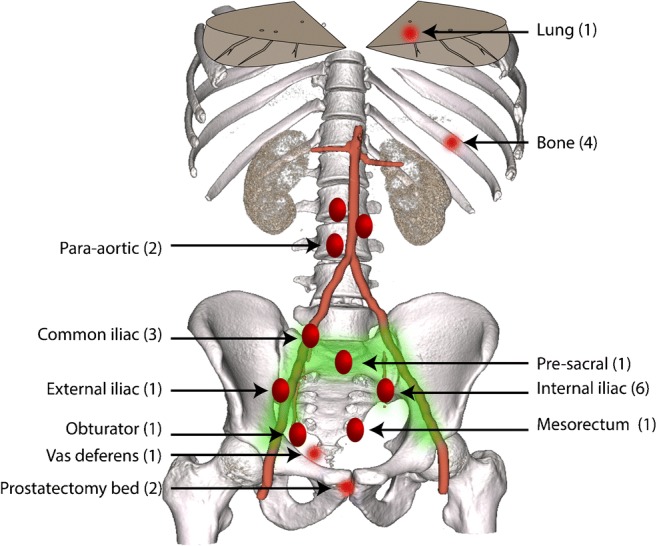
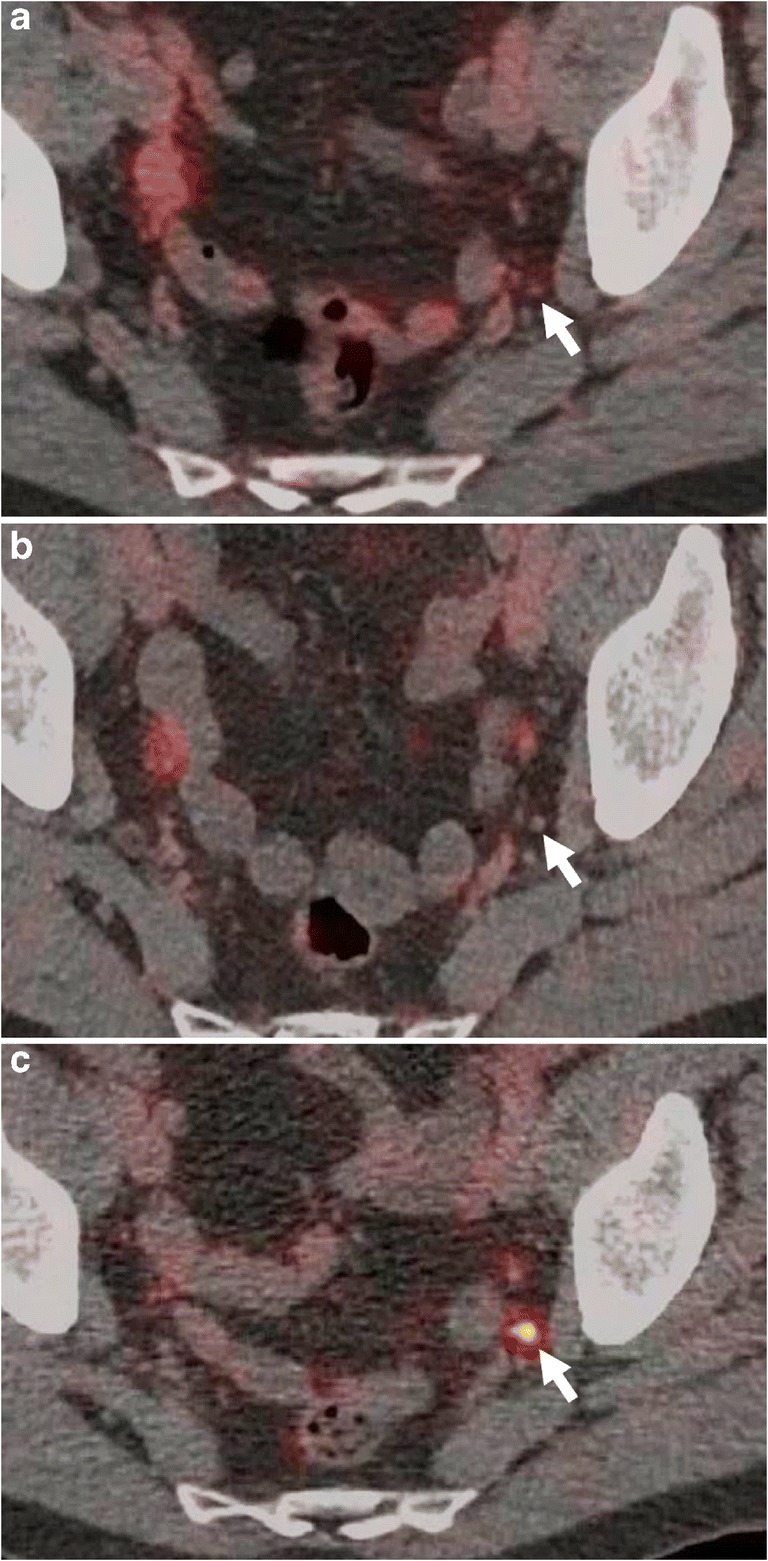
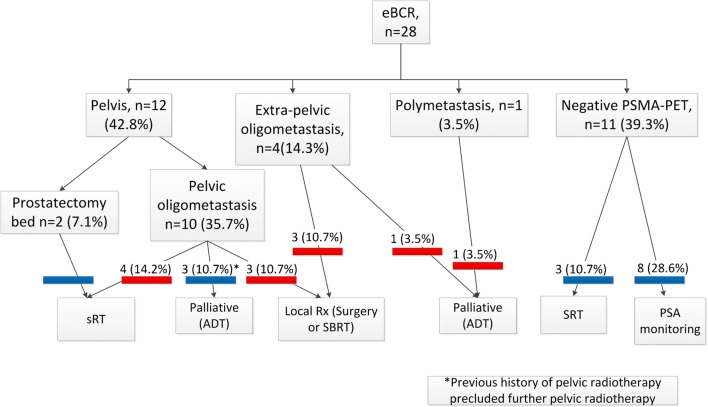
The mean age of patients was 65.6 years (range: 50-76.2 years); median PSA was 0.22 ng/ml (interquartile range: 0.15 ng/ml to 0.34 ng/ml). Thirteen patients (46.4%) had received radiotherapy in the past. PSMA-PET/CT was positive in 17 patients (60.7%). Only one patient had polymetastasis (> 3 sites); the remainder either had prostatectomy bed recurrence (n = 2), pelvic oligometastasis (n = 10), or extra-pelvic oligometastasis (n = 4). PSMA-PET/CT resulted in management change in 12 patients (42.8%), involving stereotactic body radiotherapy (n = 6), salvage radiotherapy (n = 4), and systemic treatment (n = 2).
Our findings show that PSMA-PET/CT has a high detection rate in the eBCR setting following RP, with a large proportion of patients found to have fewer than three lesions. PSMA-PET/CT may be of value in patients with early PSA failure, and impact on the choice of potentially curative salvage treatments.
随着超敏 PSA 检测方法的出现,前列腺癌的早期生化复发(eBCR)在远低于 0.2ng/ml 的传统阈值时越来越多地被检测到。在这种情况下,准确的疾病定位可能会允许治疗方式的改变和改善预后,特别是在骨盆局限性或骨盆外寡转移(定义为最多三个盆腔淋巴结或远处部位)的患者中。我们旨在测量[68]Ga-PSMA-HBNED-CC(PSMA)-PET/CT 在根治性前列腺切除术后(RP)前列腺癌 eBCR 中的检测率及其对患者管理的影响。
我们回顾性地确定了 28 名在我们的三级癌症中心接受 PSMA-PET/CT 检查的接受 RP 后 eBCR(PSA<0.5ng/ml)的患者。两名核医学医师独立记录 PSMA-PET/CT 阳性部位。访问多学科会议记录以确定 PSMA-PET/CT 扫描后管理决策的变化。
患者的平均年龄为 65.6 岁(范围:50-76.2 岁);中位 PSA 为 0.22ng/ml(四分位距:0.15ng/ml 至 0.34ng/ml)。13 名患者(46.4%)曾接受过放疗。17 名患者(60.7%)的 PSMA-PET/CT 呈阳性。只有一名患者有多处转移(>3 处);其余患者要么是前列腺床复发(n=2),要么是骨盆寡转移(n=10),要么是骨盆外寡转移(n=4)。PSMA-PET/CT 导致 12 名患者(42.8%)的管理改变,包括立体定向体部放疗(n=6)、挽救性放疗(n=4)和全身治疗(n=2)。
我们的研究结果表明,PSMA-PET/CT 在 RP 后 eBCR 中具有较高的检测率,其中很大一部分患者的病变少于 3 个。PSMA-PET/CT 可能对早期 PSA 失败的患者有价值,并影响潜在治愈性挽救治疗的选择。