Pharmaceutical Sciences Laboratory, Åbo Akademi University, Artillerigatan 6A, 20520, Åbo, Finland.
Department of Pharmaceutics and Drug Delivery, The University of Mississippi, Oxford, Mississippi, 38677, USA.
AAPS PharmSciTech. 2019 Jan 7;20(2):52. doi: 10.1208/s12249-018-1233-7.
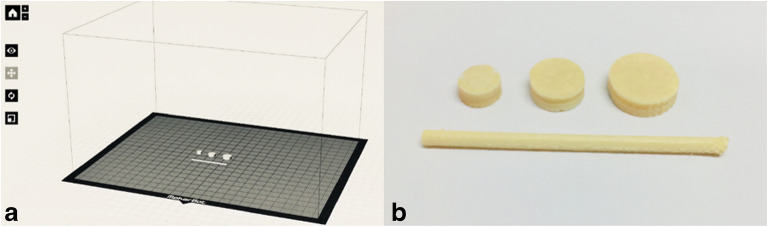
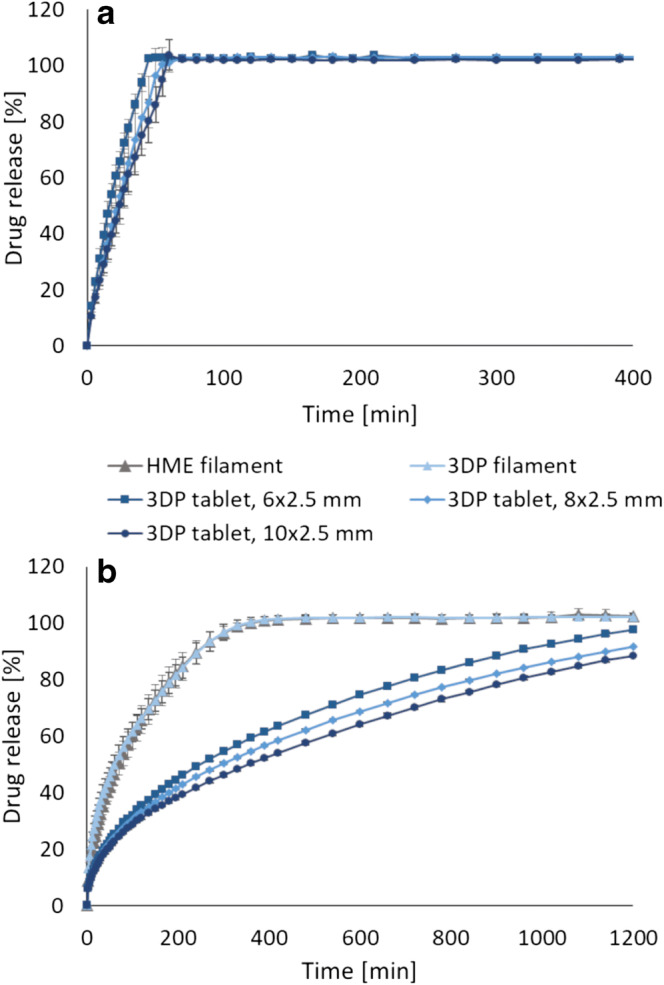
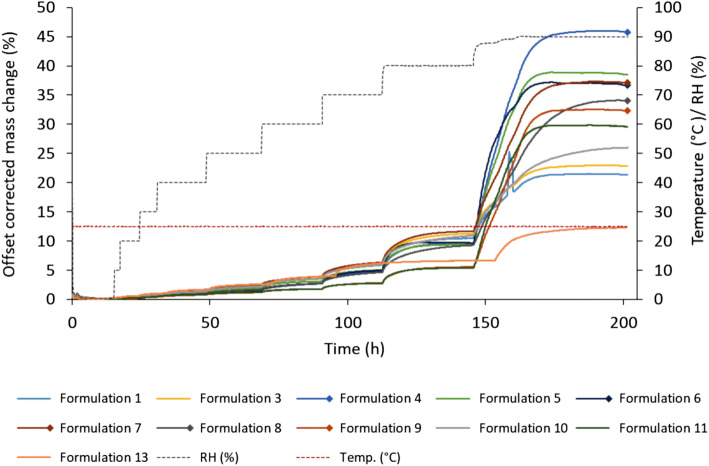
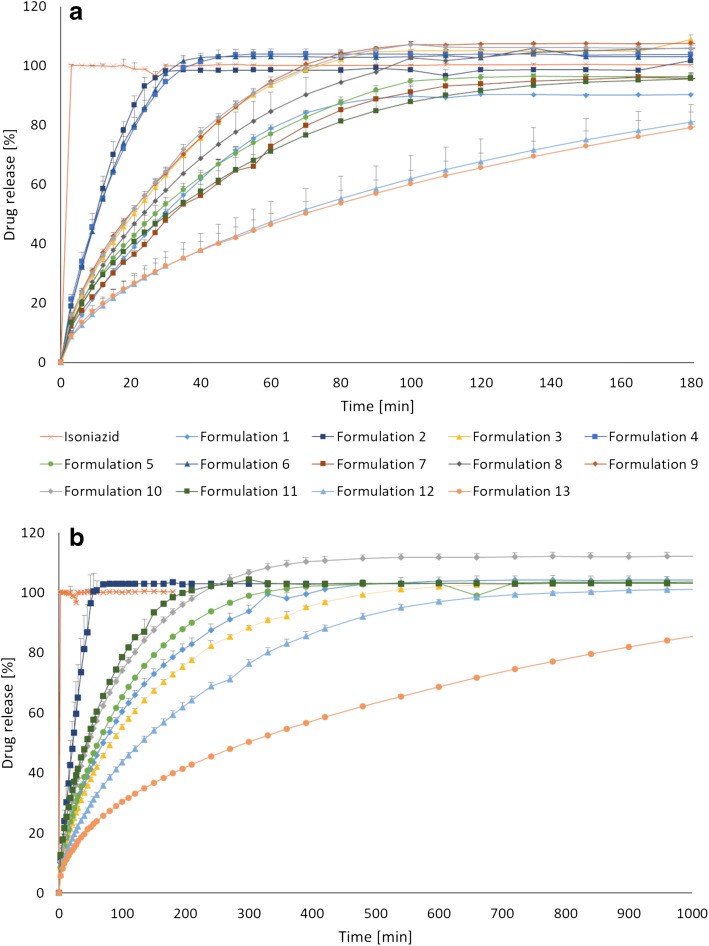
The aim of the present work was to produce 3D-printed oral dosage forms with a sufficient drug dose displaying various release profiles. Hot-melt extrusion was utilized to produce drug-loaded feedstock material that was subsequently 3D-printed into 6, 8, and 10 × 2.5 mm tablets with 15% and 90% infill levels. The prepared formulations contained 30% (w/w) isoniazid in combination with one or multiple pharmaceutical polymers possessing suitable properties for oral drug delivery. Thirteen formulations were successfully hot-melt extruded of which eight had properties suitable for fused deposition modeling 3D printing. Formulations containing HPC were found to be superior regarding printability in this study. Filaments with a breaking distance below 1.5 mm were observed to be too brittle to be fed into the printer. In addition, filaments with high moisture uptake at high relative humidity generally failed to be printable. Different release profiles for the 3D-printed tablets were obtained as a result of using different polymers in the printed formulations. For 8 mm tablets printed with 90% infill, 80% isoniazid release was observed between 40 and 852 min. Drug release characteristics could further be altered by changing the infill or the size of the printed tablets allowing personalization of the tablets. This study presents novel formulations containing isoniazid for prevention of latent tuberculosis and investigates 3D printing technology for personalized production of oral solid dosage forms enabling adjustable dose and drug release properties.
本工作旨在制备具有足够药物剂量且显示不同释放特征的 3D 打印口服剂型。利用热熔挤出法制备载药原料,随后将其 3D 打印成 6、8 和 10×2.5mm 的片剂,填充度分别为 15%和 90%。所制备的制剂包含 30%(w/w)异烟肼,与一种或多种具有适合口服药物递送性能的药用聚合物结合。成功热挤出了 13 种配方,其中 8 种具有适合熔丝制造 3D 打印的性能。在本研究中,含有 HPC 的配方在可打印性方面表现出色。观察到断裂距离低于 1.5mm 的长丝过于脆弱,无法送入打印机。此外,在高相对湿度下吸湿率高的长丝通常无法打印。由于在打印配方中使用了不同的聚合物,因此获得了 3D 打印片剂的不同释放特征。对于用 90%填充度打印的 8mm 片剂,在 40-852min 之间观察到 80%的异烟肼释放。通过改变填充度或打印片剂的尺寸,可以进一步改变药物释放特性,从而实现片剂的个性化。本研究提出了含有异烟肼的新型制剂,用于预防潜伏性结核病,并研究了 3D 打印技术用于个性化生产口服固体制剂,从而实现可调节的剂量和药物释放特性。