Xing Ying, Zhang Min, Li Wen-Bin, Dong Fang, Zhang Feng
Department of Rehabilitation Medicine, The Third Hospital of Hebei Medical University, Shijiazhuang, China.
Department of Pathophysiology, Hebei Medical University, Shijiazhuang, China.
Front Neurosci. 2018 Dec 11;12:929. doi: 10.3389/fnins.2018.00929. eCollection 2018.
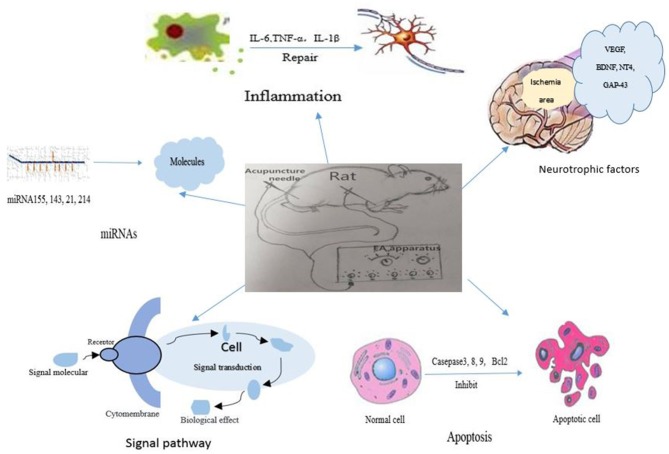
Stroke is one of the main causes of death all over the world. As the combination of acupuncture and electric stimulation, electroacupuncutre is a safe and effective therapy, which is commonly applied in ischemic stroke therapy in both experimental studies and clinical settings. The review was performed via searching for related articles in the databases of OVID, PUBMED, and ISI Web of Science from their respective inceptions to May 2018. In this review, we summarized the mechanism of EA for ischemic stroke via a series of factors, consisting of apoptosis related-factors, inflammatory factors, autophagy-related factors, growth factors, transcriptional factors, cannabinoid CB1 receptors, and other factors. In summary, EA stimulation may effectively alleviate ischemic brain injury via a series of signal pathways and various other factors.
中风是全球主要的死亡原因之一。作为针灸与电刺激的结合,电针是一种安全有效的治疗方法,在实验研究和临床环境中常用于缺血性中风治疗。通过在OVID、PUBMED和ISI Web of Science数据库中从各自创建到2018年5月搜索相关文章进行了本综述。在本综述中,我们通过一系列因素总结了电针对缺血性中风的作用机制,这些因素包括凋亡相关因子、炎症因子、自噬相关因子、生长因子、转录因子、大麻素CB1受体及其他因素。总之,电针刺激可能通过一系列信号通路和各种其他因素有效减轻缺血性脑损伤。