Subramoney Sivenesi, Eastman Emma, Adnams Colleen, Stein Dan J, Donald Kirsten A
Division of Developmental Pediatrics, Department of Pediatrics, and Child Health, Red Cross War Memorial Children's Hospital, University of Cape Town, Cape Town, South Africa.
Department of Psychiatry and Mental Health, University of Cape Town, Cape Town, South Africa.
Front Neurol. 2018 Dec 18;9:1108. doi: 10.3389/fneur.2018.01108. eCollection 2018.
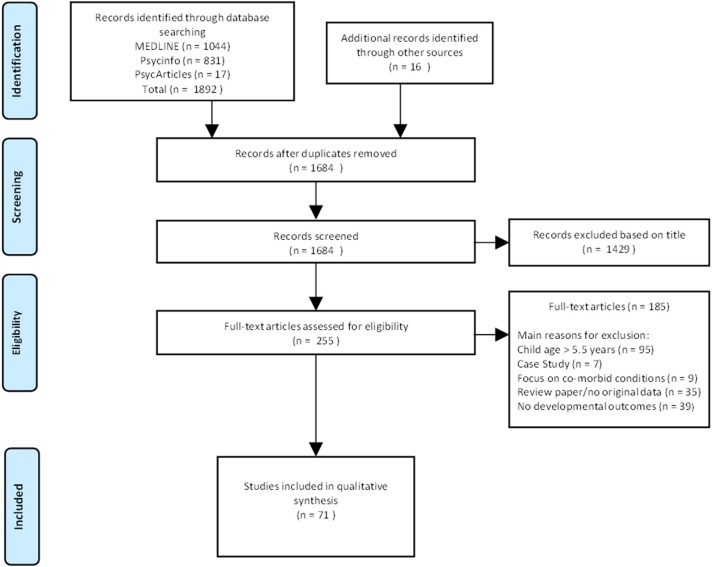
This paper systematically reviews the literature on the effects of prenatal alcohol exposure on early child development from birth to 5 years with the aim to synthesize the developmental outcomes associated with prenatal alcohol exposure, and inform further research to improve our knowledge of the manifestations of prenatal alcohol exposure. Electronic databases (MEDLINE, Psych INFO, and Psych ARTICLES) were searched to find papers on the developmental outcomes of prenatal alcohol exposure in neonates, infants and toddlers and pre-school aged children. Studies were selected based on participants self-reporting alcohol consumption during pregnancy (either prospectively or retrospectively) and/or children being diagnosed with FASD based on a standardized assessment that includes a dysmorphology examination. The search was limited to peer-reviewed, English language studies involving human subjects, up to 5.5 years old. Out of the 1,684 titles screened, a total of 71 papers were identified as relevant and included in this review. The majority of studies were prospective longitudinal studies. A range of assessment modalities (or tools) was used to determine neurodevelopmental outcomes of prenatal exposure to alcohol in the age group under review, the most frequently described being the Bayley Scales of Infant and Toddler Development (BSID) ( = 19). Studies varied in terms of the dose, frequency, and timing of alcohol consumption during pregnancy and methodology used to assess alcohol consumption. Findings demonstrate extensive evidence for poor global developmental outcomes in children prenatally exposed to alcohol, particularly with moderate to severe levels of prenatal alcohol exposure. The outcomes related to lower levels of prenatal alcohol exposure as well as outcomes in specific developmental domains, are poorly understood. Further research should aim to clarify the more subtle or less easily measurable manifestations of prenatal alcohol exposure on early development when the potential for greatest impact of interventions is highest.
本文系统回顾了关于产前酒精暴露对出生至5岁儿童早期发育影响的文献,旨在综合与产前酒精暴露相关的发育结果,并为进一步研究提供信息,以增进我们对产前酒精暴露表现的认识。我们检索了电子数据库(MEDLINE、Psych INFO和Psych ARTICLES),以查找有关新生儿、婴幼儿和学龄前儿童产前酒精暴露发育结果的论文。研究的选择基于参与者在孕期自我报告饮酒情况(前瞻性或回顾性)和/或根据包括畸形检查在内的标准化评估诊断为胎儿酒精谱系障碍(FASD)的儿童。检索限于涉及人类受试者、年龄在5.5岁以下的同行评审英文研究。在筛选的1684篇标题中,共有71篇论文被确定为相关并纳入本综述。大多数研究是前瞻性纵向研究。我们使用了一系列评估方式(或工具)来确定所审查年龄组产前酒精暴露的神经发育结果,最常描述的是贝利婴幼儿发展量表(BSID)(n = 19)。研究在孕期饮酒的剂量、频率和时间以及评估饮酒的方法上各不相同。研究结果表明,有大量证据表明产前酒精暴露的儿童整体发育不良,尤其是产前酒精暴露程度为中度至重度的儿童。对于产前酒精暴露水平较低的情况以及特定发育领域的结果,我们了解较少。进一步的研究应旨在阐明产前酒精暴露对早期发育更细微或更难以测量的表现,此时干预的潜在影响最大。