Río Segade Susana, Vilanova Mar, Pollon Matteo, Giacosa Simone, Torchio Fabrizio, Rolle Luca
Dipartimento di Scienze Agrarie, Forestali e Alimentari, Università di Torino, Turin, Italy.
Misión Biológica de Galicia - Consejo Superior de Investigaciones Científicas, Pontevedra, Spain.
Front Plant Sci. 2018 Dec 11;9:1826. doi: 10.3389/fpls.2018.01826. eCollection 2018.
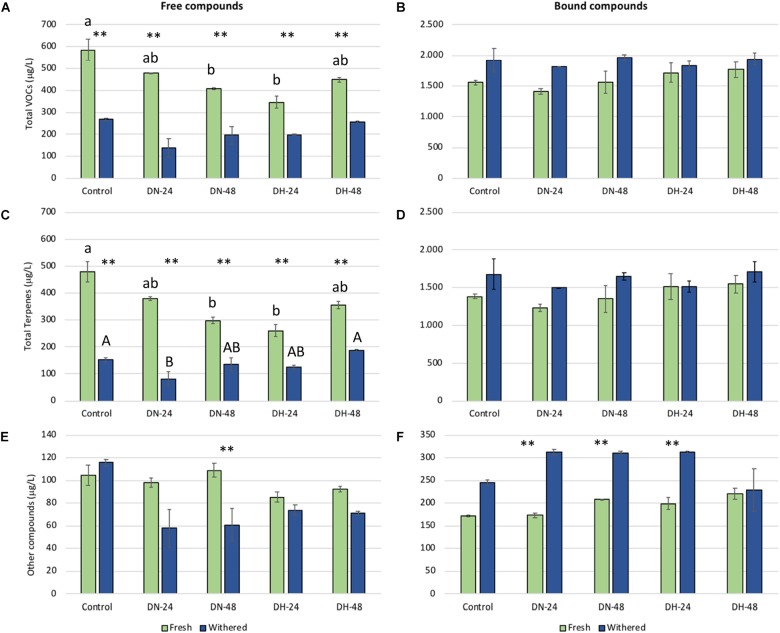
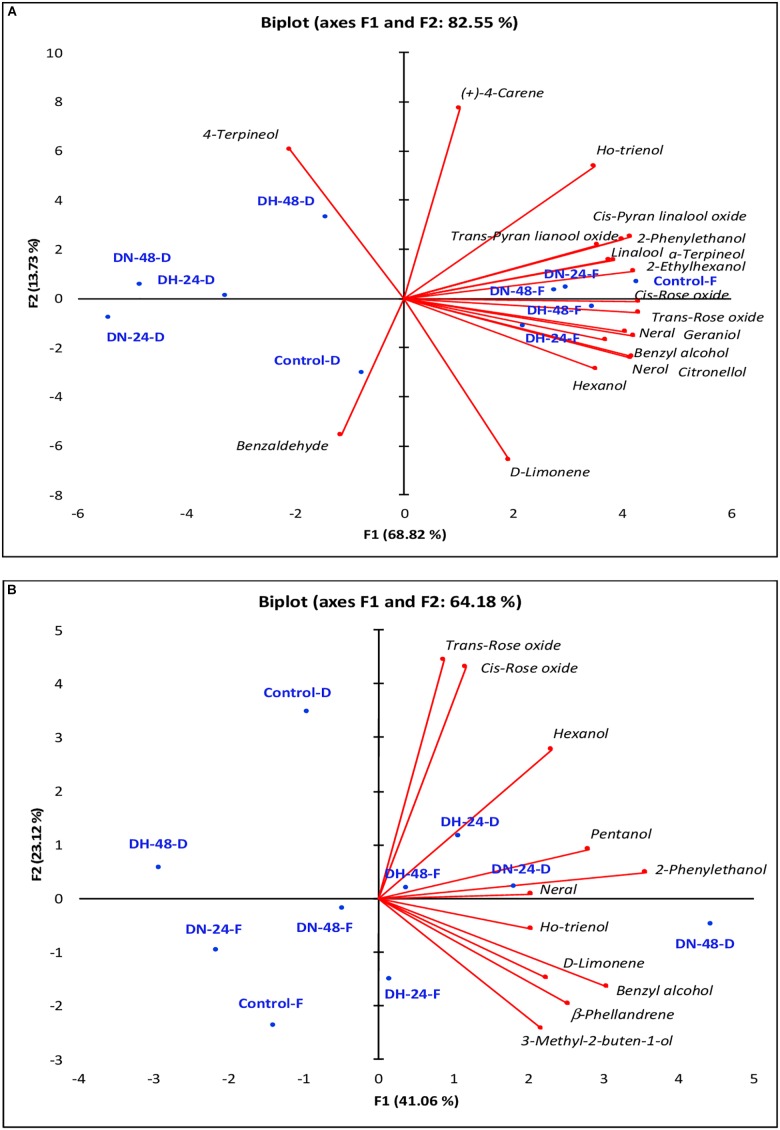
Ozone has been recently recognized as an efficient sanitizing agent in wine industry because of its powerful oxidizing properties. Furthermore, postharvest treatments of grapes with ozone can stimulate defense responses by synthetizing secondary metabolites against oxidative stress. In this study, the effect of postharvest short-term ozone treatments was assessed for the first time on free and glycosylated volatile organic compounds (VOCs) of winegrapes. Two different ozone concentrations (30 and 60 μL/L) and exposure times (24 and 48 h) were investigated just after treatment (fresh grapes) and after partial dehydration up to 20% weight loss (withered grapes). The study was carried out on Moscato bianco winegrapes ( L.) due to the importance of terpenes in white aromatic cultivars to produce high quality wines. The results obtained showed that short-term ozone treatment caused a significant decrease in total contents of free VOCs in fresh grapes, mainly due to terpenes. Among them, linalool, geraniol, and nerol are the major aromatic markers of Moscato bianco grapes. Ozone entailed a significant decrease of free linalool contents in fresh grapes, the less stressful ozone treatment showing the smaller linalool degradation. However, the stronger and longer ozone treatment induced the synthesis of this compound probably in response to higher abiotic stress. Instead, significant changes were not observed in geraniol and nerol contents in fresh grapes. This last ozone treatment also reduced the loss of free linalool by water loss in withered grapes even though total VOCs and terpenes remained relatively stable. Furthermore, ozone seems to promote the synthesis of free (+)-4-carene and 4-terpineol in withered grapes under certain treatment conditions. Regarding glycosylated compounds, total VOCs and terpenes were less sensitive to ozone. Our findings highlight that ozone can be used as sanitizing agent in aromatic grape varieties prior to winemaking without affecting sharply the aromatic profile of fresh grapes and even improving it in withered grapes.
由于臭氧具有强大的氧化特性,其最近在葡萄酒行业中被公认为一种高效的消毒剂。此外,用臭氧对葡萄进行采后处理可以通过合成次生代谢产物来抵御氧化应激,从而刺激防御反应。在本研究中,首次评估了采后短期臭氧处理对酿酒葡萄中游离态和糖基化挥发性有机化合物(VOCs)的影响。在处理后(新鲜葡萄)以及部分脱水至失重20%(风干葡萄)后,研究了两种不同的臭氧浓度(30和60 μL/L)以及暴露时间(24和48小时)。由于萜类物质在白葡萄芳香品种中对生产高品质葡萄酒的重要性,该研究以白莫斯卡托酿酒葡萄( )为材料进行。所得结果表明,短期臭氧处理导致新鲜葡萄中游离VOCs的总含量显著降低,主要原因是萜类物质。其中,芳樟醇、香叶醇和橙花醇是白莫斯卡托葡萄的主要芳香标记物。臭氧使新鲜葡萄中游离芳樟醇的含量显著降低,压力较小的臭氧处理导致的芳樟醇降解较小。然而,更强、更长时间的臭氧处理可能会因更高的非生物胁迫而诱导该化合物的合成。相反,新鲜葡萄中香叶醇和橙花醇的含量未观察到显著变化。最后这种臭氧处理还减少了风干葡萄因水分流失导致的游离芳樟醇损失,尽管总VOCs和萜类物质保持相对稳定。此外,在某些处理条件下,臭氧似乎促进了风干葡萄中游离(+)-4-蒈烯和4-松油醇 的合成。对于糖基化化合物,总VOCs和萜类物质对臭氧的敏感性较低。我们的研究结果表明,在酿酒前,臭氧可用于芳香葡萄品种的消毒,而不会大幅影响新鲜葡萄的香气特征,甚至在风干葡萄中还能改善其香气特征。