Guo Qingjie, Zheng Ruonan, Huang Jiarui, He Meng, Wang Yuhan, Guo Zonghao, Sun Liankun, Chen Peng
Department of Genetics, College of Basic Medical Sciences, Jilin University, Changchun, China.
Key Laboratory of Pathobiology, Ministry of Education, Jilin University, Changchun, China.
Front Genet. 2018 Dec 19;9:663. doi: 10.3389/fgene.2018.00663. eCollection 2018.
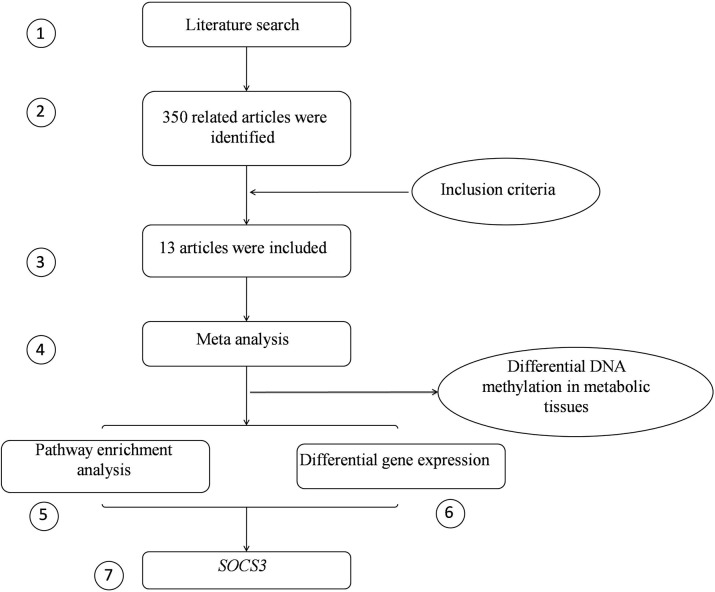
Obesity has become a major public health issue which is caused by a combination of genetic and environmental factors. Genome-wide DNA methylation studies have identified that DNA methylation at Cytosine-phosphate-Guanine (CpG) sites are associated with obesity. However, subsequent functional validation of the results from these studies has been challenging given the high number of reported associations. In this study, we applied an integrative analysis approach, aiming to prioritize the drug development candidate genes from many associated CpGs. Association data was collected from previous genome-wide DNA methylation studies and combined using a sample-size-weighted strategy. Gene expression data in adipose tissues and enriched pathways of the affiliated genes were overlapped, to shortlist the associated CpGs. The CpGs with the most overlapping evidence were indicated as the most appropriate CpGs for future studies. Our results revealed that 119 CpGs were associated with obesity ( ≤ 1.03 × 10). Of the affiliated genes, was the only gene involved in all enriched pathways and was differentially expressed in both visceral adipose tissue (VAT) and subcutaneous adipose tissue (SAT). In conclusion, our integrative analysis is an effective approach in highlighting the DNA methylation with the highest drug development relevance. SOCS3 may serve as a target for drug development of obesity and its complications.
肥胖已成为一个主要的公共卫生问题,它是由遗传和环境因素共同导致的。全基因组DNA甲基化研究已确定,胞嘧啶-磷酸-鸟嘌呤(CpG)位点的DNA甲基化与肥胖有关。然而,鉴于大量已报道的关联,对这些研究结果进行后续功能验证具有挑战性。在本研究中,我们应用了一种综合分析方法,旨在从众多相关的CpG中确定药物开发候选基因的优先级。关联数据从先前的全基因组DNA甲基化研究中收集,并采用样本量加权策略进行合并。将脂肪组织中的基因表达数据与相关基因的富集途径进行重叠分析,以筛选出相关的CpG。具有最多重叠证据的CpG被确定为未来研究最合适的CpG。我们的结果显示,119个CpG与肥胖相关(≤1.03×10)。在相关基因中,是唯一参与所有富集途径且在内脏脂肪组织(VAT)和皮下脂肪组织(SAT)中均有差异表达的基因。总之,我们的综合分析是一种有效的方法,可突出显示与药物开发相关性最高的DNA甲基化。SOCS3可能作为肥胖及其并发症药物开发的靶点。