Hart Kristen M, Iverson Autumn R, Fujisaki Ikuko, Lamont Margaret M, Bucklin David, Shaver Donna J
Wetland and Aquatic Research Center U.S. Geological Survey Davie Florida.
Wetland and Aquatic Research Center CNT, Contracted to U.S. Geological Survey Davie Florida.
Ecol Evol. 2018 Nov 26;8(24):12656-12669. doi: 10.1002/ece3.4691. eCollection 2018 Dec.
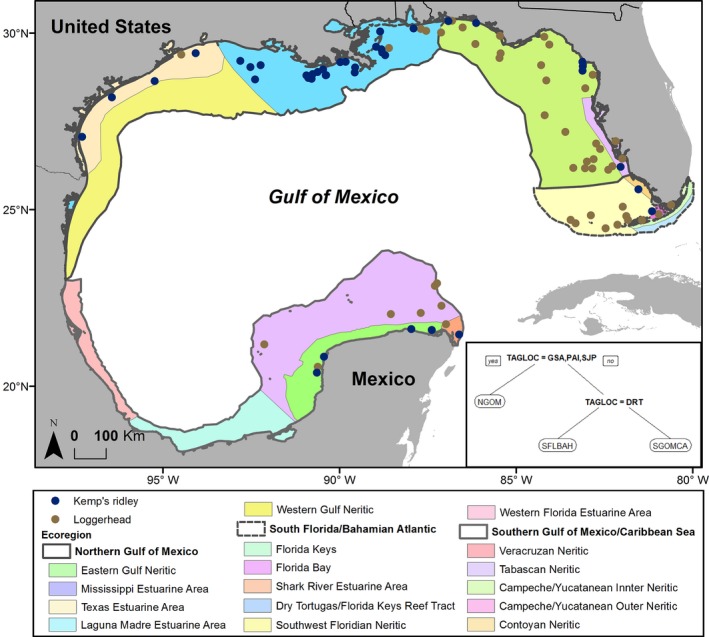
Animals co-occurring in a region (sympatry) may use the same habitat (syntopy) within that region. A central aim in ecology is determining what factors drive species distributions (i.e., abiotic conditions, dispersal limitations, and/or biotic interactions). Assessing the degree of biotic interactions can be difficult for species with wide ranges at sea. This study investigated the spatial ecology of two sea turtle species that forage on benthic invertebrates in neritic GoM waters: Kemp's ridleys () and loggerheads (). We used satellite tracking and modeled behavioral modes, then calculated individual home ranges, compared foraging areas, and determined extent of co-occurrence. Using six environmental variables and principal component analysis, we assessed similarity of chosen foraging sites. We predicted foraging location (eco-region) based on species, nesting site, and turtle size. For 127 turtles (64 Kemp's ridleys, 63 loggerheads) tracked from 1989 to 2013, foraging home ranges were nine to ten times larger for Kemp's ridleys than for loggerheads. Species intersected off all U.S. coasts and the Yucatán Peninsula, but co-occurrence areas were small compared to species' distributions. Kemp's ridley foraging home ranges were concentrated in the northern GoM, whereas those for loggerheads were concentrated in the eastern GoM. The two species were different in all habitat variables compared (latitude, longitude, distance to shore, net primary production, mean sea surface temperature, and bathymetry). Nesting site was the single dominant variable that dictated foraging ecoregion. Although Kemp's ridleys and loggerheads may compete for resources, the separation in foraging areas, significant differences in environmental conditions, and importance of nesting location on ecoregion selection (i.e., dispersal ability) indicate that adult females of these species do not interact greatly during foraging and that dispersal and environmental factors more strongly determine their distributions. These species show sympatry in this region but evidence for syntopy was rare.
在一个区域(同域分布)中共存的动物可能会在该区域内使用相同的栖息地(同处分布)。生态学的一个核心目标是确定哪些因素驱动物种分布(即非生物条件、扩散限制和/或生物相互作用)。对于在海洋中分布范围广泛的物种来说,评估生物相互作用的程度可能很困难。本研究调查了两种在墨西哥湾浅海海域以底栖无脊椎动物为食的海龟的空间生态学:肯氏丽龟()和蠵龟()。我们使用卫星追踪和行为模式建模,然后计算个体的活动范围,比较觅食区域,并确定共存程度。利用六个环境变量和主成分分析,我们评估了所选觅食地点的相似性。我们根据物种、筑巢地点和海龟大小预测觅食位置(生态区域)。对于1989年至2013年追踪的127只海龟(64只肯氏丽龟,63只蠵龟),肯氏丽龟的觅食活动范围比蠵龟大九到十倍。这两个物种在美国所有海岸和尤卡坦半岛附近都有交叉,但与物种分布相比,共存区域较小。肯氏丽龟的觅食活动范围集中在墨西哥湾北部,而蠵龟的觅食活动范围集中在墨西哥湾东部。在所有比较的栖息地变量(纬度、经度、离岸距离、净初级生产力、平均海表面温度和水深)方面,这两个物种都有所不同。筑巢地点是决定觅食生态区域的唯一主要变量。尽管肯氏丽龟和蠵龟可能会争夺资源,但觅食区域的分离、环境条件的显著差异以及筑巢位置对生态区域选择的重要性(即扩散能力)表明,这些物种的成年雌性在觅食期间的相互作用不大,扩散和环境因素更强烈地决定了它们的分布。这些物种在该区域表现出同域分布,但同处分布的证据很少。