Copenhagen Prospective Studies on Asthma in Childhood, Herlev and Gentofte Hospital, University of Copenhagen, Copenhagen, Denmark.
PLoS Med. 2019 Jan 8;16(1):e1002722. doi: 10.1371/journal.pmed.1002722. eCollection 2019 Jan.
Studies have shown that airway obstruction and increased bronchial reactivity are present in early life in children developing asthma, which challenges the dogma that airway inflammation leads to low lung function. Further studies are needed to explore whether low lung function and bronchial hyperreactivity are inherent traits increasing the risk of developing airway inflammation and asthmatic symptoms in order to establish timely primary preventive initiatives.
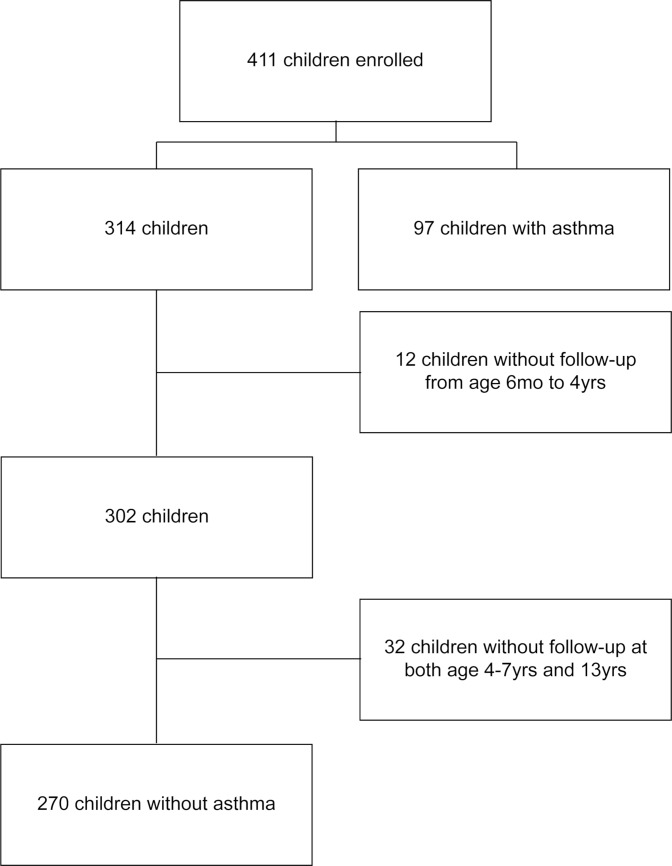
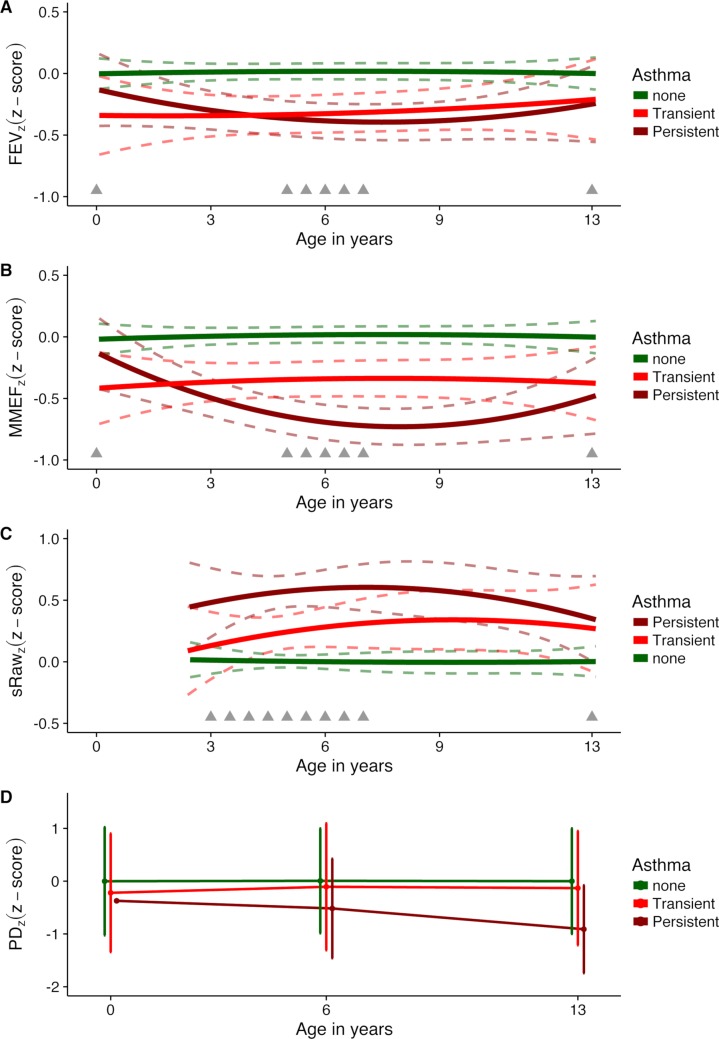
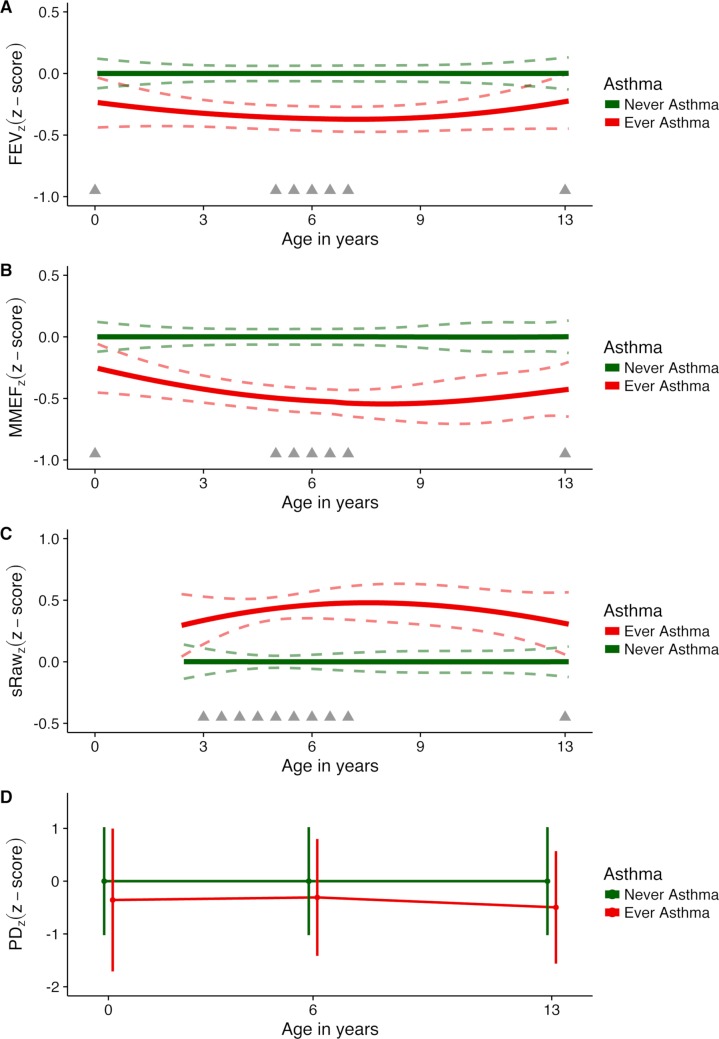
We investigated 367 (89%) of the 411 children from the at-risk Copenhagen Prospective Studies on Asthma in Childhood 2000 (COPSAC2000) birth cohort born to mothers with asthma, who were assessed by spirometry and bronchial reactivity to methacholine from age 1 month, plethysmography and bronchial reversibility from age 3 years, cold dry air hyperventilation from age 4 years, and exercise challenge at age 7 years. The COPSAC pediatricians diagnosed and treated asthma based on symptom load, response to inhaled corticosteroid, and relapse after treatment withdrawal according to a standardized algorithm. Repeated measures mixed models were applied to analyze lung function trajectories in children with asthma ever or never at age 1 month to 13 years. The number of children ever versus never developing asthma in their first 13 years of life was 97 (27%) versus 270 (73%), respectively. Median age at diagnosis was 2.0 years (IQR 1.2-5.7), and median remission age was 6.2 years (IQR 4.2-7.8). Children with versus without asthma had reduced lung function (z-score difference, forced expiratory volume, -0.31 [95% CI -0.47; -0.15], p < 0.001), increased airway resistance (z-score difference, specific airway resistance, +0.40 [95% CI +0.24; +0.56], p < 0.001), increased bronchial reversibility (difference in change in forced expiratory volume in the first second [ΔFEV1], +3% [95% CI +2%; +4%], p < 0.001), increased reactivity to methacholine (z-score difference for provocative dose, -0.40 [95% CI -0.58; -0.22], p < 0.001), decreased forced expiratory volume at cold dry air challenge (ΔFEV1, -4% [95% CI -7%; -1%], p < 0.01), and decreased forced expiratory volume after exercise (ΔFEV1, -4% [95% CI -7%; -1%], p = 0.02). Both airway obstruction and bronchial hyperreactivity were present before symptom debut, independent of disease duration, and did not improve with symptom remission. The generalizability of these findings may be limited by the high-risk nature of the cohort (all mothers had a diagnosis of asthma), the modest study size, and limited ethnic variation.
Children with asthma at some point at age 1 month to 13 years had airway obstruction and bronchial hyperreactivity before symptom debut, which did not worsen with increased asthma symptom duration or attenuate with remission. This suggests that airway obstruction and bronchial hyperreactivity are stable traits of childhood asthma since neonatal life, implying that symptomatic disease may in part be a consequence of these traits but not their cause.
研究表明,在儿童哮喘发展过程中,早期就存在气道阻塞和支气管高反应性,这挑战了气道炎症导致肺功能降低的观点。需要进一步研究,以探索低肺功能和支气管高反应性是否是固有特征,增加了发展气道炎症和哮喘症状的风险,以便及时制定初级预防措施。
我们对来自患有哮喘的母亲的 411 名儿童中的 367 名(89%)进行了研究,这些儿童来自 2000 年哥本哈根儿童哮喘前瞻性研究(COPSAC2000)队列,从 1 个月大时开始进行支气管反应性和支气管扩张试验,3 岁时进行体描法和支气管可逆性试验,4 岁时进行冷干空气通气试验,7 岁时进行运动挑战试验。COPSAC 儿科医生根据症状负荷、吸入皮质激素的反应以及治疗停药后的复发情况,按照标准化算法诊断和治疗哮喘。采用重复测量混合模型分析在 1 个月至 13 岁期间有或没有哮喘的儿童的肺功能轨迹。在他们 13 年的生命中,有 97 名(27%)和 270 名(73%)儿童分别首次确诊患有哮喘。诊断中位年龄为 2.0 岁(IQR 1.2-5.7),缓解中位年龄为 6.2 岁(IQR 4.2-7.8)。有哮喘的儿童与无哮喘的儿童相比,肺功能(用力呼气量 z 分数差异,-0.31[95%CI-0.47;-0.15],p<0.001)、气道阻力(特异性气道阻力 z 分数差异,+0.40[95%CI0.24;0.56],p<0.001)、支气管扩张试验(第一秒用力呼气量变化差值[ΔFEV1],+3%[95%CI2%;4%],p<0.001)、气道反应性(气道激发剂量 z 分数差异,-0.40[95%CI-0.58;-0.22],p<0.001)、冷干空气通气后用力呼气量(ΔFEV1,-4%[95%CI-7%;-1%],p<0.01)和运动后用力呼气量(ΔFEV1,-4%[95%CI-7%;-1%],p=0.02)降低。气道阻塞和支气管高反应性在症状出现之前就存在,与疾病持续时间无关,并且在症状缓解后也没有改善。这些发现的普遍性可能受到队列(所有母亲都被诊断患有哮喘)的高风险性质、研究规模较小以及种族差异有限的限制。
在 1 个月至 13 岁期间,患有哮喘的儿童在出现症状之前就存在气道阻塞和支气管高反应性,而随着哮喘症状持续时间的增加,这种情况并没有恶化,也没有随着缓解而减轻。这表明气道阻塞和支气管高反应性是儿童哮喘自新生儿期以来的稳定特征,这意味着有症状的疾病可能部分是这些特征的结果,但不是其原因。