COPSAC, Copenhagen Prospective Studies on Asthma in Childhood, Herlev and Gentofte Hospital, University of Copenhagen, Copenhagen, Denmark.
Department of Paediatrics, Slagelse Sygehus, Slagelse, Denmark.
Sci Rep. 2023 Aug 10;13(1):13044. doi: 10.1038/s41598-023-40320-4.
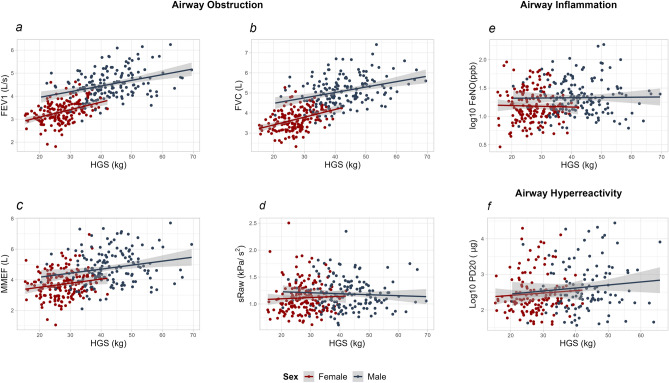
Studies have shown association between handgrip strength (HGS) and FEV1, but the importance of this in relation to asthma pathophysiology and diagnostics remains unclear. We investigated the relationship between HGS and lung function metrics and its role in diagnosing asthma. We included 330 participants (mean age: 17.7 years, males: 48.7%) from the COPSAC cohort and analyzed associations between HGS, asthma status, spirometry measures (FEV1, FVC, MMEF, FEV1/FVC), airway resistance (sRaw), methacholine reactivity (PD20) and airway inflammation (FeNO). Finally, we investigated whether HGS improved FEV1 prediction and classification of asthma status. HGS was only associated with forced flows, i.e., positive association with FEV1 and FVC for both sexes in models adjusted for age, height, and weight (P < 0.023). HGS improved adjusted R-values for FEV1 prediction models by 2-5% (P < 0.009) but did not improve classification of asthma status (P > 0.703). In conclusion, HGS was associated with the effort-dependent measures FEV1 and FVC, but not with airway resistance, reactivity, inflammation or asthma status in our cohort of particularly healthy adolescents, which suggests that the observed associations are not asthma specific. However, HGS improved the accuracy of FEV1 estimation, which warrants further investigation to reveal the potential of HGS in asthma diagnostics.
研究表明握力(HGS)与 FEV1 之间存在关联,但这种关联与哮喘病理生理学和诊断之间的关系尚不清楚。我们研究了 HGS 与肺功能指标之间的关系及其在诊断哮喘中的作用。我们纳入了来自 COPSAC 队列的 330 名参与者(平均年龄:17.7 岁,男性:48.7%),并分析了 HGS、哮喘状态、肺活量计测量值(FEV1、FVC、MMEF、FEV1/FVC)、气道阻力(sRaw)、乙酰甲胆碱反应性(PD20)和气道炎症(FeNO)之间的关系。最后,我们研究了 HGS 是否可以改善 FEV1 预测和哮喘状态的分类。HGS 仅与用力相关的流量相关,即与男女的 FEV1 和 FVC 呈正相关,这些模型在调整年龄、身高和体重后(P<0.023)。HGS 提高了 FEV1 预测模型的调整 R 值 2-5%(P<0.009),但不能改善哮喘状态的分类(P>0.703)。总之,在我们特别健康的青少年队列中,HGS 与依赖于努力的 FEV1 和 FVC 测量值相关,但与气道阻力、反应性、炎症或哮喘状态无关,这表明观察到的关联不是哮喘特异性的。然而,HGS 提高了 FEV1 估计的准确性,这需要进一步研究以揭示 HGS 在哮喘诊断中的潜力。