Department of Pathology, Microbiology and Immunology, School of Veterinary Medicine, University of California, Davis, Davis, California, USA.
Department of Biology, Massachusetts Institute of Technology, Cambridge, Massachusetts, USA.
mBio. 2019 Jan 8;10(1):e02388-18. doi: 10.1128/mBio.02388-18.
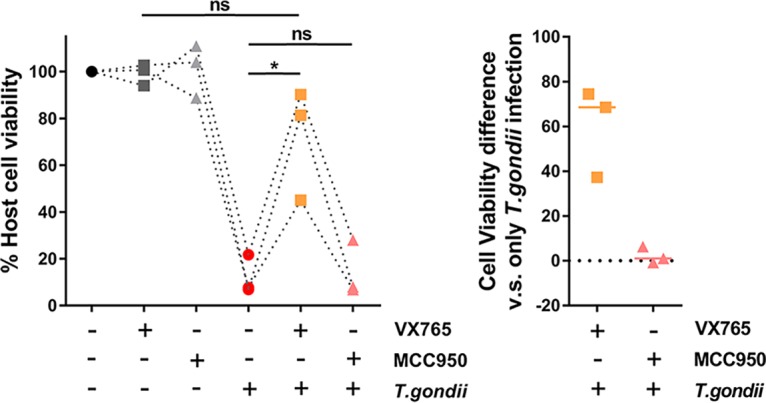
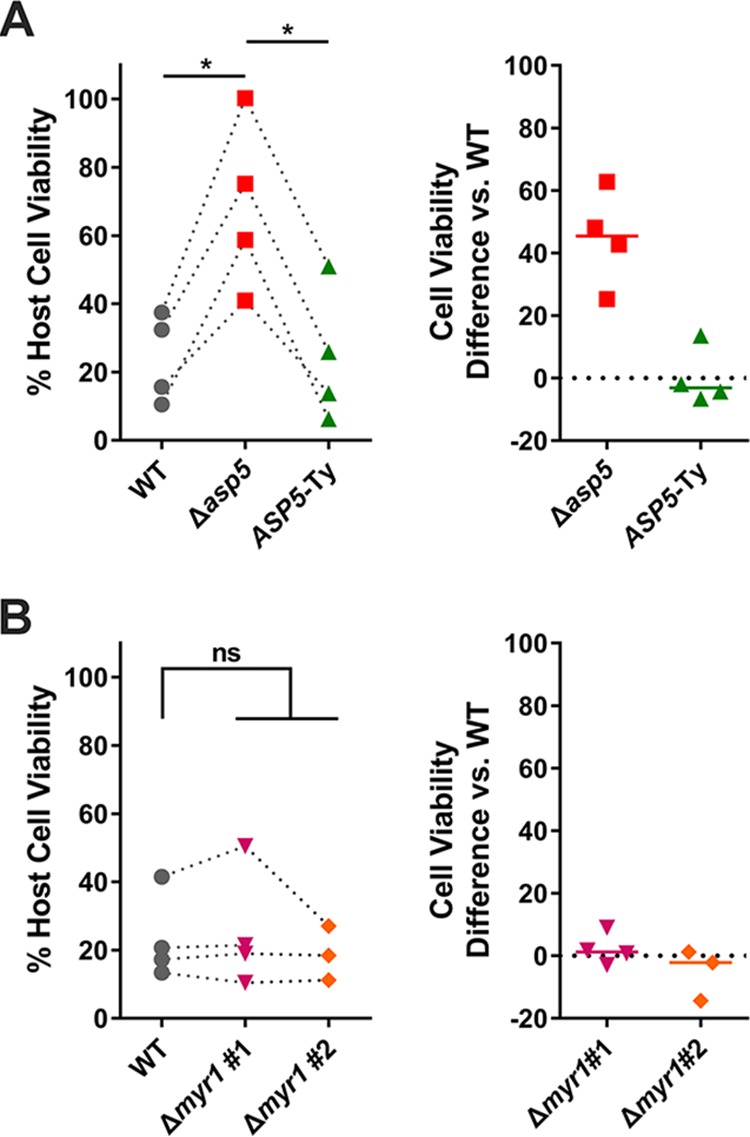
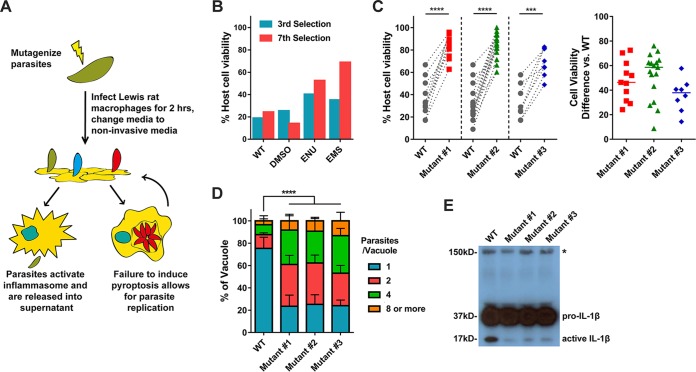
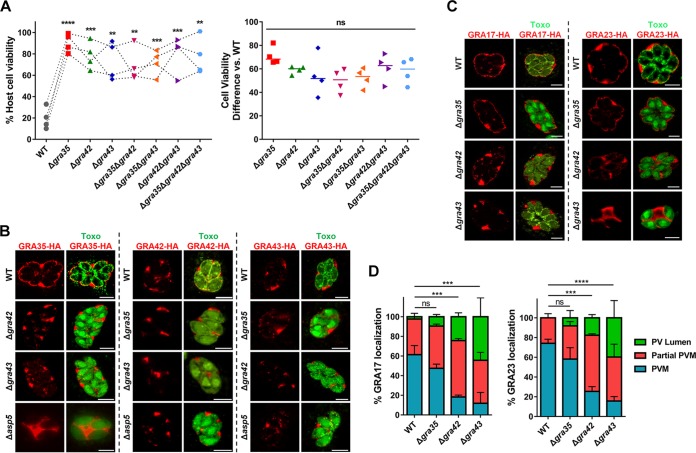
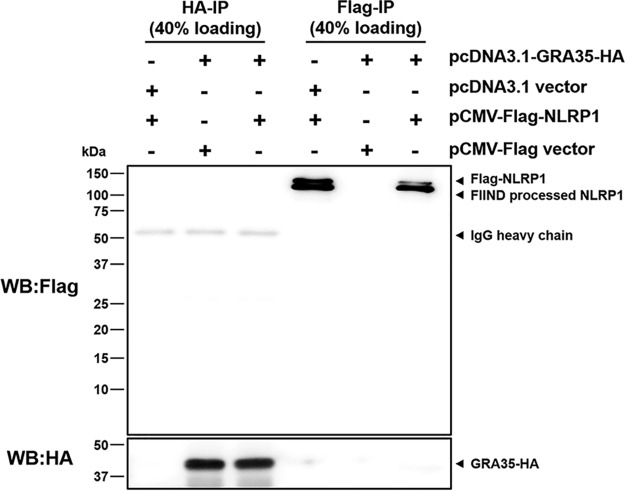
Upon invasion of Lewis rat macrophages, rapidly induces programmed cell death (pyroptosis), which prevents replication, possibly explaining the resistance of the Lewis rat to Using a chemical mutagenesis screen, we identified mutants that no longer induced pyroptosis. Whole-genome sequencing led to the identification of three parasitophorous vacuole-localized dense granule proteins, GRA35, GRA42, and GRA43, that are individually required for induction of Lewis rat macrophage pyroptosis. Macrophage infection with Δ, Δ, and Δ parasites led to greatly reduced cell death rates and enhanced parasite replication. Lewis rat macrophages infected with parasites containing a single, double, or triple deletion of these GRAs showed similar levels of cell viability, suggesting that the three GRAs function in the same pathway. Deletion of or resulted in GRA35 (and other GRAs) being retained inside the parasitophorous vacuole instead of being localized to the parasitophorous vacuole membrane. Despite having greatly enhanced replication in Lewis rat macrophages , Δ, Δ, and Δ parasites did not establish a chronic infection in Lewis rats. did not induce F344 rat macrophage pyroptosis, but F344 rats infected with Δ, Δ, and Δ parasites had reduced cyst numbers. Thus, these GRAs determined parasite fitness in F344 rats. Overall, our data suggest that these three dense granule proteins play a critical role in establishing a chronic infection , independently of their role in mediating macrophage pyroptosis, likely due to their importance in regulating protein localization to the parasitophorous vacuole membrane. Inflammasomes are major components of the innate immune system and are responsible for detecting various microbial and environmental danger signals. Upon invasion of Lewis rat macrophages, the parasite rapidly activates the NLRP1 inflammasome, resulting in pyroptosis and elimination of the parasite's replication niche. The work reported here revealed that GRA35, GRA42, and GRA43 are required for induction of Lewis rat macrophage pyroptosis. GRA42 and GRA43 mediate the correct localization of other GRAs, including GRA35, to the parasitophorous vacuole membrane. These three GRAs were also found to be important for parasite fitness in a -susceptible rat strain, independently of their role in NLRP1 inflammasome activation, suggesting that they perform other important functions. Thus, this study identified three GRAs that mediate the induction of Lewis rat macrophage pyroptosis and are required for pathogenesis of the parasite.
当 侵袭刘易斯大鼠巨噬细胞时,会迅速诱导程序性细胞死亡(细胞焦亡),从而阻止 的复制,这可能解释了刘易斯大鼠对 的抗性。通过化学诱变筛选,我们鉴定出不再诱导细胞焦亡的 突变体。全基因组测序导致鉴定出三个寄生虫质膜下致密颗粒蛋白(GRA35、GRA42 和 GRA43),它们分别是诱导刘易斯大鼠巨噬细胞细胞焦亡所必需的。用 Δ、Δ 和 Δ 寄生虫感染巨噬细胞会导致细胞死亡率大大降低和寄生虫复制增强。用含有单个、双个或三个缺失这些 GRAs 的寄生虫感染刘易斯大鼠巨噬细胞会显示出相似的细胞活力水平,表明这三个 GRAs 作用于相同的途径。缺失 或 会导致 GRA35(和其他 GRAs)保留在寄生虫质膜下,而不是定位于寄生虫质膜下致密颗粒蛋白。尽管在刘易斯大鼠巨噬细胞中具有极大增强的复制能力,但 Δ、Δ 和 Δ 寄生虫在刘易斯大鼠中并未建立慢性感染。虽然不诱导 F344 大鼠巨噬细胞细胞焦亡,但感染 Δ、Δ 和 Δ 寄生虫的 F344 大鼠的囊泡数量减少。因此,这些 GRAs 决定了寄生虫在 F344 大鼠中的适应性。总体而言,我们的数据表明,这三个 致密颗粒蛋白在建立慢性感染中起着关键作用,这与它们在介导巨噬细胞细胞焦亡中的作用无关,可能是由于它们在调节质膜下致密颗粒蛋白定位方面的重要性。炎症小体是先天免疫系统的主要组成部分,负责检测各种微生物和环境危险信号。当 侵袭刘易斯大鼠巨噬细胞时,寄生虫迅速激活 NLRP1 炎症小体,导致细胞焦亡并消除寄生虫的复制场所。这里报道的工作表明,GRA35、GRA42 和 GRA43 是诱导刘易斯大鼠巨噬细胞细胞焦亡所必需的。GRA42 和 GRA43 介导其他 GRAs(包括 GRA35)正确定位于寄生虫质膜下致密颗粒蛋白。还发现这三个 GRAs 对寄生虫在易感大鼠株中的适应性很重要,这与它们在 NLRP1 炎症小体激活中的作用无关,表明它们具有其他重要功能。因此,这项研究鉴定出三个介导刘易斯大鼠巨噬细胞细胞焦亡诱导的 GRAs,它们是寄生虫发病机制所必需的。